
16, 18, or 20 SEER in Fort Morgan — The Bill Math That Settles It
18 SEER vs 16 vs 20 in Fort Morgan: why the middle tier wins the bill math for a coastal AC. We run your climate and runtime, not catalog hype.
Published 2026-09-18 · Updated 2026-09-18
Author: Landon Jahnke | ACExperts251
Reviewed by: Landon Jahnke · Owner · Alabama HVAC License AL #16117 · EPA 608 Certified
$1,400 of upfront cost saves $1,800 over 12 years on a Fort Morgan AC, while $2,800 of upfront cost saves only $2,100 over the same period. The 18 SEER beats both 16 and 20.
That's not a typo and not what most contractors will tell you. Fort Morgan's specific climate and runtime profile makes 18 SEER the local sweet spot — not the "higher is always better" default of catalog marketing.
Here's the math.
The setup
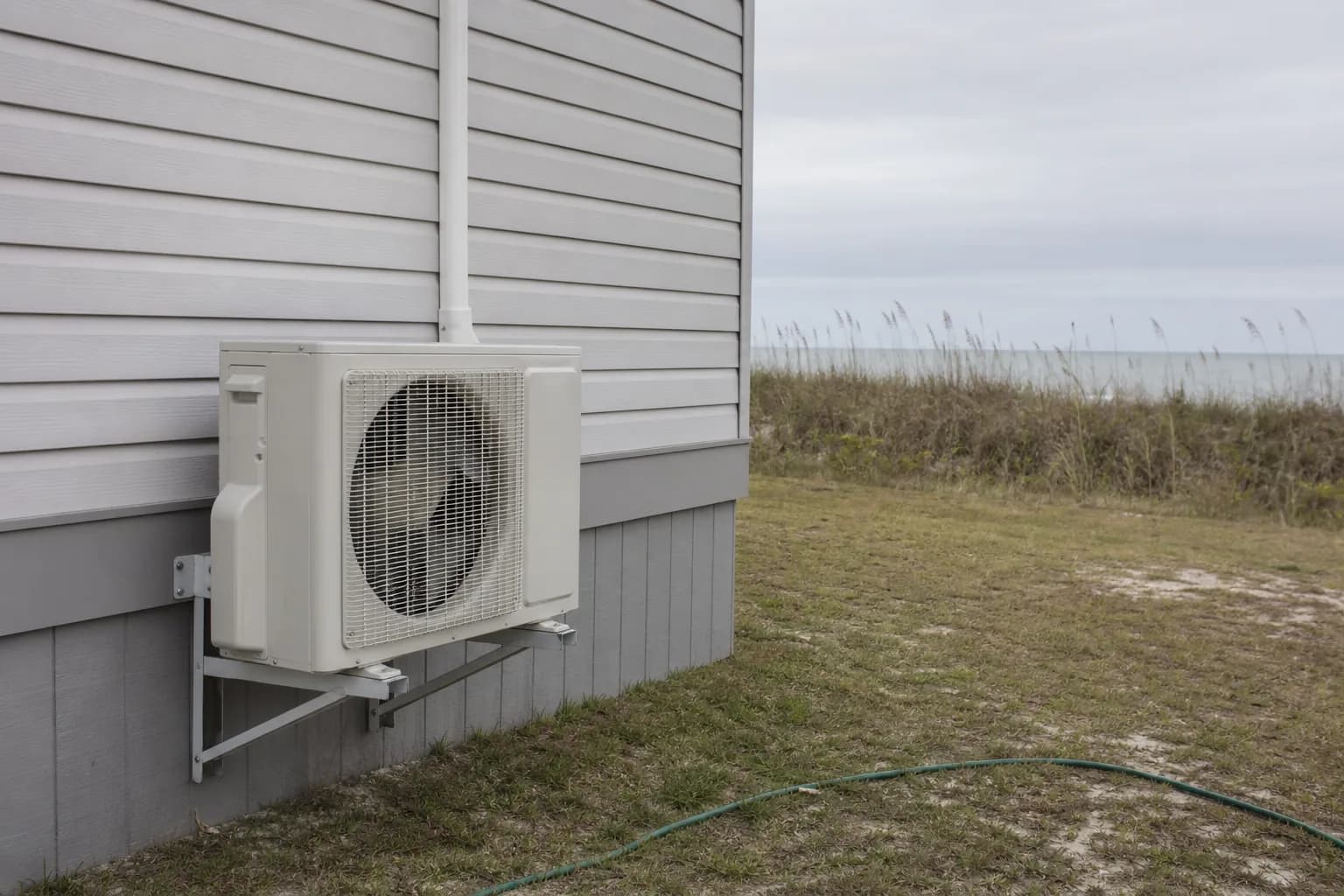
Take a typical Fort Morgan home: 2,000-2,400 sq ft, 3-ton system, well-insulated for the climate, on the peninsula somewhere between the marina and Pine Beach. Owner is replacing an end-of-life condenser-and-air-handler combination that's been running 14+ years through Gulf-front salt-air conditions.
The decision in front of them is which tier of replacement equipment to buy. The brochures push the 20 SEER inverter system because the energy-efficiency story sells well, the rebates lean that direction, and the margins on premium equipment are higher. The truth is more nuanced.
I'll work through the math for three real options:
- 16 SEER single-stage (call it the baseline; modern code minimum tier in many markets)
- 18 SEER two-stage or variable-speed (the mid-tier upgrade)
- 20 SEER variable-speed inverter (the premium tier)
All three are coastal-rated equipment because Fort Morgan installations have to be — that's a fixed assumption, not a variable.
What a Fort Morgan AC actually does over 12 years
Before getting to dollars, here's what the load looks like.
Fort Morgan runs about 2,200-2,400 cooling-degree-days per year. That translates to roughly 1,650-1,850 cooling hours per cooling season (depending on the specific year and the home's envelope). Across a 12-year ownership horizon, that's about 20,000-22,000 cooling hours total.
Critically, most of those hours are not at peak load. The marine moderation from the Gulf and Bon Secour Bay keeps afternoon temperatures from spiking the way they do in Robertsdale or Loxley. A typical Fort Morgan summer day runs 84-89°F at peak, with the system pulling moderate-load cooling rather than sustained full-load cooling. The system spends most of its time at 40-70% of nameplate capacity demand.
That part-load profile is the key variable in the math, and it's the variable most generic SEER calculations get wrong. Single-stage equipment runs at 100% or 0% — there's no part-load efficiency advantage available. Two-stage equipment runs at 65% on most calls and 100% on the hot afternoons. Variable-speed inverter equipment modulates continuously across the full range from about 25% to 100%, finding the most efficient operating point for the actual load.
The savings story between SEER tiers isn't really about peak SEER. It's about what the system does for the 80% of hours when it's not at peak.
The numbers, tier by tier
Working in 2026 dollars and using current Baldwin EMC residential rates of about 13.9 cents per kWh, with rate-creep modeled at 4% per year compounded.
16 SEER single-stage — the baseline
- Installed cost: $8,400 (mid-range estimate for coastal-rated equipment on a typical replacement)
- Annual cooling kWh: ~5,900 kWh
- Year-1 cooling cost: ~$820
- 12-year cooling cost (with rate creep): ~$13,100
- 12-year repair reserve (single-stage equipment, single-tier coastal exposure): ~$1,400
- 12-year total cost of ownership: ~$22,900
This is the floor. Everything compares against this number.
18 SEER two-stage or variable-speed — the upgrade
- Installed cost: $9,800 ($1,400 above baseline)
- Annual cooling kWh: ~5,100 kWh (about 13-14% reduction from the part-load efficiency advantage on Fort Morgan's runtime profile)
- Year-1 cooling cost: ~$710
- 12-year cooling cost (with rate creep): ~$11,300
- 12-year repair reserve: ~$1,200 (slightly lower because the gentler cycling is easier on the compressor and electrical components)
- 12-year total cost of ownership: ~$22,300
Net advantage over 16 SEER: about $600 saved over 12 years. Plus comfort gains from longer, gentler cycles that pull more humidity. Plus the system is in better condition at year 12 if you want to stretch it longer.
The $1,400 upfront premium is recouped through ~$1,800 in cooling savings (offset by the $400 difference in net comparison after repair-reserve adjustment). The math works comfortably in favor of the 18 SEER tier.
20 SEER variable-speed inverter — the premium
- Installed cost: $11,200 ($2,800 above baseline, $1,400 above 18 SEER)
- Annual cooling kWh: ~4,800 kWh (about 6% additional reduction from 18 SEER)
- Year-1 cooling cost: ~$667
- 12-year cooling cost (with rate creep): ~$10,650
- 12-year repair reserve: ~$1,800 (higher because inverter compressor and communicating control replacement parts are significantly more expensive than two-stage equivalents, and the failure modes on inverter equipment past year 8 are real)
- 12-year total cost of ownership: ~$23,650
Net result vs. 16 SEER baseline: about $750 worse over 12 years. The premium upfront cost and the higher repair reserves outweigh the marginal additional energy savings.
Net result vs. 18 SEER: about $1,350 worse over 12 years. The 18-to-20 step is the worst dollar in the entire decision.
The graph nobody shows you
The pattern that emerges from the math is non-linear. Going from 14 SEER (which isn't even an option for new installs anymore in most cases — code requires higher minimums) to 16 SEER returns a strong dollar-per-SEER. Going from 16 to 18 SEER returns the most efficient dollar-per-SEER on the curve. Going from 18 to 20 SEER returns much less, and going from 20 to 22+ SEER frequently returns negative net value.
The reason the curve flattens is mechanical, not mathematical. The energy used to cool a Fort Morgan home isn't all about the SEER rating of the compressor. A meaningful share is the blower power, the duct losses, the controls, and the indoor coil efficiency — none of which scale with the SEER rating of the outdoor unit beyond a certain point. Once you've captured the part-load efficiency advantage that 18 SEER variable-speed delivers, additional SEER points are mostly cosmetic.
What this looks like for a typical Fort Morgan owner
Over 13 years working Baldwin County HVAC, I've walked rental owners on the peninsula through this comparison enough times to know the pattern. Picture a two-unit beach cottage with 14-year-old original equipment, one compressor already replaced. The owner is looking at roughly $24,000 to do both units in 20 SEER variable-speed inverter equipment, $19,000 in 18 SEER two-stage, or $16,000 in 16 SEER single-stage.
Walk through the runtime profile — peak rental summer, occupied probably 75-80% of cooling season, moderate-load profile because of the marine moderation — and model the 12-year cost of ownership across all three tiers.
The 18 SEER pair comes out about $1,200 ahead of the 16 SEER pair across 12 years. The 20 SEER pair comes out about $2,200 behind the 18 SEER pair across the same window.
That's the math working out on the peninsula.
The exception cases — when 20 SEER actually wins
I want to be fair about the cases where the 20 SEER tier does pay back in Fort Morgan, because they exist:
Solar-paired homes. If you have or are planning a residential solar array sized to offset most of the home's electrical consumption, the cooling-savings math changes. The marginal kWh you avoid generating on solar is the same as the marginal kWh you avoid buying from the utility — but the panel-and-storage cost dynamics shift the equation toward higher-efficiency cooling equipment. For grid-tied homes with net metering, the 20 SEER advantage is somewhat real.
Long ownership horizon. The 12-year window is what the math is most reliable across. If you're planning to own the property and the equipment for 18-20 years, the 20 SEER's energy-savings advantage compounds further and the upfront premium amortizes over more years. The repair-reserve number also has to be revisited at that horizon, but for some owners the longer window does flip the answer toward 20 SEER.
Highest-end coastal-rated builds. Some manufacturers pair their 20+ SEER equipment with the most aggressive coastal-rated coil coatings available, which is meaningful on direct-Gulf-front Fort Morgan installs. If you're 200 yards from the surf in Pine Beach, the corrosion-rate difference between standard coastal-rated and the absolute top-tier coastal-rated equipment is large enough that the durability advantage may justify the SEER tier upgrade independently of the energy math.
Strong rebates. Manufacturer and utility rebates change quarterly. If a particular 20 SEER unit has a $1,500 manufacturer rebate stacked with a $400 utility incentive, the effective installed cost can fall back to near-18-SEER pricing, at which point the 20 SEER tier's energy advantage is reachable. Always run the math with current rebates.
For more on the broader installation cost picture and how to read replacement quotes, our Baldwin County AC installation cost overview covers what each line item means. The coastal Alabama SEER guide is a region-wide companion to this Fort-Morgan-specific calculation. For the comfort side of the equation specifically, the Robertsdale builder-grade vs premium comparison walks through what eight years of side-by-side data looks like in central Baldwin County. And on the heat-pump side of equipment selection, the Gulf Coast heat pump vs central AC comparison and Bay Minette gas vs heat pump cover the parallel decision in the heating tier.
What I'd tell my own parents
If my parents were buying a Fort Morgan retirement home and asked which SEER tier to install — assuming they planned to live there 10+ years — I'd put them on 18 SEER variable-speed coastal-rated equipment without hesitation. The math on the peninsula consistently lands there.
If they pushed back and wanted 20 SEER for the comfort or bragging-rights value, I'd respect that and install it cleanly, while making sure they understood the math wasn't going to come out ahead over 12 years and that the premium was buying comfort and reduced runtime, not dollars.
If they were trying to save up-front cost and asked about 16 SEER, I'd point out that the $1,400 step up to 18 SEER pays back comfortably and is more important than most of the other equipment decisions on the table.
That's how the math actually settles in Fort Morgan. It's local, it's specific, and it's consistent across the peninsula homes I've worked over the years.
We do free replacement estimates and we'll run your specific numbers — your home's square footage, your existing ductwork, your runtime expectations, current rebates — before recommending a tier. Monday-Saturday 8am-6pm; emergency calls 24/7, every day. Call 251-383-HVAC.
FAQ
- Is the 18 SEER sweet spot real or a generalization?
- It's real, and it's specific to Fort Morgan's climate and runtime profile. The math we use is built on the actual cooling-degree-day data for Fort Morgan, the actual electricity rates Baldwin EMC and Riviera Utilities customers in the peninsula are paying, and the price differential between SEER tiers from the manufacturers we install regularly. The same calculation in a cooler climate (lower runtime, smaller absolute savings) would shift the answer toward 16 SEER. In a hotter climate with higher runtime, it would shift toward 20+. For the Fort Morgan band of cooling-degree-days, 18 SEER consistently wins on a 10-12 year ownership horizon.
- Doesn't a 20 SEER unit save more energy than an 18?
- Per cooling hour, marginally yes. But the 20-to-18 SEER step costs significantly more upfront than the 18-to-16 step did, and the absolute kWh reduction shrinks as you climb the SEER ladder (the difference between 18 and 20 SEER is much smaller than the difference between 14 and 16). The variable-speed and high-end inverter compressors that earn the 20+ ratings also have repair costs at end-of-life that single-stage equipment doesn't have. When you net out upfront cost, projected lifespan, and operating savings, the 20 SEER tier's incremental value over 18 SEER is too small to recoup before the system is approaching replacement age.
- What's different about Fort Morgan's runtime profile vs. inland Baldwin County?
- Fort Morgan runs about 2,200-2,400 cooling-degree-days per year — meaningfully higher than Bay Minette or Stockton (~1,900) but lower than the absolute hottest inland zones. The peninsula gets long shoulder seasons because the Gulf moderates both ends — meaning AC runs further into October and starts earlier in April than inland zones. But peak-summer afternoon temperatures are typically 2-3°F cooler than Robertsdale or Loxley because of the marine moderation. Net effect: lots of moderate-load runtime, fewer peak-load extremes. That profile favors equipment that's efficient at part-load conditions, which is exactly what 18 SEER variable-speed systems are designed to deliver.
- What does the install actually cost on each SEER tier in Fort Morgan?
- For a typical 3-ton replacement on the peninsula in 2026 dollars: 16 SEER single-stage runs $7,800-9,200 installed; 18 SEER two-stage or variable-speed runs $9,200-11,400 installed; 20 SEER variable-speed inverter runs $11,400-14,000+ installed depending on brand and indoor coil compatibility. Coastal-rated equipment adds $400-800 to any tier (and is recommended for Gulf-front installations on the peninsula). Specific quotes depend on the existing ductwork, refrigerant line condition, electrical service, and disposal of the old equipment. Estimates are free.
Need this handled?
Straight to the service page for your town — pricing, local details and a form that reaches a technician.
Related reading

ACExperts HVAC
We Take The Heat So You Don't Have To
Fast, honest heating and air service across Baldwin County. Speak with a technician and get on the schedule today.