
The Stockton Schrader Valve Leak No One Catches for 3 Summers
How a missing Schrader valve cap on a Stockton condenser caused three summers of slow refrigerant loss, and the 90-second diagnostic that finally found it.
Published 2026-11-10 · Updated 2026-11-10
Author: Landon Jahnke | ACExperts251
Reviewed by: Landon Jahnke · Owner · Alabama HVAC License AL #16117 · EPA 608 Certified
Here's a pattern I've watched play out on Stockton AC systems more than once over my career: three summers in a row, same homeowner complaint — "house feels muggy at 72°F." Three different HVAC companies, three different techs, three different refrigerant top-offs, three different invoices. Many hundreds of dollars spent on refrigerant in three years. And on every visit, the leak source went unidentified.
The fix, when this pattern finally gets traced, takes about 90 seconds to find. A missing Schrader valve cap on the suction-side service port. Refrigerant has been weeping through a slightly-aged valve core for years, and without the cap acting as a secondary seal, there's nothing catching it. A four-pack of replacement caps from the auto parts store costs a couple dollars. A whole season's worth of refrigerant loss gets prevented by installing one.
This post walks through how that failure mode works, why it slips past multiple competent techs, and how to make sure it doesn't keep happening on your Stockton, Bay Minette, Stapleton, or Summerdale outdoor unit.
The complaint history that should set off alarms
The pattern looks like this when it shows up on Stockton systems:
Year one. Mid-summer call. Complaint: "house isn't cooling like it should, feels muggy." Tech arrives same-day. Suction pressure is low. Tech adds refrigerant. System cools again. Tech notes "low charge, no obvious leak source identified, recommend follow-up inspection if symptoms recur." Homeowner files the invoice.
Year two. Same complaint, same call, different contractor (the homeowner called whoever they could get on the phone). Same low-charge diagnosis. Same top-off. Tech notes "low charge again, may have a slow leak somewhere, recommend electronic leak detector inspection if it happens a third time." Homeowner files the invoice.
Year three. Same complaint, same call, third contractor. Same diagnosis, same top-off. Tech mentions a leak detector inspection would be additional cost on top of the top-off; homeowner decides to skip it.
By year three, the homeowner has paid to refill a meaningful fraction of the system's total refrigerant charge over three years, and the leak source has never been traced. That's the pattern. That's when the math really stops working.
The 90-second diagnostic
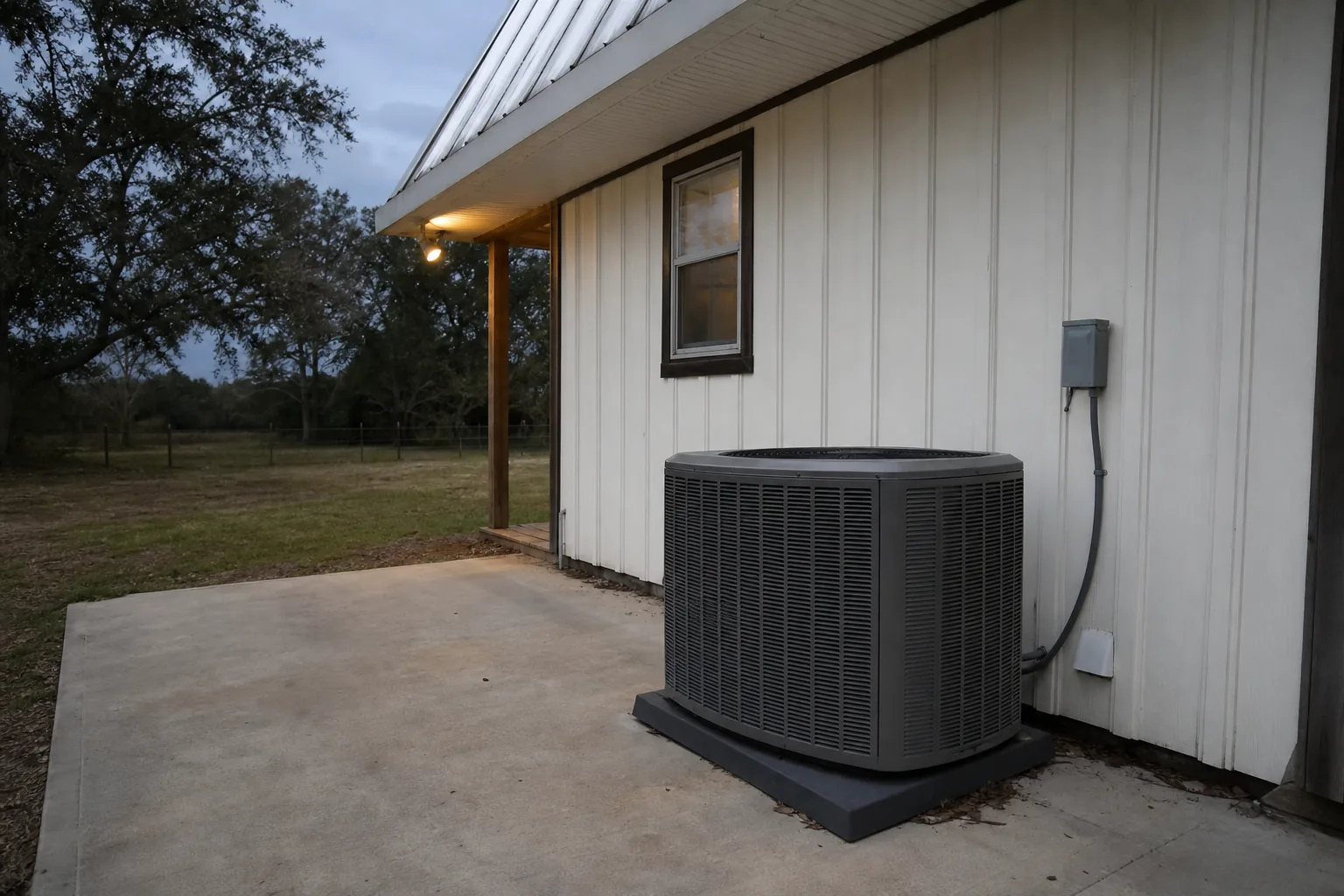
Walk to the condenser. Look at the two service ports — the suction-side service port on the larger copper line, and the liquid-side service port on the smaller copper line. Each port should have a cap threaded on.
If a cap is missing, that's the first place to check. Lean down close to the exposed valve core. Listen for the faint hiss of refrigerant escaping. Put a leak-detection soap bubble on the valve and watch for the slow rise of a bubble.
That's it. That's the diagnostic. Most of the time on a system that's been topped off repeatedly without a found source, the Schrader valves are at the top of the list to check — and the right answer is often as simple as installing a replacement cap.
Why competent techs miss it
The techs who miss this aren't bad techs. They're following standard diagnostic protocol. The protocol assumes the leak is somewhere on the refrigerant circuit other than the service ports. Service-port leaks are uncommon — most refrigerant leaks are at the indoor coil (corrosion-driven) or at flare fittings on the line set, and a tech running through the standard diagnostic flow checks those locations first.
The deeper issue: a tech who restores cooling with a top-off has solved the immediate complaint. The customer is happy. The invoice is paid. The next call, if there is one, may go to a different contractor entirely. There's no continuity-of-care that surfaces "this is the third top-off in three years on the same equipment" — unless the homeowner volunteers that history at the start of the call.
Most homeowners don't. They call each year and describe the symptom. They don't pull out the invoices from the prior years and say "look, this is happening on a clock." Each tech treats the call as a fresh diagnostic.
What should have happened on visit two
The second top-off in two years on the same equipment should trigger a different protocol. Here's what a careful tech does on a second-top-off-in-two-years situation:
- Ask the customer about prior service history before driving out. "Has anyone else worked on this system in the last twenty-four months?" A second top-off in two years means the leak rate is meaningful and the source needs to be found, not topped off again.
- On arrival, inspect the entire refrigerant circuit, not just the obvious failure points. Service ports first (because they're free to check), then line set joints, then indoor coil with electronic leak detector.
- Inject UV dye on the second top-off, even if the customer didn't ask. The dye is cheap and turns the next visit into a quick find.
- Document the suspected leak source on the invoice. Even if the source isn't found, list every place the bubbler was applied. That gives the next tech (if there is one) a starting point and prevents the diagnostic from restarting from zero.
None of these steps are exotic. They're standard practice. They don't get applied when each tech treats the call as standalone.
What this teaches the homeowner
A few practical things you should do as the homeowner of a Stockton or Stapleton AC system, especially if you've had any refrigerant top-off in the past few years.
Keep the invoices in one place. A folder, a drawer, a phone-camera album — wherever, but together. When you call for service, mention the prior history before the tech arrives. "I've had refrigerant added twice in the last three years" changes the diagnostic protocol from minute one.
Ask for the leak source on every refrigerant top-off invoice. If the invoice says "added refrigerant, no leak source identified," that's a flag — not a satisfactory resolution. Ask the next visit's tech to escalate the leak hunt.
Walk to your outdoor condenser once a season. Look at the two service ports. Confirm both have caps installed. Confirm the cabinet panels are properly seated. Confirm the disconnect box looks intact. This is a 60-second self-inspection that catches a meaningful percentage of preventable refrigerant losses.
On a maintenance plan visit, specifically ask the tech to verify Schrader caps are present and properly seated. This is normally part of our standard maintenance protocol; if you're working with another contractor, make it explicit on the work order.
We've covered related refrigerant-circuit failure modes in the ice-on-the-lineset post and in the contactor failure walkthrough on the Bay Minette welded-contact post. The diagnostic principles overlap: simple causes hide behind complex symptoms more often than complex causes hide behind simple symptoms.
What the right visit looks like
The diagnostic visit is $79. That covers the 90-second valve cap inspection plus a full leak detector pass on the rest of the refrigerant circuit — because while we're there, we should rule out anything else. Replacement Schrader caps are included in the visit, not a separate line item.
If the system actually is low on refrigerant after the cap goes back on (it usually is, by some amount), the top-off is priced against current refrigerant market pricing, which varies by refrigerant type and supply conditions. For exact pricing, call 251-383-HVAC and we'll quote against the equipment.
Compare that to the cumulative cost of multiple top-offs over multiple summers without a found source — the math favors getting the cap on and the system properly leak-checked the first time.
The Stockton-specific note
A few realities specific to Stockton and the rural north Baldwin corridor that affect this kind of diagnostic.
Drive times are longer here. A Stockton property is a longer windshield-time trip than an Eastern Shore call. That makes thorough diagnostics on visit one even more valuable — coming back for a repeat call costs both parties more in Stockton than in Daphne or Fairhope. Ask the tech to do the full leak hunt on visit one rather than scheduling a follow-up.
Seasonal homes amplify the missed-leak problem. Stockton has hunting cabins and seasonal river properties where the AC sits idle for months between owner visits. A slow Schrader-valve leak is invisible during the off-season but devastating when the property is reoccupied. Pre-season tune-ups before deer season or summer fishing weekends catch this exact failure mode.
Propane-furnace homes have specific service-port practices. Stockton has more propane-heated homes than coastal Baldwin County. The propane furnace and the AC condenser are independent systems, but a tech working on either can affect the other if they don't follow proper service procedure. Always confirm service ports are properly capped at the end of any visit — heating or cooling.
If you suspect you've been topping off refrigerant without a leak source being identified, call 251-383-HVAC or book online. The service fee is $79 and free second opinions on contractor quotes are available across the Bay Minette, Stapleton, Stockton, and Summerdale service area.
FAQ
- Why does a missing Schrader valve cap matter? Isn't the cap just decorative?
- The cap is the secondary seal. The primary seal is the Schrader valve core itself — same mechanism as a tire valve. The valve core is reliable but not perfect; over years of vibration and temperature cycling, the rubber valve seat degrades and starts to weep small amounts of refrigerant. The cap provides a positive secondary seal that catches that weep. Caps left off after a service visit can produce small but steady refrigerant loss — invisible week to week, real money in annual top-offs over time.
- Should I check my own Stockton outdoor unit for missing Schrader caps?
- Yes. Walk to the condenser, look at the two service ports — usually one suction-side (larger, on the bigger copper line) and one liquid-side (smaller, on the smaller copper line). Each port should have a brass or plastic cap threaded on. If either is missing, that's a flag. Don't try to install a replacement cap yourself — the wrong cap or a cross-threaded cap can damage the valve core. Just note it and mention it on the next service visit. The replacement cap install is a 10-second job for a tech and is included in any maintenance call.
- How is it possible for multiple techs to miss this for multiple summers?
- Two reasons. First: refrigerant leak diagnostic is usually triggered by symptoms (warm air, ice on the lineset, frozen indoor coil) rather than scheduled inspection. If a top-off restores cooling, the immediate complaint is solved and the underlying leak source isn't always traced unless the homeowner specifically asks. Second: the Schrader valve as the leak source is genuinely uncommon — most refrigerant leaks come from indoor coil corrosion or line set damage, not from the service ports. A tech running the standard diagnostic checklist may not put the bubbler on the Schrader valves until the obvious sources have been ruled out.
- If I've had multiple refrigerant top-offs without a leak source identified, what should I demand from the next tech?
- Three things in writing. First: an electronic leak detector test of every accessible joint on the line set, including the service ports. Second: a UV-dye injection (if the system isn't already dyed) with a follow-up inspection a few weeks later. Third: a pressure-decay test if the system is being shut down for any reason. Any tech who wants to do another top-off without these three steps is treating the symptom and not the cause. Second opinions on contractor quotes are free in our service area.
Need this handled?
Straight to the service page for your town — pricing, local details and a form that reaches a technician.
More from Refrigerant Leak

ACExperts HVAC
We Take The Heat So You Don't Have To
Fast, honest heating and air service across Baldwin County. Speak with a technician and get on the schedule today.