
The Foley Two-Minute Run-Time Mystery, Solved
A Foley AC that runs 2 minutes, sits 8 minutes, repeats — and never reaches setpoint. The cycle length itself is the diagnosis. Here's the math that points to the part.
Published 2026-08-25 · Updated 2026-08-25
Author: Landon Jahnke | ACExperts251
Reviewed by: Landon Jahnke · Owner · Alabama HVAC License AL #16117 · EPA 608 Certified
Solve for X: a Foley AC turns on for X minutes, off for 4X minutes, repeats. The thermostat reads 76°F set, the house reads 79°F actual after six hours of cycling. The owner has the fan set to "auto" and the system to "cool." What is X, and why does it tell you exactly which part to replace?
(Hint: the answer is around 2 minutes, and the cause is one of three things — but only one of those three matches a 2-minute cycle specifically.)
Over 13 years working Baldwin County HVAC, I've learned that the cycle length itself is the diagnostic. Here's the math.
Setting up the problem
The pattern is common in late August in Foley. The homeowner sets the thermostat low. The system kicks on, runs briefly, and shuts off before the house cools. Ten minutes later it kicks on again. Same brief run, same shutoff. Six hours of this and the house is still well above setpoint with a power bill climbing.
If the cycle is genuinely consistent — 2 minutes on, 8 minutes off, 2 minutes on, 8 minutes off — that consistency is itself a clue. Random-length cycles point one direction. Mathematically tight cycles point another.
For a properly sized residential split system in a Glenlakes or Cottages on the Greene home running on a 96°F afternoon, the expected cycle length is somewhere between 12 and 25 minutes of run time per cycle, with 5 to 12 minutes of off time. A 2-minute run is well below the low end of normal. The off time is roughly proportional to the load delta and the thermostat differential.
So the question becomes: what physical mechanism inside the system produces a hard, repeatable 2-minute run-time ceiling?
The three candidates
When a residential AC short-cycles in Foley, the cause is almost always one of three things:
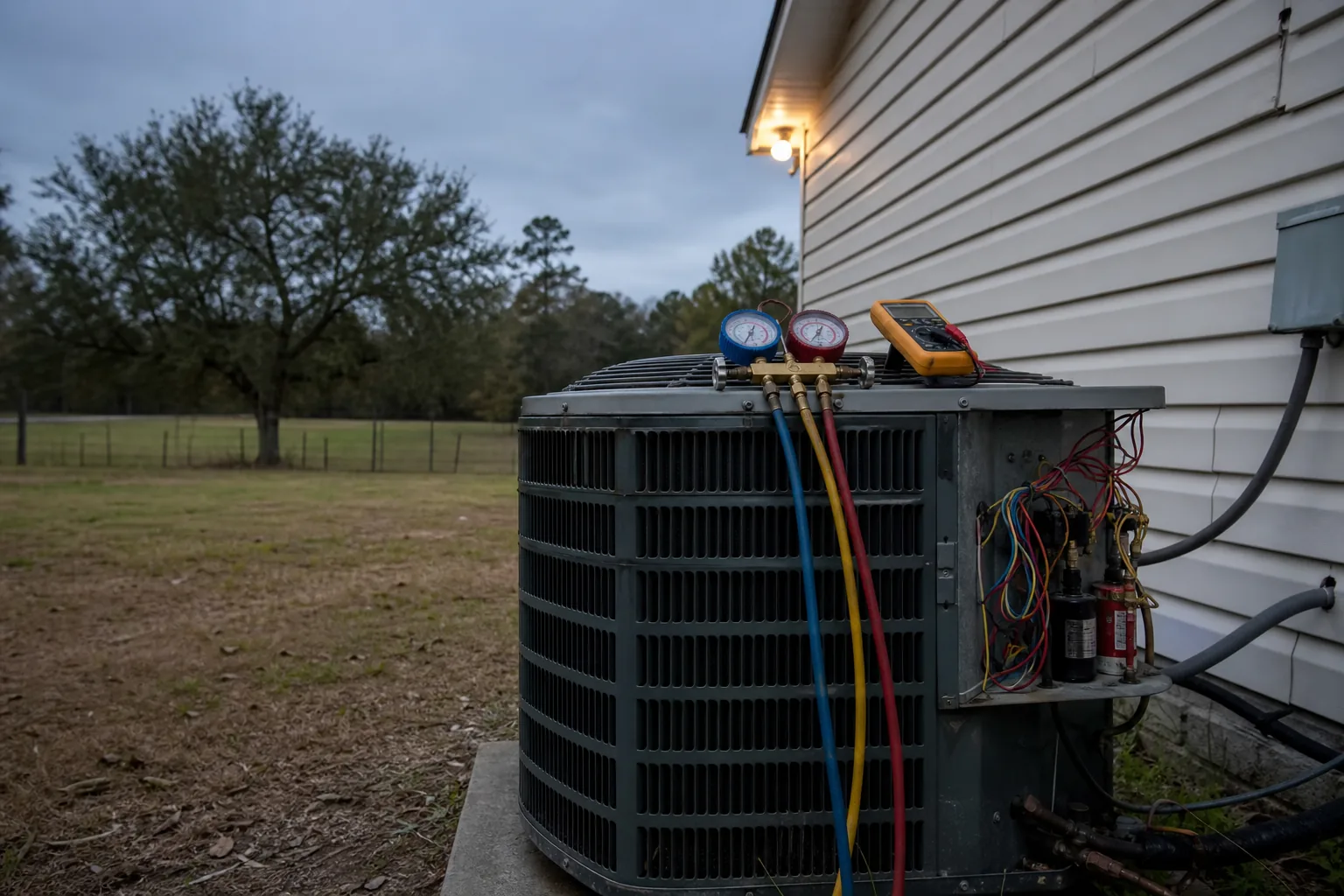
Candidate 1 — Low refrigerant charge. Pressure equalizes during the off cycle. When the compressor restarts, low-side pressure starts low and gets lower as the compressor pulls suction. Within 90 to 180 seconds, the low-side pressure drops below the low-pressure switch cutout (typically 50 to 60 psi on R-410A systems), the switch opens, the compressor shuts off. The system waits, pressures equalize, the switch closes, the cycle repeats. Time signature: 90 seconds to 3 minutes on, 3 to 8 minutes off.
Candidate 2 — Evaporator coil icing. A dirty filter, low blower speed, or undersized return restricts airflow. The evaporator coil temperature drops below 32°F as the system runs, condensate freezes, ice insulates the coil, refrigerant stops boiling, the low-pressure switch trips for the same reason as Candidate 1 — but only after enough run time to actually freeze the coil. Time signature: 8 to 25 minutes on (depends on initial coil temperature), then a long off cycle while ice melts.
Candidate 3 — Failing run capacitor. A weak capacitor produces marginal starting torque on the compressor. The compressor starts, but the motor windings draw above rated locked-rotor amperage during the entire run. Internal overload protection — the thermal cutout inside the compressor itself — opens within 60 to 180 seconds. The compressor sits, the thermal cutout cools and closes, the cycle repeats. Time signature: 1 to 3 minutes on, 5 to 15 minutes off (depends on ambient temperature affecting cooldown).
A 2-minute on / 8-minute off cycle matches Candidate 1 and Candidate 3. It does not match Candidate 2 — Candidate 2 needs the coil to actually freeze before the cycle stops, and that takes at least 8 minutes from a warm start.
Solving for X
Now the math collapses to two candidates: low charge or weak capacitor. The way to tell them apart is to measure both during the same diagnostic call, and to time the failure point precisely.
For Candidate 1 (low charge): the failure point is pressure-driven. Connect gauges and watch the low-side pressure during a cycle. You'll see it start at maybe 70 psi and drop to 55 psi in 110 seconds, then trip the switch. The trip is on the dot. Run another cycle 10 minutes later, same numbers, same trip time. The off cycle is governed by how fast the high side bleeds down through the metering device into the low side.
For Candidate 3 (weak capacitor): the failure point is current-driven. Compressor amp draw at startup is 6 to 7 times the rated load amperage instead of the normal 4 to 5 times. Steady-state running amp draw is 110% to 130% of rated load amperage instead of the normal 80% to 95%. The trip is heat-driven inside the compressor, so the time to trip varies slightly with ambient — a 96°F afternoon trips faster than a 78°F morning.
The 2-minute consistency across the day points to pressure as the trigger more often than heat. So Candidate 1 leads the leaderboard going in. But the diagnostic needs both readings before any part is replaced, because:
- A weak capacitor on a system that's also low on charge will hard-start and short-cycle. Replace just the capacitor and the system still short-cycles a week later.
- A correct charge on a system with a marginal capacitor will short-cycle initially and then run, masking the real issue.
- A low-charge condition is sometimes a leak that needs to be found and repaired, not just topped off — and topping off without finding the leak is a 4-week fix at best.
Why Foley produces this pattern in August specifically
Three things stack up in late August in Foley to push borderline systems into outright short cycling:
Ambient drives evaporator load. A 96°F day in Foley with 72% humidity puts a heavy latent and sensible load on a typical 3-ton residential system — near the equipment's rated capacity at the listed conditions. Anything degraded — slightly low charge, slightly weak capacitor, slightly restricted airflow — gets exposed. The same equipment performed fine on the same charge in May because the ambient load was a fraction of August.
Refrigerant migration during long off cycles. Older systems in Walker Grove and the 1970s-era ranches near Hadley Village develop slow refrigerant migration through worn check valves on the metering device. The system sits idle for 7 hours overnight, and pressure equalization is more complete than it should be. The first morning cycle starts with less effective charge available.
Capacitor heat aging accelerates after July. Run capacitors are rated for a maximum operating temperature, and outdoor cabinets in Foley reach 145°F internal during peak afternoon. Cumulative heat hours through June and July push borderline capacitors past their failure threshold sometime in late summer in most years. The hard-start work and the Daphne capacitor failure pattern walk through this in detail.
The intersection of those three factors is why the same system that ran without complaint in May produces a textbook 2-minute / 8-minute pattern in late August.
The Type-A and Type-B distinction
Within the low-charge candidate, the diagnostic splits one more time:
Type A: Slow leak with no visible damage. Charge drifts down over 18 to 30 months as the system loses refrigerant through microscopic seepage at brazed joints, Schrader valve cores, or service valve packing. The leak isn't visible to a UV dye check, doesn't show on a soap-bubble test of accessible joints, and may need an electronic sniffer at the indoor coil to localize. Foley fix: locate, repair, evacuate, recharge, and a written report of the recovered weight versus the calculated correct charge. Every line quoted in writing before any work is done.
Type B: Coil leak from formicary corrosion. Indoor coils on systems 8 to 15 years old in Foley develop microscopic pitting from formic acid produced by VOCs in indoor air. The coil leaks slowly at first, then accelerates. Once the pattern is visible, the coil is end-of-life. A coil swap on a system with a matched-but-aging condenser pushes the repair-vs-replace conversation into focus, especially on systems past year 11. Replacement estimates are free either way.
The 2-minute cycle doesn't tell us which type. The cycle tells us we're in the low-charge family. The pressure history, the leak-search results, and the visible coil condition tell us Type A versus Type B.
What X usually turns out to be
On the Foley short-cycling calls that walk in the door in late August, run-time-per-cycle distributes roughly like this:
- 1.5 to 2.5 minutes: the most common bucket. Low-charge Type A or Type B.
- 1 to 1.5 minutes: severely low charge or fully failed capacitor.
- 2.5 to 4 minutes: weak capacitor with marginal charge.
- 8+ minutes (with later trip): coil icing from filter restriction or duct collapse.
The 2-minute median tracks the failure mode that accounts for the largest share of Foley summer short-cycling: low refrigerant charge from a slow leak, sometimes paired with a marginal capacitor that's contributing but not the primary cause.
The fix on the typical 2-minute Foley call is the leak-locate, leak-repair, evacuate, recharge sequence — not a capacitor swap, not a thermostat replacement, and definitely not a "let's add some refrigerant and see how it does." Adding refrigerant without finding the leak is a 6-week patch at best, and at worst it overcharges the system once the leak slows or temporarily stops, producing a different short-cycling pattern from high-side pressure trips.
What to do tonight if your system is doing this
Three steps before you call:
Pull the filter. If it's grey, replace it. A clean filter doesn't fix a low-charge problem, but a dirty filter can mask the actual cycle pattern with airflow restriction layered on top. Remove that variable.
Check the outdoor unit. If the condenser fan is spinning slowly, the fan motor capacitor is part of the problem. If grass clippings are matted against the coil, clear them. If the disconnect breaker has been tripping, leave it off and call. The Stapleton Labor Day audit walkthrough covers the visual checks that matter most before service arrives.
Note the actual cycle length. Time three consecutive cycles with a stopwatch. If they're within 15 seconds of each other, that consistency is diagnostic information. If they're scattered — 2 minutes, 7 minutes, 1 minute, 9 minutes — the diagnosis bucket changes. Write the numbers down so we have data to work with.
Then call. The Foley diagnostic runs the standard $79 service fee, includes the full pressure and capacitance and amp-draw measurement set, and produces a written diagnosis you can use whether you have me do the repair or get a free second opinion from another shop. The cost guide lays out the pricing framework so the numbers in the diagnostic report match what shows up on the invoice.
The cycle length is the math problem. The math problem solves to the part. The part is rarely the thermostat, sometimes the capacitor, and most often the refrigerant charge — but only the diagnostic measurements turn the suspicion into a number you can act on.
X equals about 2. The compressor is telling you which part is failing. The only question is whether you pick up the signal in August or wait for the full failure in September. Call 251-383-HVAC.
FAQ
- Is short cycling dangerous to my Foley AC?
- Short cycling is dangerous in proportion to its frequency and duration. A system that runs 2 minutes and sits 8 minutes draws full inrush current 6 times per hour — well over a hundred starts per day during a Foley August duty cycle. Each start pulls 5 to 7 times the running current through the compressor windings and contactor, and the lubrication oil hasn't fully circulated before the unit shuts down again. Weeks of that pattern shortens compressor life considerably and burns contactors out in roughly half their normal service life. The cycle length itself is the warning.
- Can a thermostat cause short cycling?
- Yes, but a faulty thermostat short-cycles differently than a refrigerant or airflow problem. Thermostat-induced short cycles are usually irregular — 1 minute on, 12 off, 4 on, 6 off — because the thermostat is reading inconsistent temperature data, often from a failing internal sensor or from sun-heated drywall behind the wall plate. A genuinely consistent 2-minute on / 8-minute off pattern is rarely a thermostat. The math points elsewhere.
- What does the Foley diagnostic actually check for short cycling?
- Refrigerant pressure on both sides at the start of the cycle and at the moment of shutoff, superheat and subcool readings, evaporator coil temperature differential, blower amp draw and static pressure, condenser fan amp draw, and a microfarad reading on every capacitor in the system. I also pull the air handler door and inspect the evaporator coil for ice buildup or visible blockage. The whole sequence runs 35 to 45 minutes and produces a written diagnosis, not a guess. The $79 service fee covers the diagnostic, with any repair quoted in writing before any work is done.
- Why does this happen more in Foley than in coastal cities?
- Foley sits about 8 miles inland from the Gulf — far enough to lose the marine breeze that moderates afternoon temperatures along the coast, but close enough to retain coastal humidity. Equipment in Glenlakes, Cypress Gates, and Walker Grove regularly faces 96°F dry-bulb with 70%+ humidity for hours a day in late August. That duty cycle pushes evaporators toward freezing thresholds faster than coastal systems and exposes refrigerant charge errors that wouldn't surface in a milder climate.
Need this handled?
Straight to the service page for your town — pricing, local details and a form that reaches a technician.
More from Short Cycling

ACExperts HVAC
We Take The Heat So You Don't Have To
Fast, honest heating and air service across Baldwin County. Speak with a technician and get on the schedule today.