
The Elberta Musty AC Smell: Coil, Drain, or Duct?
Musty AC smell in Elberta: five distinct smells, three different causes. Identify yours by nose before you call, since most homes self-diagnose in five minutes.
Published 2026-07-22 · Updated 2026-07-22
Author: Landon Jahnke | ACExperts251
Reviewed by: Landon Jahnke · Owner · Alabama HVAC License AL #16117 · EPA 608 Certified
The wet-towel smell, the aquarium smell, the basement smell, the hotel-room smell, the dead-rodent smell. Five distinct olfactory signatures, three completely different causes, and an Elberta home in July can run any combination of them simultaneously.
Over 13 years working Baldwin County HVAC, I've learned that smell diagnostics are mostly nose work — and once you know what you're smelling for, you can usually identify the source in five minutes without specialized equipment. Here's how to tell which one is yours.
Why Elberta produces all five at the same time of year
Elberta's HVAC profile is the worst-case combination for musty-smell calls. About 8 miles inland from the Gulf, with moderate salt-air exposure, sustained subtropical humidity from May through September, a heavy share of older homes with retrofit central AC installed through 1970s and 1980s attics, and crawlspaces that hold ground moisture year-round under farmhouses that were built before vapor barriers were standard.
That construction profile means the average Elberta home has multiple potential smell sources active at the same time. A late-1960s farmhouse on the back roads toward Pine Beach Road might have biofilm on an aging indoor coil, a partially clogged drain trap that hasn't been cleared in several seasons, ductwork in a humid crawlspace that infiltrates moisture, and an air handler cabinet that a roof rat used as a nest during a previous winter. Pulling apart which smell is which is the first job of any honest diagnostic.
The good news: smells are diagnostically rich. Each category has a specific signature, and you can usually triangulate the source by walking the smell back to its strongest concentration.
The wet-towel smell
Signature: Like a damp gym towel that's been left in a duffel bag for two days. Concentrated at the supply registers when the system first cycles on, dissipates somewhat during sustained run time, returns within minutes of cycling off.
What it actually is: Biofilm on the indoor evaporator coil. Microbial growth — bacteria and fungi colonizing the coil fins and the surrounding metal — produces volatile organic compounds as a metabolic byproduct. Those compounds vaporize when the coil is wet from condensation, get blown into the air stream, and reach you via the supply register.
Why it's worse in Elberta: Sustained humidity means the coil stays wet longer between cycles. A coil that gets wet once a day in a dry climate produces minimal biofilm. A coil that's wet six hours a day for four months running supports a thriving microbial community.
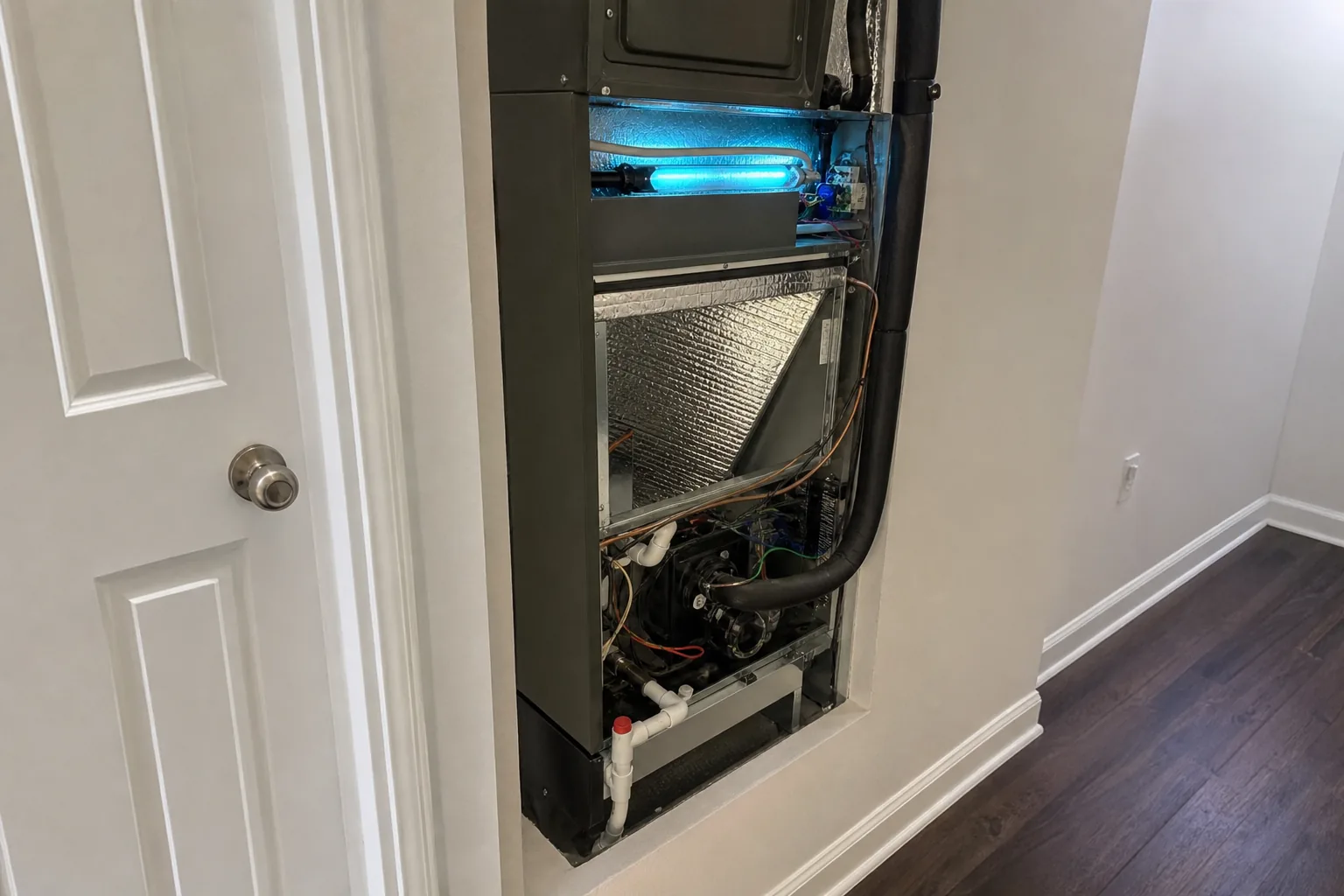
How to confirm: Pull the air handler access panel. Look at the coil face. A clean coil shows shiny aluminum fins. A biofilm-loaded coil shows a gray, slightly fuzzy surface — sometimes with visible discoloration ranging from yellow-green to brown-black depending on the species growing.
The fix: Coil cleaning with a non-acid foaming cleaner appropriate to the metal type, followed by a clear-water rinse, followed by an antimicrobial treatment that lasts months. Install a UV light if recurrence is a problem.
The aquarium smell
Signature: Like a fish tank that hasn't had a water change in three weeks. Stagnant, slightly sweet, with a metallic undertone. Usually strongest near the indoor unit itself, though it can travel to nearby supply registers.
What it actually is: Standing water in the condensate drain trap. Most residential AC systems have a P-trap in the drain line that holds a small amount of water to prevent indoor air from being pulled out through the drain. When the system runs hard during peak summer demand, condensate flows continuously and the trap stays fresh. When the system short-cycles or sits idle for days, the trapped water stagnates, microbial growth proliferates, and the smell of decomposing biological matter migrates back into the air handler.
Why it shows up in Elberta: Older retrofit installations often have drain traps installed at unconventional heights or with sub-spec slopes, which means partial blockages develop sooner than they would in newer systems. Drain treatment isn't always part of a basic tune-up at every shop.
How to confirm: Find the condensate drain line — it's a PVC pipe usually about 3/4-inch in diameter, exiting the indoor unit and routing outside or to a floor drain. Find the access port (usually a tee with a removable cap or a wye fitting). Lift or remove the cap and smell. If the smell that comes out matches the smell you're chasing, you've found it.
The fix: Drain clearing with a wet-dry vacuum on the outside termination, followed by a 50/50 distilled vinegar and water flush, followed by a calibrated drain pan tablet sized to your specific pan volume. Drain treatment is part of the Comfort Plan tune-ups at no additional charge.
The basement smell
Signature: Like an unfinished basement or a crawlspace — earthy, slightly mineral, with a distinct musty edge that's different from the wet-towel smell. Often present even when the AC isn't running, though it intensifies when the system kicks on.
What it actually is: Ductwork pulling air from a humid crawlspace, attic, or chase, then delivering that air into the conditioned living space. Older Elberta retrofit installations often run flexible duct through unconditioned spaces with minimal sealing at the connections. A six-foot section of disconnected return ductwork in a damp crawlspace effectively turns the AC into a fan that distributes crawlspace air throughout the house.
Why it's an Elberta thing: Heavy share of pre-1980s construction with retrofitted central AC, where the duct system was installed through whatever path the original installer could find. Crawlspace ductwork that's now decades old has often lost its insulation jacket, separated at takeoffs, and runs through humidity that the original construction was designed to ventilate but that the current modified building actually traps.
How to confirm: Compare the smell at a return register to the smell at a supply register. If the return smells musty and the supply smells slightly less musty (because some of the smell has been processed through the AC), the source is on the return side — almost always a duct breach in an unconditioned space. If the supply smells musty and the return smells fine, the source is on the supply side — also usually a duct breach, but on the conditioned-air delivery side.
The fix: Duct inspection, sealing of identified breaches with mastic or aerosol duct sealing, replacement of compromised flex duct sections, and sometimes encapsulation of the crawlspace itself if the underlying humidity load is severe enough that even sealed ductwork can't compensate. The pre-summer mistakes Bay Minette homeowners keep making post covers the inland-rural duct profile in more detail.
The hotel-room smell
Signature: Stale, slightly sweet, with a perfume-or-deodorizer undertone — like a hotel room that's been deep-cleaned with chemicals to mask an existing smell. Often present in homes that have had multiple occupants over the years, vacation rentals, or homes where a previous owner had pets.
What it actually is: Indoor coil dust trapped in microbial growth, with secondary contamination from years of accumulated household particulate matter that's been integrated into the biofilm matrix. Sometimes there's a chemical component from previous odor-masking attempts — air fresheners pulled into the return, deodorizing tablets dropped into drain pans, or fabric softener sheets stuck in air vents — that adds the perfume undertone.
Why it's particularly Elberta: Older homes that have been through multiple ownerships, with histories the current homeowner may not fully know. The coil may have gone many years between cleanings, a previous owner may have used a commercial-grade deodorizer in the air handler at some point, and the cumulative effect is a coil that's both microbially active and chemically saturated.
How to confirm: Same coil inspection as the wet-towel smell, but look for additional signs of historical chemical treatment — discolored streaks on the coil from old deodorizers, residue in the drain pan, or stickers and tags inside the air handler from previous service work. Talk to the homeowner about the home's service history if it's a recent purchase.
The fix: Aggressive coil cleaning with a multi-step process — alkaline cleaner first to break down biofilm and chemical residue, water rinse, then a pH-neutralizing rinse, then antimicrobial treatment. Sometimes the right answer on a coil that's been chemically saturated for years is a coil replacement rather than continued cleaning, and I'll quote both paths in writing so you can compare.
The dead-rodent smell
Signature: Unmistakable. Heavy, sweet, slightly metallic, with a putrefaction note that reaches you immediately and doesn't fade. Concentrated near the indoor unit and possibly at one specific supply register if the source is in a duct branch.
What it actually is: An actual dead rodent — usually a roof rat or a field mouse — that found its way into the air handler cabinet, the supply ductwork, or the condensate drain pan and died there. The body decomposes, the smell circulates through the air distribution, and the homeowner notices within a day or three of the death.
Why Elberta sees it: Rural and semi-rural housing with attics and crawlspaces accessible to local rodent populations. Mice and rats can squeeze through openings as small as a quarter inch, and air handler cabinets in attics often have small access points around wiring penetrations and supply duct connections.
How to confirm: Open the air handler access panel. Look. The smell is strong enough that you'll usually find the source within five minutes of starting to look. Check the blower compartment, the indoor coil pan, and any accessible duct sections that connect to the air handler.
The fix: Remove the rodent, sanitize the affected components, treat ductwork if applicable, and identify and seal the entry point that allowed the rodent access in the first place. Higher cost if the rodent died deep in the duct system and ductwork access requires cutting and patching, which gets quoted on the spot.
What to do before calling
Walk through the five smells. Identify yours. The diagnostic conversation goes very differently if you say "I think it's the wet-towel category" versus "my AC smells musty" — I can pre-stage the right cleaning chemistry, the right diagnostic tools, and the right time estimate before showing up at your house.
If you can't identify the category, that's fine. Call anyway. The diagnostic walks through all five in about 45 minutes and produces a definitive answer.
The cluster on this page goes wider. The musty smell after AC running post covers the general physics. The Magnolia Springs drain line that smells like a pond covers the river-adjacent component that affects southwestern Elberta toward Magnolia Springs. The Foley spring pollen and IAQ reset covers the prevention work that keeps coil biofilm from establishing in the first place.
What an Elberta IAQ visit covers
If you're in Elberta and your AC has been smelling musty for more than a week, schedule a diagnostic. The $79 service fee covers the visit, and any recommended repair work gets quoted in writing on the spot before I do it. Free second opinion if another company has already given you a number on a smell-repair scope.
The diagnostic that tells you which category is yours is the same regardless of where it lands. Five smells, three causes, one phone call.
Sniff first. Call 251-383-HVAC second.
FAQ
- How do I tell musty AC smell from general household mustiness in an older Elberta home?
- Walk to a supply register with the AC running for at least ten minutes. Cup your hand around the register and smell the air coming out — directly, not from across the room. If the musty smell is concentrated at the register, it's coming from your HVAC system. If the smell is the same at the register as it is in the room, it's a general humidity or building issue, not your AC system specifically. Older Elberta farmhouses sometimes have crawlspace humidity that produces a similar smell to ductwork mustiness, so this register test is the cleanest way to separate the two before spending money on a wrong diagnosis.
- Will running the AC longer dry out a musty smell or make it worse?
- Depends on the source. Wet-towel coil smell often improves with longer run times because sustained airflow dries the biofilm temporarily — but the underlying coil contamination doesn't go away, and the smell returns within hours of cycling off. Aquarium drain-trap smell gets worse with longer run times because more condensate accumulates in a clogged trap. Crawlspace duct smell stays roughly the same regardless of run time because the air is moving through ducts that stay equally humid throughout. Hotel-room dust-on-coil smell mildly improves but recurs as soon as the system cycles. The dead-rodent smell does not improve and gets worse as the body decomposes — that one needs immediate attention.
- Is a UV light system worth installing in an Elberta home for indoor air quality?
- Conditionally yes. UV lights mounted near the indoor coil reduce biofilm growth on coil surfaces and inside the drain pan, which addresses the wet-towel and hotel-room smell categories effectively. They don't help with aquarium-trap smell (that's about water in the trap, not microbial growth), and they don't help with crawlspace duct smell (that's external infiltration, not coil microbiology). For an Elberta home with persistent coil-side smell that returns within a week of every cleaning, a properly sized UV system addresses the recurring problem. For homes with primarily drain or duct origin smells, the money is better spent elsewhere. I'll quote any UV install in writing on the same visit as the diagnostic.
- How much does an AC smell diagnostic cost in Elberta?
- The $79 service fee covers the diagnostic visit. The diagnostic includes a coil inspection (visual and surface swab if biofilm is suspected), drain trap inspection and clearing, ductwork visual inspection at accessible junctions, condensate pan inspection, and air handler cabinet inspection. Most Elberta smell diagnostics resolve within 45 minutes once we know which of the five categories we're dealing with. Repair scope varies widely from a quick drain clearing to a full coil cleaning to a ductwork repair, and every line gets quoted in writing before any work is done. Free second opinions if another company has already given you a smell-repair quote.
Need this handled?
Straight to the service page for your town — pricing, local details and a form that reaches a technician.
Related reading

ACExperts HVAC
We Take The Heat So You Don't Have To
Fast, honest heating and air service across Baldwin County. Speak with a technician and get on the schedule today.