
Daphne Spring Pollen + Your HVAC: A 3-Step IAQ Reset
Daphne's pollen problem isn't pollen — it's what your AC does with what gets past the filter. Here's the 3-step March reset that actually works.
Published 2026-03-03 · Updated 2026-03-03
Author: Landon Jahnke | ACExperts251
Reviewed by: Landon Jahnke · Owner · Alabama HVAC License AL #16117 · EPA 608 Certified
Daphne's pollen problem isn't actually pollen. It's what your AC does with the pollen that gets through your filter that turns a manageable allergy season into a six-week respiratory misery.
The yellow film on your car right now? That's pine pollen — mostly visible, mostly large-grain, and mostly stopped cold by any reasonable filter on any reasonable HVAC system. If pine pollen were the problem, a $20 MERV 8 filter would solve it.
The actual indoor allergen multiplier in Daphne is what happens when oak pollen (20-30 microns), pecan pollen (30-40 microns), and sweetgum pollen (20-25 microns) — all small enough to slip past a MERV 8 filter — land on an indoor coil that's been sitting humid through the winter shoulder season. The coil grows biofilm. The biofilm captures the pollen. The pollen-loaded biofilm becomes a slow-release allergen reservoir that re-aerosolizes every time the blower starts. By April, your house has a pollen-allergen baseline that's 5-10x what it was in February, and the trees outside aren't even the immediate cause anymore. Your indoor coil is.
Below is the 3-step reset that fixes this. It works because it addresses the actual mechanism, not the visible distraction.
The Daphne pollen geography you should know
Daphne is on the Eastern Shore, sitting on bluffs above Mobile Bay. The Daphne service area page covers the housing-stock context — Jubilee Farms, Lake Forest, Old Daphne, Historic Malbis, The Reserve, Hope Vineyard. From an IAQ standpoint, the relevant variables are:
Bay-side humidity year-round. Indoor RH baseline in Daphne homes runs 5-8 points higher than inland Baldwin County in February and March. That's the difference between a coil that stays mostly dry between cooling cycles and a coil that stays slightly damp.
Long pollen season starting late February. Oak begins pollinating in coastal Alabama in late February and peaks through mid-March. Pecan and sweetgum overlap. Pine starts pollinating mid-March (the visible yellow). The total pollen load on Daphne homes is among the highest in the county because of the Eastern Shore's mature tree canopy.
Cooling season starts mid-April. From late February through mid-April, the AC isn't running enough to dehumidify or to flush the coil. The system might run 30-60 minutes a day on warmer March afternoons, then sit idle for 22 hours. That intermittent run cycle is the worst-case scenario for biofilm formation on a humid coil.
Older homes versus newer subdivisions, opposite problems. Old Daphne and Historic Malbis have retrofit ductwork through unconditioned attics — pollen infiltrates through duct leakage as well as through the filter. Jubilee Farms and The Reserve have tight modern envelopes — pollen infiltrates less, but anything that does get in has nowhere to go and accumulates inside the system.
The 3-step reset below assumes some version of this geography. Adjust intensity based on your specific neighborhood and housing era.
Step 1: filter intervention (do this first, this week)
The filter is the first line of defense and the easiest to fix. Three sub-steps:
Measure your current static pressure before you change anything. Or have us measure it during a preventive maintenance visit. Static pressure is what tells you whether your duct system can handle a higher-MERV filter without choking airflow. Total external static pressure for most residential systems should run 0.5-0.8 inches water column (in. w.c.). If you're already at 0.8, jumping to MERV 13 will push you past 1.0 and the blower will struggle, the coil will ice up, and you'll trade a pollen problem for an equipment problem.
Choose the highest MERV your system will support. For most newer Daphne homes (Jubilee Farms, The Reserve, Hope Vineyard) with proper return sizing, MERV 11 or MERV 13 in a 4-inch media format is appropriate. For older Daphne homes with retrofit ductwork (Old Daphne, Historic Malbis, parts of Lake Forest), MERV 11 in a 4-inch is usually the ceiling — and you may need to leave the existing 1-inch slot empty and install a 4-inch media cabinet on the return side. We do this work routinely.
Change the filter every 30 days from March through May. The standard "change quarterly" guidance doesn't survive Daphne pollen season. A MERV 11 filter that's clean March 1 will be 70% loaded by April 1. Loaded filters don't capture pollen better — they restrict airflow and bypass around the filter frame, which means pollen-laden air finds its way around rather than through. Mark the install date on the frame.
The visible yellow on your car will still be there. That's not the point. The pollen that matters — oak, pecan, sweetgum — is the pollen you can't see. The right filter catches that.
Step 2: coil-and-drain reset (do this in the next 2 weeks)
This is where the work moves from owner-doable to mostly tech-required. The indoor coil is the IAQ pivot point, and addressing it correctly is what separates a real reset from a cosmetic fix.
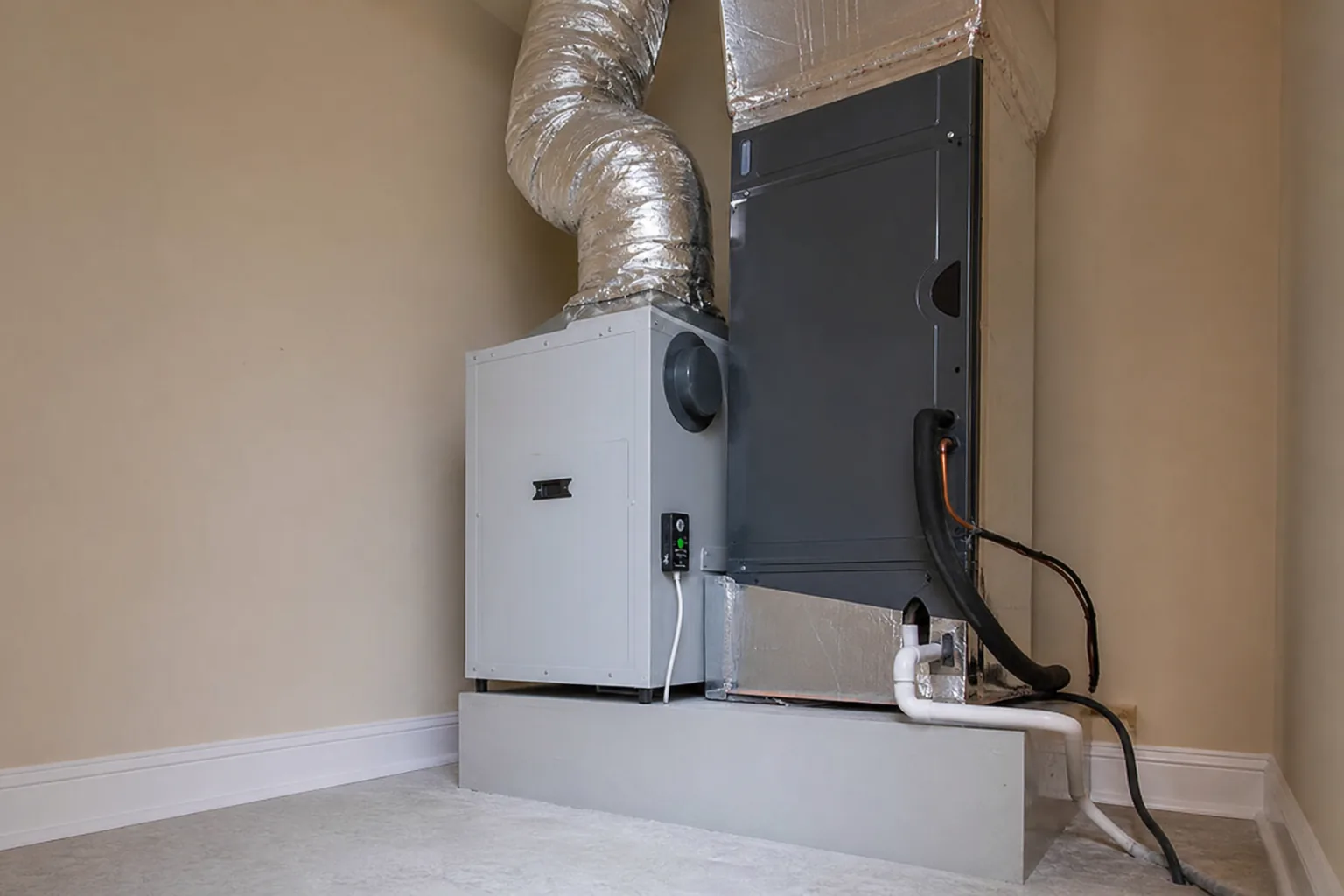
Visual coil inspection. Pull the access panel on the air handler, look at the indoor (evaporator) coil under good light. Clean coil: white aluminum fins, visible spaces between fins, no surface film. Loaded coil: brown or gray surface film, fins partially obscured, possibly visible biological growth. Most Daphne homes that haven't had a tune-up in 18+ months will show some surface load.
Coil cleaning. Two methods, depending on load level. Light load: foaming coil cleaner sprayed on the coil, allowed to dwell, rinsed by the next cooling cycle's condensate. Heavy load: pull the coil entirely, wash with no-rinse cleaner and gentle pressure water, reinstall. The light-load method is what we do during a standard maintenance visit. The heavy-load method is what we do when the coil hasn't been touched in 3+ years and the homeowner is reporting persistent allergy symptoms.
Drain pan and drain line. Pull the secondary drain pan, inspect for biological growth, treat with EPA-registered drain pan tablets. Flush the primary drain line with diluted vinegar (1:1 with warm water, 30-minute dwell, then warm water flush). Verify the line slope and confirm the float switch is operational. A clogged drain during early-cooling-season operation is one of the most common spring service calls in Daphne — the system has been mostly off all winter, the drain line has dried biofilm in it, and the first heavy cooling day produces enough condensate to flood the float switch and shut the system down.
Air handler housing inspection. The foam insulation inside the cabinet is a common biofilm host. If the foam is degraded, fragmenting, or visibly contaminated, it needs to be replaced. This is a real job — pulling the air handler enough to access the housing — and we typically only recommend it when the homeowner has reported persistent IAQ symptoms that didn't resolve after coil cleaning.
The full indoor air quality service page covers the standard coil-and-drain protocol. For homes with persistent biofilm formation despite reset work, we'll discuss UV-C installation over the coil — it suppresses biological growth at the source and is one of the few IAQ interventions that genuinely earns its cost in coastal Alabama.
Step 3: humidity and ventilation tuning (do this for the rest of the season)
Once the filter is right and the coil is clean, the third step is making sure the system stays clean through the spring and into the cooling season. This is mostly about humidity and runtime.
Indoor humidity target: 45-50% RH. Below 45%, you risk dry sinuses and static buildup. Above 50%, biofilm formation accelerates on every damp surface in the system. From late February through mid-April, the AC isn't running enough to hit this target through compressor-driven dehumidification alone. Two intervention options:
- Thermostat fan strategy. Set the fan to "circulate" (intermittent) rather than "auto" or "on." Most modern thermostats allow this — the fan runs 25-35 minutes per hour even when the compressor is off, which keeps air moving across the filter and helps equalize humidity across the house. Don't use "on" continuous fan during shoulder season — that re-evaporates condensate from the drain pan back into the airstream and actually raises indoor humidity.
- Whole-home dehumidifier. For tight-envelope new construction homes (The Reserve, Hope Vineyard, newer Jubilee Farms phases), the AC alone often can't hit the humidity target during shoulder season. A bypass dehumidifier integrated with the duct system runs independently of the compressor, holds RH at setpoint year-round, and is one of the higher-ROI integrated solutions in coastal Alabama.
Cooling-season runtime tuning. When the cooling season starts in earnest in mid-to-late April, the system should run in cycles long enough to dehumidify (15-20 minute minimum cycles, ideally) rather than short-cycling. If your system short-cycles in 5-7 minute bursts, the coil never gets cold enough long enough to condense moisture out of the air, and indoor humidity climbs even with the AC running. This is an equipment-sizing or thermostat-staging issue and we walk through it during a tune-up visit.
Outdoor unit ventilation. Pollen lands on outdoor coils too. Quarterly rinses with low-pressure water through the spring keep the condenser fins clean and let the outdoor unit reject heat efficiently. A pollen-loaded condenser doesn't directly cause indoor allergies — but it forces the system to run longer to do the same cooling work, which means more cycles through the indoor coil.
What this looks like across Daphne neighborhoods
The 3-step reset adapts to housing context:
Jubilee Farms, The Reserve, Hope Vineyard (newer, tight envelope). MERV 13 filter is realistic if static pressure supports it. Coil cleaning every 18 months. Whole-home dehumidifier likely worth discussing. Fan strategy on intermittent circulate.
Lake Forest (mixed era, large subdivision). MERV 11 filter as default. Static pressure check before any upgrade. Coil condition varies dramatically by individual home — some Lake Forest homes have had recent system replacements, others still have late-1990s equipment. Run the diagnostic before assuming.
Old Daphne, Historic Malbis (older, retrofit ductwork). MERV 11 in a 4-inch cabinet rather than the 1-inch slot. Aggressive duct sealing as a long-term project — leaky ducts pull pollen-laden attic air directly into the supply path, which no filter will fix. Coil cleaning every 12 months given the higher load.
TimberCreek, Bellaton, Oldfield (mid-era, mixed condition). Default MERV 11 with filter change every 30 days through pollen season. Coil cleaning during the standard spring tune-up.
For nearby cities with similar pollen profiles, the Bay Minette pollen post covers the inland-county variant with different tree mix. The Fairhope pollen post addresses the same Eastern Shore geography from a Fairhope-specific angle. For Fort Morgan, Lillian, and Stapleton — different geographies, different filter recommendations, but the same 3-step framework.
Timing the reset
If you're reading this in early March, you're on time. The work spreads across about 3 weeks:
- Week 1: Filter swap, static pressure check, set the fan to circulate.
- Week 2: Coil cleaning, drain line flush, drain pan treatment. This is where the tech visit lands.
- Week 3: Verify indoor humidity is tracking toward the 45-50% target, monitor symptoms, follow up on anything that didn't fully resolve.
If you're reading this in April, do it anyway — late is better than not. If you're reading this in May, you're behind, but the reset still works. The goal is to land the cooling season with a clean filter, a clean coil, a clean drain, and a humidity strategy. Do that and the symptoms that have been building since late February usually resolve within 2-3 weeks.
When you should call us
Call us for the static pressure check and the coil cleaning — those are the tech-required pieces. Call us if symptoms haven't resolved after a complete 3-week reset (something else is going on, possibly duct leakage, possibly a coil condition that surface cleaning didn't reach). Call us if you've never had a humidity reading in your house and want a baseline (it's a 15-minute measurement and it changes the conversation about everything else). The emergency HVAC line is for system failures, not IAQ work — IAQ scheduling is normal-business-hours, and we book it 1-2 weeks out during March-May.
The yellow film will still be on your car tomorrow. It always is in March. The point isn't to make it go away. The point is to keep what's not visible from doing the actual damage.
FAQ
- Why does my Daphne house feel worse for allergies in March than in fall?
- Two reasons. First, March is peak oak pollen in coastal Alabama, and oak pollen grains are roughly 20-30 microns — small enough to slip past a standard MERV 8 filter and reach the indoor coil. Second, Daphne's combination of bay-side humidity plus a cooling season that's just beginning means the indoor coil is operating in conditions that favor biofilm formation, which captures and amplifies pollen-allergen response. Fall pollen is mostly ragweed and grass, which different filter media handle better, and the coil is operating in steady-state cooling that's less biofilm-prone.
- Is the yellow pollen on my car actually getting into my house through the AC?
- Mostly no — and that's the counterintuitive part. The yellow stuff is pine pollen, with grain sizes around 60-100 microns, and a MERV 8 filter catches almost all of it. The indoor allergen problem isn't pine. It's oak (20-30 microns), pecan (30-40 microns), and sweetgum (20-25 microns) — all of which slip past MERV 8 and land on a damp coil. The yellow car is a visible distraction from an invisible problem.
- Will switching to a MERV 13 filter solve the Daphne pollen problem?
- It helps significantly with airborne pollen capture, but only if your duct system can handle the static pressure of a MERV 13 filter without strangling airflow. Many older Daphne homes — especially in Old Daphne and Historic Malbis — have undersized returns that can't support MERV 13 without reducing system airflow below the manufacturer's minimum. The right answer depends on a static pressure measurement, not a default upgrade.
- Do I need a UV-C light or whole-home dehumidifier for spring pollen issues in Daphne?
- If basic filter and coil interventions don't resolve symptoms after a 3-week reset cycle, then yes — a UV-C light over the coil suppresses biofilm formation that captures and re-volatilizes allergens, and a properly sized dehumidifier holds indoor RH below 50% during shoulder season when the AC isn't running long enough to dehumidify naturally. Both are integrated solutions that address sources rather than symptoms.
Need this handled?
Straight to the service page for your town — pricing, local details and a form that reaches a technician.
More from Spring Pollen

ACExperts HVAC
We Take The Heat So You Don't Have To
Fast, honest heating and air service across Baldwin County. Speak with a technician and get on the schedule today.