
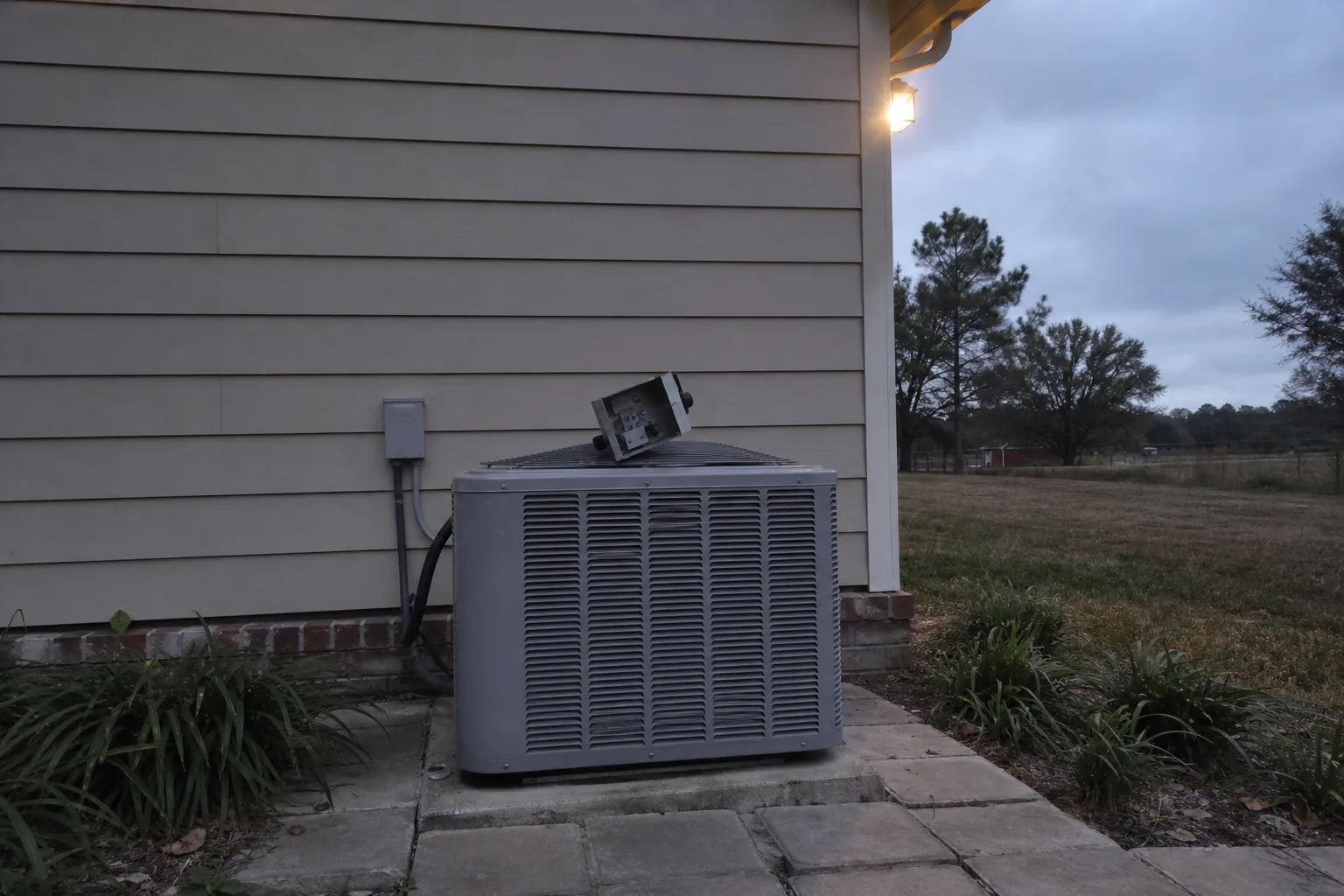
Overnight HVAC Failure in Loxley — Triage Before You Pay After-Hours Rates
Five 'don't' rules for a 2 AM Loxley HVAC failure that can save real money, plus the shorter 'do' list, so you triage smart before paying after-hours rates.
Published 2026-11-23 · Updated 2026-11-23
Author: Landon Jahnke | ACExperts251
Reviewed by: Landon Jahnke · Owner · Alabama HVAC License AL #16117 · EPA 608 Certified
Don't call us at 2 AM unless it actually qualifies. Don't flip the breaker on and off three times. Don't pour anything into the condensate drain. Don't drag the outdoor unit into the garage. Don't run the system on a portable generator unless you can confirm pure-sine output. Five "don't" rules for a 2 AM Loxley HVAC failure that can save real money depending on how many of them you'd otherwise have done. The "do" list is shorter — but it's the back half of the post.
Most overnight HVAC failures in Loxley aren't actually emergencies. They feel like emergencies because you woke up sweating, or the bedroom is cold, or there's a noise that wasn't there at midnight. Real emergencies — the kind that justify any HVAC company being out at 2 AM — are a small subset. The rest are situations where the wrong move between now and 8 AM costs you more than the failure itself.
So before the "do" list, the "don't" list. In order.
Don't 1 — Don't call unless the situation actually warrants it
A note on how ACExperts handles this versus the typical industry pricing: many Baldwin County contractors charge a meaningful overnight surcharge on top of the daytime diagnostic. ACExperts doesn't. Emergency calls run around the clock, any day of the week at the standard $79 service fee, including Saturdays at no extra charge.
Even so, the math on calling at 2 AM versus 8 AM still matters. A 2 AM call is genuinely less available, lower on parts availability, and the schedule the next day is tighter. If the failure can survive until 8 AM, the call goes faster, the parts are more likely to be on hand, and you're not waking up your HVAC tech to roll a truck through the night.
The threshold for "real emergency" is short:
- Indoor temperature trajectory is hostile: climbing above 88°F or dropping below 55°F with vulnerable occupants (infants, elderly, anyone with cardiopulmonary conditions or diabetes)
- Active damage to the home: water actively flooding from the air handler, electrical burning smell, visible smoke, refrigerant smell strong enough to be noticeable from another room
- Carbon monoxide alarm sounding on a gas furnace home (CO is a separate, more urgent emergency that involves leaving the home, not waiting on the HVAC tech)
If none of those three apply, the right move at 2 AM is: open windows if outdoor air is comfortable, run ceiling fans, hydrate, and call when the office opens. We pick up calls Monday-Saturday 8am-6pm, plus emergency calls day or night, every day.
Don't 2 — Don't flip the breaker on and off three times
This is the most expensive instinct in residential HVAC, and almost everyone does it.
A circuit breaker trips because something pulled more current than the breaker is rated to allow. There's always a reason. The reasons include: a failing capacitor, a seized compressor, a shorted contactor, a wet outdoor unit after heavy rain, a rodent chewing through low-voltage wire, or rarely — and this is the reason people assume — a "nuisance trip" where nothing's actually wrong.
When you flip the breaker back on and the system runs for 30 seconds before tripping again, here's what just happened mechanically: the compressor pulled inrush current trying to start, and whatever component was failing got pushed harder. Specifically, if the run capacitor is weak (the most common cause), each restart pulls peak amperage through it and drives it closer to outright failure.
This pattern shows up repeatedly during storm season. Homeowner flips the breaker three times. Capacitor that was 80% dead at the first trip is now 100% dead at the third. Sometimes the surge takes the contactor with it, or in worst cases, the start winding on the compressor itself. A daytime visit that would've been a quick capacitor swap (if you'd just left the breaker alone and called in the morning) becomes a compressor replacement that runs into four figures.
Rule: One reset is fine if you understand why the breaker tripped (storm just hit, lightning struck, you saw the lights flicker). Three resets is destructive. If it trips a second time after one reset, leave it off and wait for daylight.
Don't 3 — Don't pour anything into the condensate drain
The condensate drain is the small PVC pipe that exits the air handler — usually in a closet, garage, or attic — and runs to a drain or to the exterior. When it clogs, water backs up. The water can flood a closet, drip through a ceiling, or trigger a safety float switch that shuts the whole system down.
Internet advice tells you to pour bleach down the drain. Sometimes it tells you to pour vinegar. Sometimes it tells you to pour Drano.
Don't. Especially at 2 AM.
The condensate drain runs through aluminum drain pans on most modern air handlers. Bleach and aluminum react. The reaction is slow but cumulative — over a year of bleach pours, the drain pan develops pinhole corrosion, and water that used to drain cleanly starts leaking through the pan into the cabinet, into the insulation, and eventually through the drywall under the air handler. The repair is a new drain pan plus drywall and ceiling work depending on where the leak landed.
Drano is worse. It's caustic enough to soften the PVC at glued joints, and it's reactive enough to damage the safety float switch's contacts.
What to do instead: shut off the system at the thermostat. Place a wet/dry vacuum at the exterior end of the condensate line and pull a clean vacuum for 30-60 seconds. That clears most clogs without damaging anything. If you don't have a wet/dry vac, leave it for the morning — the system off, the float switch tripped, no further damage occurring.
Don't 4 — Don't drag the outdoor unit into the garage
This one happens during tropical storm warnings. Homeowner sees the storm forecast, decides the condenser will be damaged outside, and tries to move it into the garage.
Three problems:
- The unit weighs 180-280 pounds and is full of refrigerant under pressure. Tipping it more than 15 degrees from level can damage the compressor's lubrication.
- The refrigerant lines are copper tubing that doesn't bend without kinking. Moving the cabinet without disconnecting the lines breaks the seal.
- Once disconnected (even briefly), the system requires professional recharging and evacuation before it'll run again — minimum several hundred dollars of recovery work even if nothing else broke.
A condenser strapped to its pad (see our Loxley hurricane strap post) will survive almost anything Loxley realistically sees from a tropical system. A condenser pulled into a garage by panicked homeowners frequently doesn't survive the move itself.
If you're worried about wind damage and you don't have a strap installed, the right move is to leave the unit where it sits, document its position with photos for insurance purposes, and ride out the storm. Equipment damage from wind is what insurance is for. Equipment damage from a panicked move at 2 AM is on you.
Don't 5 — Don't run the system on a portable generator unless it's pure-sine
When power goes out and the generator comes on, the instinct is to power back up everything — including the central HVAC. For most consumer-grade portable generators, this destroys the equipment.
Modern HVAC compressors — especially variable-speed inverter compressors and most multi-stage equipment from the last decade — require pure-sine wave power. They detect the harmonic distortion in modified-sine generator output and either shut down with a fault code (best case) or run for hours degrading control board components and inverter electronics (worst case).
Consumer-grade portable generators in the $400-$1,200 range are almost universally modified-sine output. Pure-sine portable generators exist but cost meaningfully more — typically $1,500+ for the units that produce truly clean power and have the 7,000+ surge watts required to start a 3-ton condenser.
Rule: If your generator manual doesn't say "pure sine wave" explicitly in the spec sheet, don't connect HVAC to it. Run window units, fans, refrigerator, and lights off the portable generator. Leave the central system off until grid power returns. The 12-24 hours of discomfort is meaningfully cheaper than a fried inverter board.
The "do" list — the short half
Five "don'ts" later, here's what to actually do at 2 AM:
- Assess the threshold conditions above. If none apply, the failure can wait until morning.
- Set the thermostat to OFF. Don't leave it calling for cooling or heating with the system unable to respond — the contactor will keep cycling and that wears it down.
- Open windows if outdoor air is comfortable. Cross-ventilation in Loxley's mild fall and spring seasons can drop indoor temperature 8-12°F overnight. Loxley nights in November sit in the 50s — open the house up.
- Document with photos: thermostat reading, breaker panel, outdoor unit (if accessible safely). These matter for warranty and insurance follow-through.
- Call when the office opens. We pick up calls Monday-Saturday 8am-6pm, plus emergency calls 24/7, every day of the week at 251-383-HVAC. Tell us the failure mode, when it happened, what you've already tried (or not tried, given this list).
For homeowners in nearby cities — Spanish Fort, Robertsdale, and Orange Beach — the same triage rules apply. Geography doesn't change the don't list.
What the math looks like across all five
The dollar exposure on the five don'ts compounds quickly:
- Don't #1 (calling at 2 AM when it could have waited): the cost is mostly schedule and parts availability rather than the call itself, since ACExperts doesn't add a Saturday or evening upcharge during emergency hours.
- Don't #2 (breaker bouncing): potentially turns a small repair into a four-figure compressor replacement.
- Don't #3 (chemicals in the drain): cumulative damage to the drain pan and water damage to the home over time.
- Don't #4 (moving the condenser): several hundred dollars minimum in recovery work, often more if anything else broke during the move.
- Don't #5 (modified-sine generator power): hundreds to thousands of dollars depending on what gets damaged.
Most homeowners only do one or two, but the cumulative damage from "the wrong moves" is the single largest source of avoidable HVAC spending in Baldwin County. The triage list is the single best return on attention you can get at 2 AM.
For emergency HVAC work that genuinely qualifies as emergency, we're available at any hour, every day. The triage list is here to keep you from calling unnecessarily — and to keep you from doing damage in the meantime.
FAQ
- Is it really cheaper to wait until morning?
- Almost always, when the weather isn't life-threatening and the system isn't smoking, sparking, or actively damaging the home. Many Baldwin County contractors add an after-hours premium that can run several hundred dollars on top of standard daytime pricing. ACExperts handles things differently — emergency calls are answered 24/7, any day of the week at the standard $79 service fee, including Saturdays at no extra charge. Even so, if the failure can wait until morning, the call typically goes faster, the part availability is better, and the call slot is easier to schedule.
- What counts as a real overnight HVAC emergency in Loxley?
- Three things: (1) ambient indoor temperature is climbing above 88°F or dropping below 55°F with vulnerable occupants present (infants, elderly, medical conditions); (2) the system is actively damaging the home — water flooding from a clogged condensate, refrigerant smell from a major leak, electrical burning smell or visible smoke; (3) carbon monoxide alarm is sounding on a gas-furnace home. Any of those three is a real emergency. The rest can wait.
- Why is flipping the breaker repeatedly bad?
- Each cycle stresses the compressor's start winding and the run capacitor at peak inrush current. A capacitor that was failing-but-cooperating before the breaker dance can die outright after three cycles, turning a small part swap (in a daytime visit) into a much larger repair. One reset is fine if there's a clear reason for the trip. Three is destructive.
- Can I run my HVAC on a portable generator?
- Only if you can confirm the generator outputs pure-sine wave power and has the surge capacity (typically 7,000+ starting watts for a 3-ton condenser). Most consumer-grade portable generators output modified-sine or 'simulated' sine, which destroys variable-speed inverter compressors and damages even older single-stage units over time. If your generator manual doesn't say 'pure sine wave' explicitly, don't connect HVAC to it. Run window units or fans off the generator and let the central system stay off until power restores.
Need this handled?
Straight to the service page for your town — pricing, local details and a form that reaches a technician.
More from 2am Quit

ACExperts HVAC
We Take The Heat So You Don't Have To
Fast, honest heating and air service across Baldwin County. Speak with a technician and get on the schedule today.