
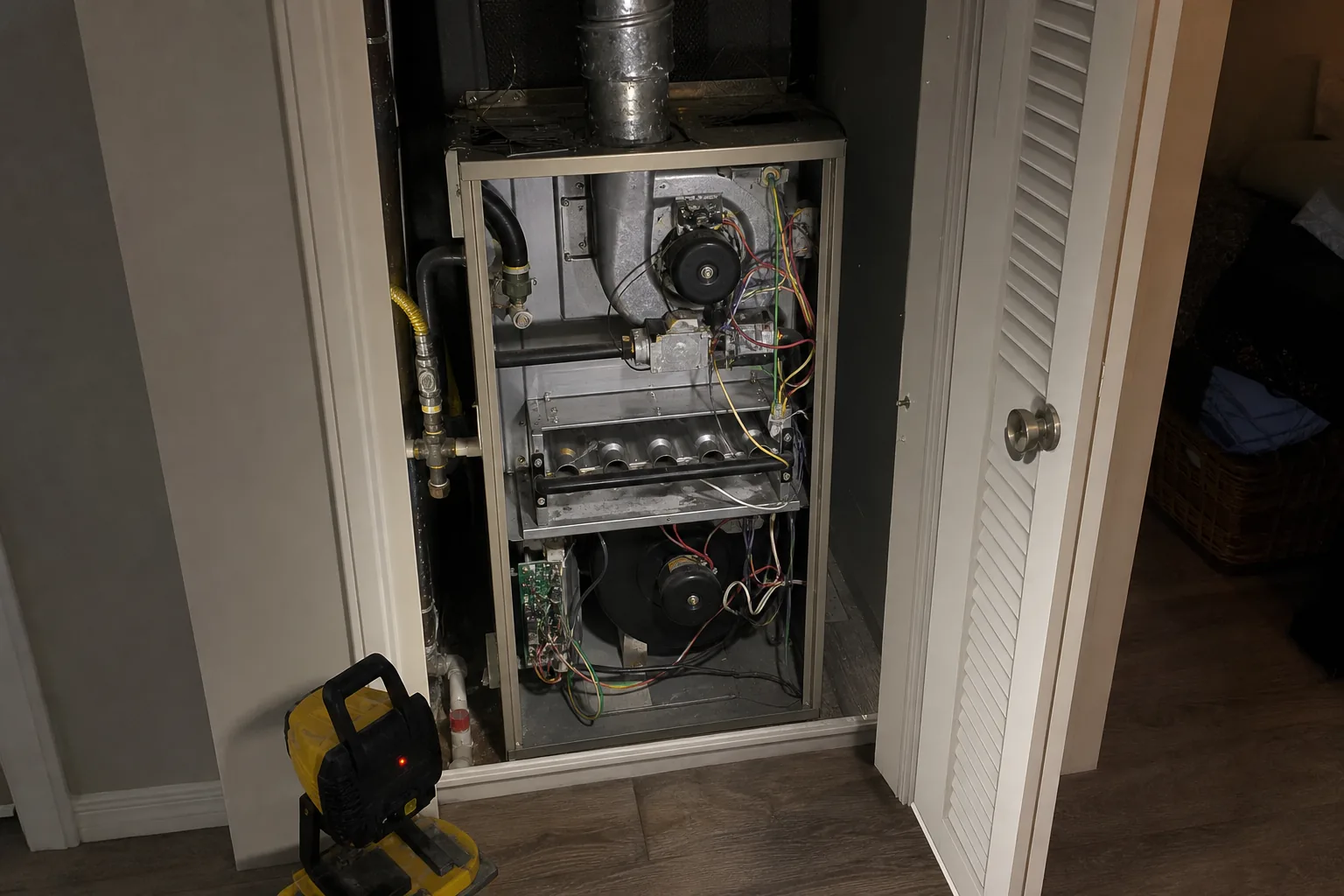
The Elberta 11 PM Service Call: What an Honest Tech Will and Won't Try
The Elberta 11 PM service call: the short menu worth attempting after dark, the longer list that should wait for daylight, and why the do-everything tech is a flag.
Published 2026-09-29 · Updated 2026-09-29
Author: Landon Jahnke | ACExperts251
Reviewed by: Landon Jahnke · Owner · Alabama HVAC License AL #16117 · EPA 608 Certified
Late-night cooling failures look more frightening than they usually are, and a clear-eyed tech can talk most of them down to "stabilize until daylight." The line between what's worth trying after 11 PM and what should wait for morning is sharper than most homeowners realize.
Over 13 years working Baldwin County HVAC, I've spent enough late nights at customer houses — and one or two at my own — to learn what a short list of useful after-hours moves looks like, and a much longer list of things the tech who shows up at 11 PM should not be trying.
Here's the line, in detail, for an Elberta service call after dark.
What I will try after hours in Elberta
Things that have a real chance of fixing the failure with parts on the truck and that don't risk damaging the equipment.
Capacitor swap. Failed capacitors are the single most common after-hours failure mode in Baldwin County. Symptom: outdoor compressor hums but the fan doesn't spin, or the fan spins slowly and the compressor cycles on and off. The part is on the truck, the swap is 15 minutes, and the system runs normally afterward. A meaningful share of after-hours calls in coastal Baldwin County resolve this way.
Contactor swap. Symptom: outdoor unit completely silent when the thermostat calls for cooling, or contactor stuck closed and unit running constantly. The contactor is a small relay that sends 240V to the compressor on signal from the thermostat. Failure is usually pitting from arc damage or a stuck plunger. Part on the truck, swap is 20 minutes, system runs normally afterward.
Thermostat replacement. Symptom: thermostat showing wrong room temperature, dead screen, or call-for-cooling that the equipment isn't receiving. I carry generic replacement thermostats — Honeywell T4, Emerson Sensi — that cover most residential applications. A swap is 30 minutes including pulling the old thermostat, transferring wires, and configuring system type. Won't help on every thermostat-symptom call (sometimes the issue is the control board on the air handler, which means a daytime visit), but worth trying when the indicators point that way.
Condensate drain clear. Symptom: indoor unit running but blowing warm air, water pooling around the air handler, float switch shutting the system down on safety. A wet-vac at the condensate line termination outside the house clears the line in 90 seconds, the float switch resets, and the system runs again. Common in Elberta homes near the marshy areas off Pine Beach Road during humid stretches.
Tripped breaker reset (with diagnosis first). Symptom: outdoor unit silent, breaker tripped at the panel. I will not just reset the breaker. I'll first measure compressor windings, capacitor microfarad, and contactor function to confirm the breaker tripped due to a transient surge and not a developing short. If everything tests clean, reset the breaker, run the system, watch a full cycle. If anything tests questionable, defer to morning rather than risk a compressor short circuit on the breaker reset.
Float switch reset. Symptom: indoor unit completely off despite thermostat call, condensate pan dry. Sometimes the float switch sticks in the high position even after the pan drains. A finger tap on the float switch — combined with a clean condensate line — resolves it. Two-minute fix when it's that.
Filter replacement. Symptom: high static pressure tripping the equipment, severely restricted airflow, frozen evaporator coil that's now thawed. I carry common filter sizes on the truck and will swap a clogged filter on any after-hours call where filter condition is contributing to the failure mode.
That's the list. Seven categories, all parts on the truck, all repairs that take less than 45 minutes start to finish, all failure modes that have clean diagnostic indicators.
What I will not try after hours in Elberta
Things that either require parts I don't carry on the truck, or that risk damaging the equipment if attempted with insufficient diagnostic time, or that need daylight conditions to do correctly.
Compressor replacement. No truck carries spare compressors. A residential scroll compressor weighs 70+ pounds and requires brazing on the discharge and suction lines, refrigerant recovery beforehand, evacuation to 500 microns afterward, and a recharge. The job is several hours of careful work, none of which happens late at night. If the diagnosis is a failed compressor, the answer is "I can confirm what's wrong tonight; I'll be back in the morning with the part."
Evaporator coil replacement. Same reasoning. A residential evaporator coil is a several-hour job, requires brazing and evacuation, and the supply houses don't stock every coil for every system. Some coils ship from regional warehouses on next-day delivery. Not a midnight repair.
Refrigerant leak repair. Leaks happen at brazed joints, at Schrader valve cores, at evaporator coil U-bends, and at flare connections on line sets. Finding the leak requires either electronic leak detection (which requires the system to be holding pressure) or UV dye injection followed by inspection in daylight with a UV flashlight. Repairing a found leak requires brazing, which requires nitrogen purge to prevent oxidation inside the lines. None of that is good late-night work.
Refrigerant top-off without leak diagnosis. This one matters. A system that's low on refrigerant has a leak. Period. R-410A and R-454B and the older R-22 don't evaporate, don't get consumed by normal operation, don't degrade. If the system is low, refrigerant is escaping. Topping it off without finding the leak is throwing money at a problem that will recur in weeks or months. I will not top off refrigerant without a leak diagnosis. Honest contractors don't, and the ones who do are pulling a padding mechanic that the customer pays for again on the next service call.
Major control board replacement. Air handler control boards and outdoor defrost boards exist in dozens of variants by manufacturer and model year. The truck inventory covers a handful of the most common. If the diagnosis is a failed board on a less common model, the answer is "I'll order it in the morning."
Blower motor replacement on uncommon configurations. PSC blower motors I carry. ECM modules I carry a few. Specific Carrier or Trane variable-speed motors with proprietary control connections — those are next-day parts. I'll diagnose after dark and stage the repair for morning rather than try to make a non-matching motor work.
Anything that requires lockout-tagout in a finished crawl space. Crawl spaces in older Elberta farmhouses sometimes have HVAC equipment and sometimes have surprises — wasps, snakes, standing water from recent rain, wiring that's been compromised by rodents. None of those are diagnosed safely with a flashlight at midnight. If the failure mode points to crawl-space equipment, the answer is daylight.
Any new install or major modification. If the call escalates from a repair to "this system is beyond repair, you need a replacement" — I'll explain that conclusion, talk through stabilization for the night, and schedule a daytime appointment for the replacement consultation. Replacement estimates are free. I will not sell a system after hours. The customer who's hot and frustrated and not at their decision-making best is the customer who deserves a daylight conversation, not a midnight signature on a multi-thousand-dollar install agreement.
What I will do regardless of the diagnosis
Three things that are part of every after-hours call no matter what.
Show up in a marked truck with photo ID. A homeowner letting a stranger into their home after dark deserves to know who they're letting in. I arrive in a marked vehicle and you'll know who's coming.
Explain the diagnosis in plain language. If the issue is a capacitor, I'll show you the part, explain what it does (stores energy to give the compressor and fan motor enough torque to start), and show you the multimeter reading on the failed unit versus the spec range. If the issue is something I can't fix tonight, I'll explain why, what the next steps are, and what to expect on tomorrow's visit.
Give a written quote before any work. Even after hours. The estimate goes on a phone screen if not on paper, customer signs off, work proceeds. No verbal-only agreements. No "we'll figure out the price afterward." Same standard at noon on a Tuesday.
What you can do before I arrive
If you've called and I'm 35 minutes out, here's how to use the time.
Set the thermostat to 78 if it's currently lower. A smaller temperature gap reduces load on the equipment if it's still partially functional, and it stops the system from short-cycling on whatever fault state it's in. If the system is completely dead, this doesn't matter, but it doesn't hurt.
Run all available fans. Ceiling fans, box fans, oscillating fans. Air movement at 78 feels like 74. Air movement matters more than temperature for short-term comfort.
Close blinds on west and south windows. Late-day radiant heat through west-facing glass holds longer than people expect. Cutting that gain stabilizes the indoor temp faster than anything else you can do passively.
Identify the equipment. Walk to the outdoor unit and check whether it's running, silent, or making a hum without the fan spinning. Walk to the indoor air handler — usually in the attic or a closet — and check whether the blower is running. These three observations let me prioritize what to bring up first when I arrive.
Pull a flashlight on the thermostat and read the screen. Some thermostats display fault codes when the equipment is in lockout. "Check Filter," "AUX Heat Fault," "Fan Limit Switch Open" — any of those tell me something about the failure mode before I ever step on site.
A note on Elberta and rural drive times
Elberta sits a decent stretch from most of the coastal routing across Baldwin County. After-hours dispatch to Elberta means I'm on the road for 35 to 50 minutes before I'm at your door, and sometimes longer if a Friday night beach return or a road incident on Highway 98 is in play. Tell me the household composition when you call — infants, elderly, anyone with cardiovascular conditions or oxygen — so I can route accordingly. Emergency hours run 24/7, every day, including Saturdays at no extra charge. For a true emergency I'll head out; for a failure that can safely wait for daylight, the right answer is often phone stabilization and a next-day visit, and I'll tell you straight which kind of call this is.
The whole reason this post exists is that the menu of useful late-night fixes is short, the menu of things-not-to-try is long, and the honest answer most of the time is stabilization until daylight. A homeowner who sleeps with windows open and a box fan on for one night, then has the capacitor replaced by 8:15 the next morning, comes out better than the one who gets a $1,000 invoice for work that didn't actually need to happen at midnight.
Call 251-383-HVAC. Same diagnosis, same honest approach, day or evening.
FAQ
- Does ACExperts take after-hours emergency calls in Elberta?
- Regular hours are Monday-Saturday 8am-6pm. Emergency calls are answered 24/7, every day, including Saturdays, with no Saturday upcharge. The number rings directly to me. For a true emergency (no cooling with infants, elderly, or medically vulnerable occupants; no heat in cold weather; smoke or burning smells; water damage in progress), call and I'll come out — day or night. For a failure that can safely wait, the right answer is often to talk through stabilization steps over the phone and set a daylight visit, especially when a part isn't on the truck — and I'll tell you straight which kind of call this is.
- If the tech says 'I can't fix this until morning,' is that honest or are they trying to upsell a daytime call?
- Almost always honest, especially for parts not on truck. Standard truck inventory covers capacitors, contactors, thermostats, common control boards, condensate pumps, and a limited selection of fan motors. It does not cover compressors, evaporator coils, refrigerant leak repairs requiring brazing, or specialty parts for older equipment. A tech telling you 'this needs a part I'd have to order' is being honest — the alternative is a botched repair late at night with whatever's on the truck, which costs you more in the long run.
- What can I do before the tech arrives or before morning?
- Three things help in most cases. First, set the thermostat to 78 if it's currently lower — a smaller temperature gap reduces the load on damaged equipment. Second, run ceiling fans and box fans aggressively; air movement at 78 feels like 74. Third, close blinds on west and south-facing windows to cut radiant heat gain. If the home is occupied by infants, elderly, or anyone with cardiovascular conditions, tell us the household composition when you call so I can prioritize accordingly.
- What does the service fee look like for an emergency call?
- The $79 service fee covers the diagnostic visit. Any repair work gets quoted in writing on the spot before I do it. Emergency calls, every day including Saturdays, carry no Saturday upcharge. Whatever the repair runs is written into the quote you sign — no 'we'll figure out the price afterward.' Comfort Plan members ($20/month or $240/year) get $0 service fees and no overtime fees as part of the plan.
Need this handled?
Straight to the service page for your town — pricing, local details and a form that reaches a technician.
More from 2am Quit

ACExperts HVAC
We Take The Heat So You Don't Have To
Fast, honest heating and air service across Baldwin County. Speak with a technician and get on the schedule today.