
Why Bay Minette Allergy Symptoms Spike in March — It's the Coil
Allergy-driven HVAC calls in Bay Minette spike in March. Most aren't a filter problem — they're a coil problem. What to look for and how to fix it.
Published 2026-03-09 · Updated 2026-03-09
Author: Landon Jahnke | ACExperts251
Reviewed by: Landon Jahnke · Owner · Alabama HVAC License AL #16117 · EPA 608 Certified
Allergy-driven HVAC service requests in Bay Minette spike hard every March. Over 13 years working Baldwin County HVAC, the pattern has been consistent: most of those calls aren't a filter problem. They're a coil problem. The headline is simple — by the second week of March, the indoor coil is the dominant IAQ problem in north Baldwin homes that haven't had a proper maintenance pass in two-plus years. Bay Minette has a lot of those homes.
What "allergy-driven" calls actually look like inside the air handler
The intake conversation usually goes the same way. The homeowner is sneezing more indoors than outdoors, the symptoms get worse when the blower kicks on, and the supply registers smell faintly musty when you put your nose to one. They call expecting a filter recommendation. The diagnostic finds something different.
The breakdown of root causes on March IAQ calls in this area, in rough order of frequency:
- Visibly contaminated indoor coils — biofilm, dust mat, pollen residue caked into the fin pack. By far the most common.
- Clean coils but contaminated air handler interiors — blower wheel, drain pan, secondary insulation.
- Duct contamination — usually a return duct in an attic that has developed a tear or lost insulation.
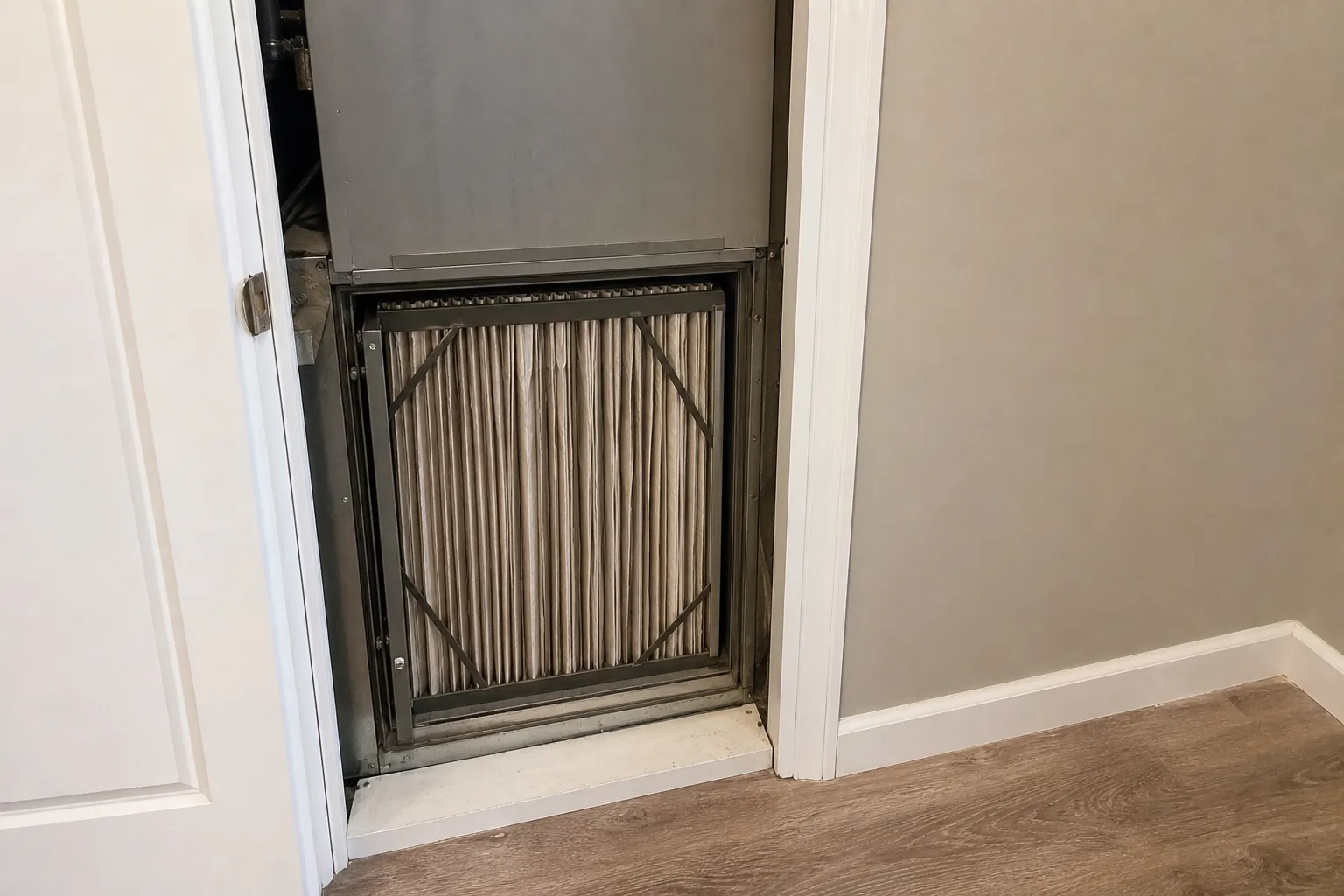
- Legitimate filter-only problems — filter overdue, wrong MERV, or filter installed backward.
The first two — coil-side problems — are the bulk of what shows up in March. Filter changes alone wouldn't have helped any of them.
Here's the part that matters for homeowners trying to figure out whether this applies to them: the systems with the worst coils are not always the oldest systems. The worst contamination tends to show up in homes 8 to 14 years old that have skipped maintenance for the prior 3 to 5 years. Older systems often run cleaner because the homeowners on them know they're running borrowed time and pay attention. The middle-aged systems get neglected.
Why coastal Alabama oak pollen specifically is the culprit
Oak is the worst allergen-producing tree in the southeast and Bay Minette sits in the middle of an oak canopy that runs from Stockton south through Stapleton and into the residential streets around the courthouse square. The neighborhoods around Lakeview, Aubrey Estates, Hidden Cove, Wilkins Creek, and Old Town Bay Minette all have heavy mature oak coverage. Pecan, sweetgum, and pine pile on, but oak is the headline.
Oak pollen has two properties that matter for HVAC. First: the grain is small. About 30 microns. That's small enough to slip through a standard MERV 8 filter without much trouble — most MERV 8s are rated to capture 70-85% of particles in that size range, which means 15-30% of the pollen drifting past your filter ends up downstream. Second: oak pollen is sticky. It's coated in a protein-lipid mix designed to adhere to whatever it lands on, which is why your truck looks yellow in March even after a rain. That same stickiness makes it adhere to the wet evaporator coil during cooling cycles.
Coastal Alabama oak pollen peaks the second and third weeks of March and tails off through the first week of April. By the time you've started running the AC for daytime cooling — which in Bay Minette typically happens by mid-March on the warm afternoons — the coil has already been collecting two weeks of oak pollen, riding the airflow through the filter gap. Add condensation from cooling cycles, add residual biofilm from the previous year, and the coil is now a feeding substrate.
Every cycle, the blower kicks on, air passes over the contaminated coil, and biological residue gets aerosolized and pushed back into the supply ducts. Homeowners describe this as "my allergies are worse inside than outside." That's exactly what's happening.
Three patterns that show up repeatedly
The same three failure shapes repeat across north-Baldwin homes every March:
The 2011-era heavily-fouled coil. Single-story 2,000+ sq ft home, original equipment, no maintenance for several years. The complaint is usually a spouse waking up with sinus pressure that disappears on weekends away. The coil looks like a green felt pad — biofilm grown thick enough to bridge the fin spacing, dust embedded throughout, faint yellow oak pollen residue on the upstream face. The blower wheel typically has similar buildup. Resolution requires a full pull-and-clean — not a surface spray.
The drainage-and-insulation cascade. A four-to-eight-year-old retrofit gas-pack with a teenage occupant whose asthma has been creeping worse over two springs. Coil is moderately fouled. The bigger find is usually a secondary drain pan with standing water year-round because the slope is off, and insulation around the air handler that's wet and mildewed. Coil clean plus drainage correction plus insulation replacement is the right scope. Symptoms don't always fully resolve, but rescue-inhaler usage typically drops noticeably.
The compromised return duct. 1960s-era ranch with a more recent retrofit, original ductwork in the attic. Homeowner is having trouble sleeping with the system running. Coil is only mildly dirty — but the return duct in the attic has a tear at a sheet-metal seam, and the duct is pulling unconditioned attic air past disturbed insulation every time the blower runs. Sealing the duct and replacing the disturbed insulation in the immediate area is the fix.
The pattern across all three: the homeowner has been treating the symptom from outside the system. The fix is always inside the system.
Why Bay Minette specifically is different from Daphne or Fairhope
Two things make north Baldwin a different IAQ profile than the bay-front cities.
First, the air is drier. Bay Minette sits 25 miles inland from Mobile Bay. Indoor humidity in the cooling season runs lower than in Daphne homes. Dry air sounds like it should help — and for some IAQ issues it does — but for biofilm specifically, the lower humidity means the coil never quite gets clean during a cycle. In a more humid bay-front home, condensation rinses the upstream face of the coil with every cooling cycle. In a drier inland home, dust and pollen accumulate more readily because the rinse cycle is weaker.
Second, the housing stock is older with retrofit ductwork. The neighborhoods around Bay Minette have a lot of homes from the 1960s and 70s that had central AC added in the 80s through ductwork installed in attics or crawl spaces with whatever clearances existed. Forty years later, that ductwork has often shrunk at joints, lost sections of insulation, or been compromised by rodents. Duct-side contamination shows up more here than in most parts of Baldwin County, and it's most visible in March when the system starts running heavily again after a quiet winter.
Both factors push the same direction: by March in Bay Minette, the coil and the duct system are loaded with last year's residue, and the first heavy cooling cycles of the year aerosolize it.
What changes when homeowners actually act
The reliable pattern when the coil is the actual problem: a proper coil cleaning resolves or substantially improves the indoor allergy symptoms within a week. Filter upgrades alone, without coil work, don't move the needle. Duct sealing alone, without coil work, helps some homeowners but not most. Coil cleaning is the primary lever in nearly every successful resolution.
The cases where coil cleaning doesn't fully resolve symptoms usually turn out to have actual allergic triggers unrelated to the HVAC system — a new pet, an adjacent renovation, a recent landscaping change that brought new exposure into the home.
What to do if this is your March
If you're reading this in mid-March and your symptoms match the pattern — worse indoors than out, worse when the fan runs, faint smell at the supply registers — here's the order to work through:
-
Don't start with a filter change. Change the filter, sure, but don't expect that alone to fix anything if the coil is loaded. You'll get a few days of marginal improvement and the symptoms will return.
-
Book a diagnostic visit. ACExperts charges a flat $79 service fee. The visit covers a borescope of the coil, inspection of the air handler interior, return-ductwork check, and a written quote with photos before any work starts. Free second opinions on quoted repairs.
-
Have the coil cleaned if it needs it. Standard cleaning vs heavier pull-and-clean depends on how loaded the coil is. Both options get quoted before any work begins.
-
Get on a maintenance cadence after. Two visits per year — spring and fall — keeps the coil from getting back to where you started. The Comfort Plan ($20/month or $240/year) covers both visits plus 10% off repairs and $0 service fees.
For homeowners in Lillian, Stapleton, and Stockton — the same logic applies. The neighborhoods are different, the canopy is similar, and the coil-loaded-by-March pattern doesn't really care about the city line.
Two cluster posts worth reading alongside this one: the Daphne three-step IAQ reset walks through the same problem on a tighter coastal envelope, and the Fairhope spring pollen post covers the historic-home wrinkle that makes some Fairhope houses behave differently. The Magnolia Springs early-catch story covers what catching this early looks like in practice.
What a March IAQ visit covers, for context
A proper IAQ diagnostic starts with conversation: what the symptoms are, when they started, when they're worst, who in the household has them, and what's changed in the home recently. That conversation is where most of the diagnostic work happens.
Then the equipment side. Filter check first. Return grille off and look upstream into the duct. Coil access cover off — either visual inspection or borescope. Blower compartment opened. Drain pan checked for standing water and microbial growth. Combustion analyzer if it's gas-fired. Static pressure measured if duct or filter restriction is suspected. Indoor humidity logged at multiple points.
The output: photos of what's found, a written quote before any work begins, and an explanation in plain language of what each line item is and why it matters. If the answer is "your coil is fine, change the filter monthly, you're done," that's the answer — and the $79 service fee is the only charge.
Bay Minette in March surfaces this problem reliably every year because the canopy, the housing stock, and the maintenance gaps line up the same way. The good news is the fix is reliable. The bad news is the system won't fix itself, and the symptoms will keep coming back every March until somebody opens the cabinet and addresses the coil.
FAQ
- If pollen is the trigger, why isn't a better filter the fix?
- A better filter helps — but the filter sits upstream of the coil, and what shows up in Bay Minette homes by March is biofilm growing on the coil itself, downstream of any filter you put in. That biofilm holds last year's oak pollen residue and feeds it back into the air every time the blower kicks on. You can't filter your way out of contamination that's living past the filter. The fix is cleaning the coil. The prevention is annual maintenance plus the right filter cadence.
- How do I know if my coil is the problem versus an actual pollen exposure?
- Three tells. First, your symptoms are worse indoors than outdoors — opposite of what you'd expect with seasonal pollen. Second, symptoms get worse when the system fan kicks on, not just from the outdoor air. Third, the supply registers smell faintly musty when you put your nose to one. Any two of those and the coil is in play. A borescope on the coil access plate during a diagnostic visit confirms it visually.
- How often is coil cleaning needed in Bay Minette?
- Most Bay Minette homes need a coil cleaning every 2 to 3 years, more often if pets, smokers, or proximity to heavy oak canopy. Heavily loaded coils — the kind that show up in March on systems that haven't been maintained in 5+ years — sometimes need a full pull-and-clean. ACExperts charges a flat $79 service fee on diagnostics and gives free estimates on replacements; coil-cleaning quotes come before any work starts.
- Should I just upgrade to a higher MERV filter and skip the coil work?
- No, because the contamination is already past the filter. Higher MERV filters help going forward — but only if a tech has measured static pressure and confirmed the blower can handle it. On older Bay Minette retrofit systems, jumping from MERV 8 to MERV 13 without checking can starve airflow and freeze the coil. Coil cleaning first, then filter strategy is the right order.
Need this handled?
Straight to the service page for your town — pricing, local details and a form that reaches a technician.
More from Spring Pollen

ACExperts HVAC
We Take The Heat So You Don't Have To
Fast, honest heating and air service across Baldwin County. Speak with a technician and get on the schedule today.