
How Magnolia Springs Homeowners Catch Spring Pollen HVAC Issues Early
An over-the-shoulder Magnolia Springs March IAQ walkthrough — what we check before the equipment, and why week two of pollen costs less than week six.
Published 2026-03-19 · Updated 2026-03-19
Author: Landon Jahnke | ACExperts251
Reviewed by: Landon Jahnke · Owner · Alabama HVAC License AL #16117 · EPA 608 Certified
When a Magnolia Springs homeowner calls and says "my AC is making my allergies worse," the first thing I do is ignore the air conditioner. I look at the wall calendar. I ask if they've opened windows. The first three things I check on a March IAQ call have nothing to do with the equipment, and that's the right place to start.
Over 13 years working Baldwin County HVAC, I've learned the diagnostic structure is the part homeowners rarely see, and it's where the real value of the call lives. Here's how an early-catch March IAQ visit typically unfolds in a Magnolia Springs cottage.
The phone conversation: what we ask before scheduling
Before booking the appointment, four questions matter most:
- When did the symptoms start, and were you running the AC, the heat, or neither?
- Are symptoms worse indoors or outdoors?
- Have you opened windows in the last two weeks?
- Has anything physically changed in the house — new furniture, a renovation, a pet, a guest, a leak?
A typical answer pattern on an early-March call: symptoms started a handful of days ago, system had been cycling between heat and AC depending on the day. Symptoms worse indoors. Windows had been open most of the prior weekend because the weather was beautiful. Nothing else changed.
That's enough to walk into the appointment with a working hypothesis: a windows-open weekend let outdoor pollen settle on every horizontal surface in the house, the system then circulated it through the indoor coil during the next round of cooling cycles, and we're now looking at either a coil-side contamination problem or — given the timeline — possibly a problem still mostly in the room dust that would respond to a heavy cleaning plus a filter change.
Those two scenarios have very different costs. The questions narrow the diagnostic search before I ever get in the truck.
Step one: ignore the air conditioner
When I arrive, I introduce myself, sit at the kitchen table, and ask the homeowner to walk me through what they've observed. Not the symptoms — those I already have from the phone call. The observations.
The Magnolia Springs homeowners I work with tend to pay attention to their houses. The observations that matter: a faint dusty smell when the system fan kicks on. A thin yellow film on a dining table that wiped off easily. A pet sneezing more than usual. Sinus pressure or watery eyes worst in the rooms with the largest supply registers.
That's a complete diagnostic before I touch a panel. The yellow film is oak pollen settled out of the air during the windows-open period. The dusty smell when the fan kicks on is that pollen being aerosolized as the system runs. The rooms with high-flow supply registers being worst is consistent with those registers moving the most air past whatever the indoor coil is now coated with.
That kitchen-table conversation — ten minutes, no tools — is the most valuable part of the visit. Skipping it would mean walking to the coil, finding something, but missing the cause. I'd recommend coil cleaning, the homeowner would pay for coil cleaning, and three weeks later when they opened the windows again on a beautiful April afternoon they'd be back where they started.
Step two: look at the wall calendar
Magnolia Springs sits in the heaviest oak canopy in the county. Every neighborhood — Magnolia River corridor, Riverside Drive, Magnolia Springs Historic District — runs under mature live oaks and water oaks. Coastal Alabama oak pollen peaks in the second and third weeks of March.
The calendar tells me which version of this house I'm walking into. If the homeowner called within a week of the windows-open weekend, the contamination is fresh and mostly on the coil's upstream face. If they called six weeks later, the math changes meaningfully — every-cycle aerosolization with the higher river-driven humidity feeding biofilm growth on whatever organic material has landed on the coil. The blower wheel is also dirty. The secondary insulation in the air handler may be starting to mildew.
Step three: ask about windows
I ask explicitly: had they opened windows during the windows-open weekend, and how widely. The answer that matters is the obvious one — most of the windows in the house, both for the morning hours and again in the evening when it cooled off. Doors to a porch open for several hours during garden time.
That confirms a heavy dose of outdoor pollen settling indoors over a couple of days. A tight-built historic envelope (renovated cottages often have appropriate vapor barriers and tighter window installations) holds that pollen inside instead of letting it disperse the way an older leakier cottage would.
This is the Magnolia Springs paradox: the historic cottages here are often more carefully air-sealed than newer construction in Daphne or Fairhope because the renovations were done thoughtfully by owners who cared about the houses. That tightness is a feature in winter and most of the year. In windows-open pollen weekends, it works against you.
Step four (now we look at the equipment)
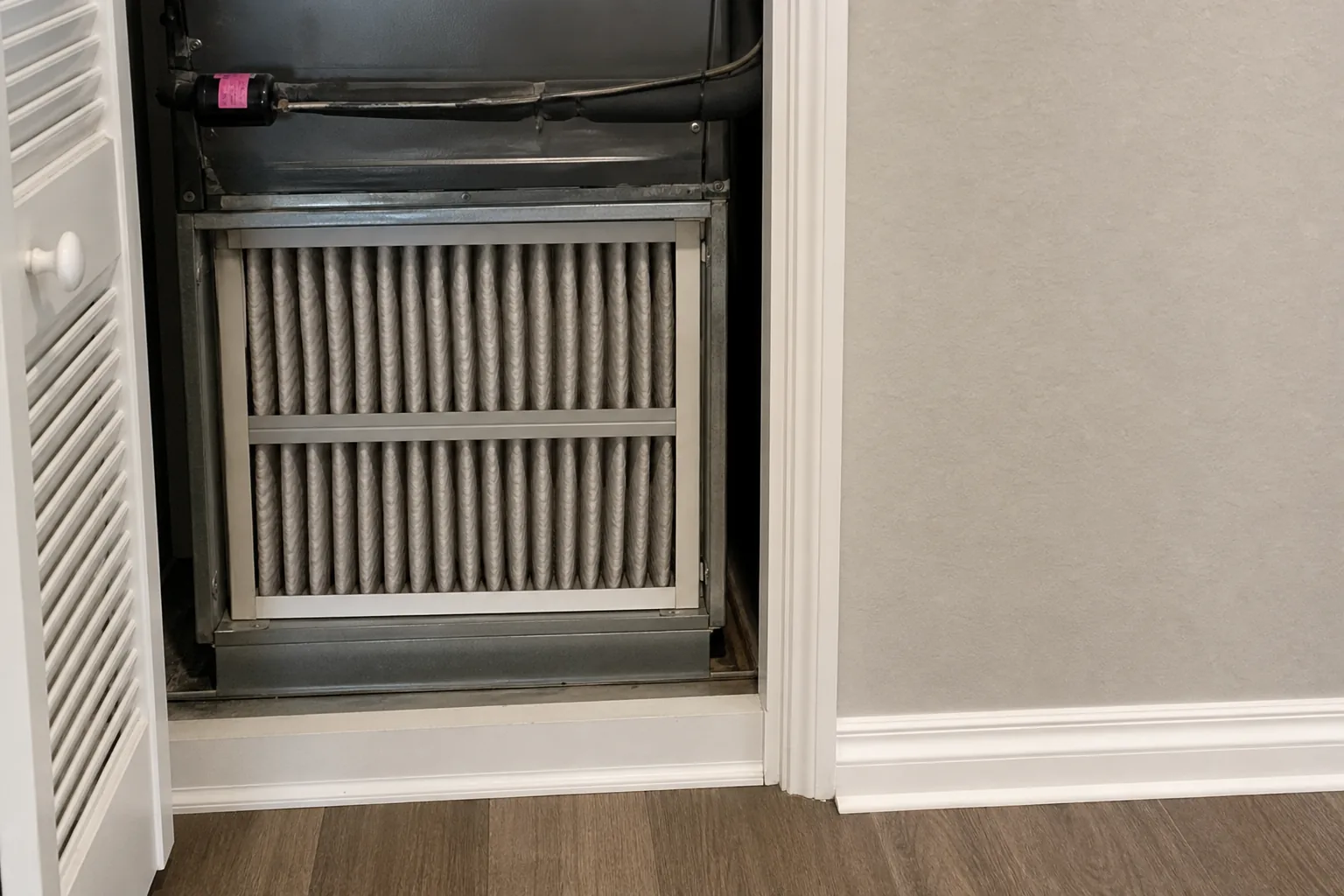
The air handler in a cottage retrofit is often in a closet off a back hall. Access is tight — usually about 18 inches of clearance on the working side, enough for diagnostic work but not for a comfortable coil cleaning without pulling a panel.
I pull the filter first. If it's loaded with yellow-tinged dust on the upstream face, I replace it before doing anything else, because I don't want pollen continuing to migrate downstream while I work.
Borescope the coil through the access plate. A moderately fouled coil at this point in the season looks like a light yellow film on the upstream face — that's recent oak pollen — sitting on top of a thin gray-green base layer of older biofilm from the previous summer's cooling season. The fin pack is usually still mostly clear.
Check the blower wheel, the drain pan, the secondary insulation in the air handler. In the best-case version of the call, the contamination is fresh, mostly on the coil's upstream face, with no spread into the air handler interior or the duct system.
Why early catch matters here
The economic gap between catching this in week one and catching it in week six is real. The behavioral gap is small — pay attention and call when symptoms appear, instead of waiting to see if it will pass.
A few things worth taking from a typical visit:
The historic-cottage tightness works for you and against you. Renovated historic homes in Magnolia Springs are often well-sealed by Baldwin County standards. That's mostly a feature. In a windows-open pollen weekend, it becomes a liability — the pollen comes in fast and settles slowly. Plan accordingly.
The river humidity changes the timeline. Biofilm grows faster here than in inland cities like Stockton because the year-round indoor humidity loads stay higher.
Catch it early or pay more later. If you notice a dusty smell from a supply register, a faint film on horizontal surfaces, or unexplained sinus symptoms during March, the call to make is a diagnostic — not a $20 filter change you hope will fix it.
Closing windows during peak pollen weekends is a real lever. Magnolia Springs in mid-March is beautiful and the temptation to throw open the porch doors is strong. The bedroom can stay open for sleep if you want; the whole-house pollen ingress that does the damage is during daytime hours when wind is moving through the house.
What we do on a Magnolia Springs IAQ diagnostic visit
We allocate extra time because the cottages here take longer to walk and the equipment access rarely lines up the way it does in newer subdivisions. We spend the first 10-15 minutes at the kitchen table or the living room, asking the questions above plus follow-ups based on what we see. We look at the equipment second, not first.
We borescope the coil rather than relying on a flashlight through the access hole, because we want photos that go to your file and that we can show you. We measure static pressure before recommending any filter upgrades. If the answer is "your coil is fine, change the filter, you're done," we tell you that — and the $79 service fee is the only invoice.
If we find work to do, we quote with photos before we touch anything. The full menu lives on the indoor air quality service page. For homeowners who want to plan ahead instead of reacting, the Comfort Plan is designed around the spring-fall cadence that prevents the March compounding described above.
Pay attention to your house. It's telling you what it needs.
FAQ
- Why does the diagnostic start with questions instead of looking at the equipment?
- Because in March, the equipment is the symptom and the homeowner's habits are usually the diagnosis. When you walked through the house, when the fan kicked on, whether you opened windows last weekend, whether the dog has been on the couch — those answers shape what we look for in the cabinet. Walking straight to the air handler and skipping the conversation means we'll find something but might miss the actual cause.
- What's special about Magnolia Springs that makes early-catch matter more here?
- Three things. The river-driven humidity runs higher year-round than the rest of Baldwin County, so anything biological in the system grows faster. The dense oak canopy through the historic district loads the outdoor air with pollen heavier than inland north-Baldwin areas. And the housing stock is mostly historic cottages with retrofit HVAC, where access is tight and remediation work costs more once it's compounded.
- How can a homeowner tell whether their March symptoms are HVAC-related or just outdoor pollen?
- The cleanest test: spend a full day at the house with windows shut and the system off — read a book, take a nap, no fan running. If symptoms are better, the system is contributing. If symptoms are the same or worse, the issue is something in the house that isn't HVAC-driven.
- What does a Magnolia Springs IAQ diagnostic visit cost?
- Our $79 service fee covers the diagnostic. Coil cleaning cost depends on access and load — we quote with photos before we touch anything. The full menu lives on our indoor air quality and preventive maintenance pages.
Need this handled?
Straight to the service page for your town — pricing, local details and a form that reaches a technician.
More from Spring Pollen

ACExperts HVAC
We Take The Heat So You Don't Have To
Fast, honest heating and air service across Baldwin County. Speak with a technician and get on the schedule today.