
Summerdale Thanksgiving Heating Prep: Three Off-Season Failure Patterns to Catch Before the Holiday
Three off-season heating failures show up in Summerdale before Thanksgiving: gas valve debris, blower wheel imbalance, low-voltage corrosion. What to check first.
Published 2026-11-02 · Updated 2026-11-02
Author: Landon Jahnke | ACExperts251
Reviewed by: Landon Jahnke · Owner · Alabama HVAC License AL #16117 · EPA 608 Certified
Summerdale runs heat heavier than people expect. The town sits inland enough — about 11 miles north of the Gulf coast — that overnight lows in late November and December consistently hit the upper 30s and low 40s. Heating systems run sustained nightly cycles for 4-6 weeks of pre-Thanksgiving build-up before the holiday itself, which means equipment problems get a real workout before homeowners notice them.
Over 13 years working Baldwin County HVAC before founding ACExperts in 2026, three off-season failure patterns have shown up consistently on pre-Thanksgiving visits in this area. Each one is fixable cheaply if caught proactively, and each one is the kind of thing that ruins Thanksgiving morning if it's not.
Pattern 1: Gas valve debris
On gas furnaces specifically, debris accumulates at the gas valve seat during the off-season months — particulate that has settled out of the gas supply during the spring and summer when the valve sits closed. On first heating-season startup, the valve has to overcome the debris load to open fully.
The mechanism: gas supply lines carry trace amounts of pipe scale, oxidation, and sediment year-round. During heating season, gas flows continuously enough to keep the valve seat clean. During the long idle period (roughly May through October in Summerdale), the valve sits closed and trace debris settles onto the seat.
What it looks like in practice:
- System ignites correctly
- Burner runs for 30-90 seconds
- Flame appears slightly low or yellow-tipped
- System runs the full cycle but at reduced gas flow
- Heat exchanger does not reach full design temperature
- House never quite gets warm enough on demand
The homeowner's experience: "It's running but it's not really heating well." Easy to miss as a problem until it's the morning of the holiday and the house won't get above 64°F with a turkey in the oven and 14 people on the way.
Service action: shut off gas, disassemble valve, clean seat, verify clean operation, reassemble with new gasket if needed. Caught proactively, this is a quick fix. Caught during a holiday emergency, it's a same-day premium service call against a saturated schedule.
Pattern 2: Blower wheel imbalance
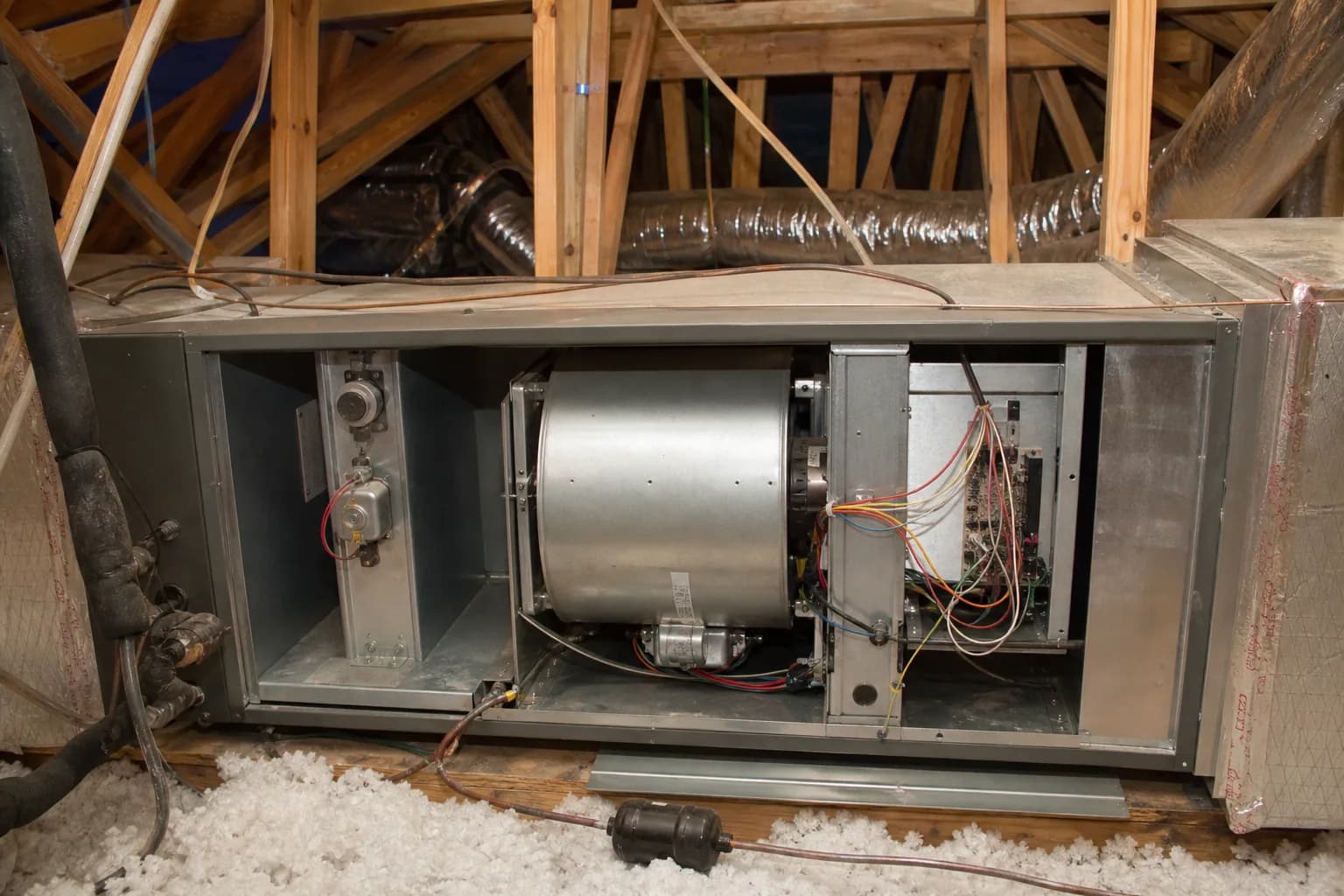
Blower wheels — the squirrel-cage fans inside the air handler that move conditioned air through the ductwork — arrive at fall season slightly out of balance, producing vibration that is either audible or is driving premature bearing wear on the motor.
The mechanism: blower wheels accumulate dust and debris on the curved blade surfaces during the year of operation. Cooling-season runtime puts moisture into the airstream, which combines with airborne dust to deposit a thin sticky film on the blade leading edges. That film accumulates unevenly across the blades — more on some blades than others — which throws the wheel out of rotational balance.
Out-of-balance wheels create three problems:
- Vibration transmitted through the air handler cabinet, audible as a low hum or rattle
- Increased load on the motor bearings, accelerating bearing wear
- Reduced supply CFM, which makes the heating cycle less effective and forces the system to run longer
What it looks like:
- Low-frequency hum or rumble during blower operation
- Vibration felt at supply registers (especially with hand on the metal grille)
- Supply air feels less forceful than it should
- System runs longer cycles to satisfy thermostat
Service action: disassemble blower assembly, clean wheel thoroughly with appropriate solvent, dynamically balance if needed, verify motor bearing health, reassemble. Catch it now and it's a clean job. Catch it after the motor bearing has failed from running on the imbalanced wheel for too long, and you're paying for a motor replacement on top.
Pattern 3: Low-voltage corrosion at thermostat sub-base
Less common than the first two but distinctive. The thermostat itself operates fine, but the low-voltage terminal connections at the sub-base (the plate that mounts to the wall behind the thermostat display) show visible corrosion that produces intermittent connection failures.
The mechanism: thermostat low-voltage wiring runs at 24V AC and carries trivial current under normal operation. The terminal screws that connect the wires to the sub-base have brass or aluminum contact surfaces that are vulnerable to oxidation in humid environments. Summerdale's summer humidity — with average dewpoints in the high 60s to low 70s for 5+ months of the year — creates ideal conditions for terminal oxidation during the off-season.
The result: terminals develop a fine layer of oxide that increases electrical resistance at the connection. The thermostat continues to register temperature and send signals, but the signals occasionally fail to reach the equipment cleanly. System ignores some heat calls, runs late on others, or short-cycles unpredictably.
What it looks like:
- Random heating cycles that don't match thermostat schedule
- Thermostat showing "Heat" but no equipment response for several minutes
- Inconsistent runtime patterns
- Occasional "stuck" heating that won't shut off
Service action: pull thermostat from sub-base, inspect terminals, clean with appropriate contact cleaner, re-tighten connections, verify all wires firmly seated. Trivial fix once identified, but easy to misdiagnose as a thermostat or control board problem if the technician isn't looking specifically at the terminal connections. Some homeowners I've worked with had already replaced the thermostat itself or even paid for a new control board trying to solve the problem — neither of which helps when the issue is at the wires.
What homeowners can check themselves before our visit
Three quick checks that flag the issues above before scheduling service:
Gas valve check (gas furnaces only): turn the heat on for the first time of the season. Watch the burner flame through the inspection window if your unit has one. A healthy flame is uniform blue across all burners, no yellow tips, lights crisply within 2-3 seconds of gas valve opening. A flame that is mostly blue with yellow tips, or that takes longer than 4-5 seconds to light, signals possible valve debris. Don't try to fix this yourself — gas work belongs with a licensed technician — but flag it on the service call.
Blower vibration check: with the system running on heat or fan-only, place your hand flat on a supply register grille (a metal one, ideally). Light vibration is normal. Distinct rumble or "buzz" you can feel through the metal is not normal — that's blower imbalance transmitting through the duct system.
Thermostat schedule check: if you have a programmable or smart thermostat, review the runtime history for the past 30 days. Patterns of cycles that don't match your programmed schedule, or cycles that started 5-15 minutes late from when commanded, suggest the low-voltage corrosion issue.
If any of those three flags appear, the maintenance visit is overdue.
What the prep visit actually covers
For Summerdale homeowners booking pre-Thanksgiving service through the heating repair service or heating installation line, the standard prep visit includes:
- Full burner and ignition system inspection (gas furnaces)
- Heat exchanger visual inspection where accessible
- Gas valve operation test and clean if indicated
- Blower assembly cleaning and balance verification
- Refrigerant cycle reversing test (heat pumps)
- Thermostat terminal cleaning and re-tightening
- Filter replacement
- Carbon monoxide check at supply registers
- Full-load runtime test (30-45 minutes at maximum demand)
- Written report with any identified issues and replacement recommendations
That last bullet — the full-load runtime test — is what separates a real prep visit from a generic tune-up. The system is forced to operate at sustained maximum demand for long enough to surface issues that only appear under load. The kind of issue that ruins Thanksgiving morning is almost always the kind that doesn't show up in a 5-minute initial-startup check.
What I'd tell a Summerdale neighbor
If a Summerdale neighbor asked me right now (early November) whether to call about heating service, the answer is yes — book it this week. The schedule fills toward the end of the month and the failures we'll find now are the ones the homeowner cannot afford to discover on Thanksgiving morning.
If they asked whether to skip the visit and "just hope" because the heater worked fine last March, the answer is no. Equipment that worked last winter is not necessarily equipment that will work this winter without intervention. Off-season conditions in Summerdale's climate produce predictable failures by November.
ACExperts is a one-truck shop — Landon Jahnke, AL #16117, 13 years of Baldwin County HVAC experience before founding the business in 2026. Service fee is $79. Comfort Plan members get the fall heating tune-up included as part of the annual maintenance schedule along with $0 service fees on repair calls. Call 251-383-HVAC or request a maintenance visit online and we'll get a Summerdale prep slot on the calendar before the schedule fills.
FAQ
- How early should I get my Summerdale heater checked before Thanksgiving?
- Schedule the visit by mid-October if at all possible — early November at the latest. By the second week of November the schedule fills with same-week emergency calls from homeowners whose heaters did not start up cleanly on the first cold morning, and proactive maintenance bookings get pushed into December. The whole point of pre-holiday maintenance is to find problems before they ruin Thanksgiving morning, which means scheduling far enough ahead that there is time to order parts if anything is found that needs replacement.
- If my heater worked fine last winter, do I really need a fall maintenance visit?
- Yes. Off-season conditions in the Baldwin County climate produce predictable failures by November. The failures I find at fall visits have usually developed during the off-season — corrosion at the thermostat low-voltage terminals during the humid summer months, debris settling in the gas valve from idle months, blower wheels going out of balance from accumulated film on the blade surfaces. Equipment that worked last winter is not necessarily equipment that will start clean this winter without inspection.
- Should I just replace my heater if it is older than 12 years?
- Not automatically. Heat exchangers, gas valves, and basic combustion components on a well-maintained gas furnace can run reliably for 18-25 years. The replacement decision should be driven by the specific equipment condition, the homeowner's operating cost trajectory, and the comparative pay-back math against replacement equipment. We document equipment condition during every fall maintenance visit and provide a written replacement-versus-repair recommendation. If your existing equipment is healthy and just needs annual service, we will tell you that. If it is failing and replacement makes financial sense, we will say that too — with the math to back it up. ACExperts offers free estimates on replacements.
- What is the difference between a tune-up and a Thanksgiving prep visit?
- A tune-up is the routine annual service: clean burners, check ignition, verify gas pressure, change filter, test thermostat. A Thanksgiving prep visit includes the tune-up but adds load-testing the system at full demand for an extended period — typically running heat at maximum continuous demand for 30-45 minutes — to surface problems that only appear under sustained load rather than initial startup. The kind of failure that ruins a holiday morning is usually the kind that does not show up in a 5-minute startup test.
Need this handled?
Straight to the service page for your town — pricing, local details and a form that reaches a technician.
More from Thanksgiving Prep

ACExperts HVAC
We Take The Heat So You Don't Have To
Fast, honest heating and air service across Baldwin County. Speak with a technician and get on the schedule today.