
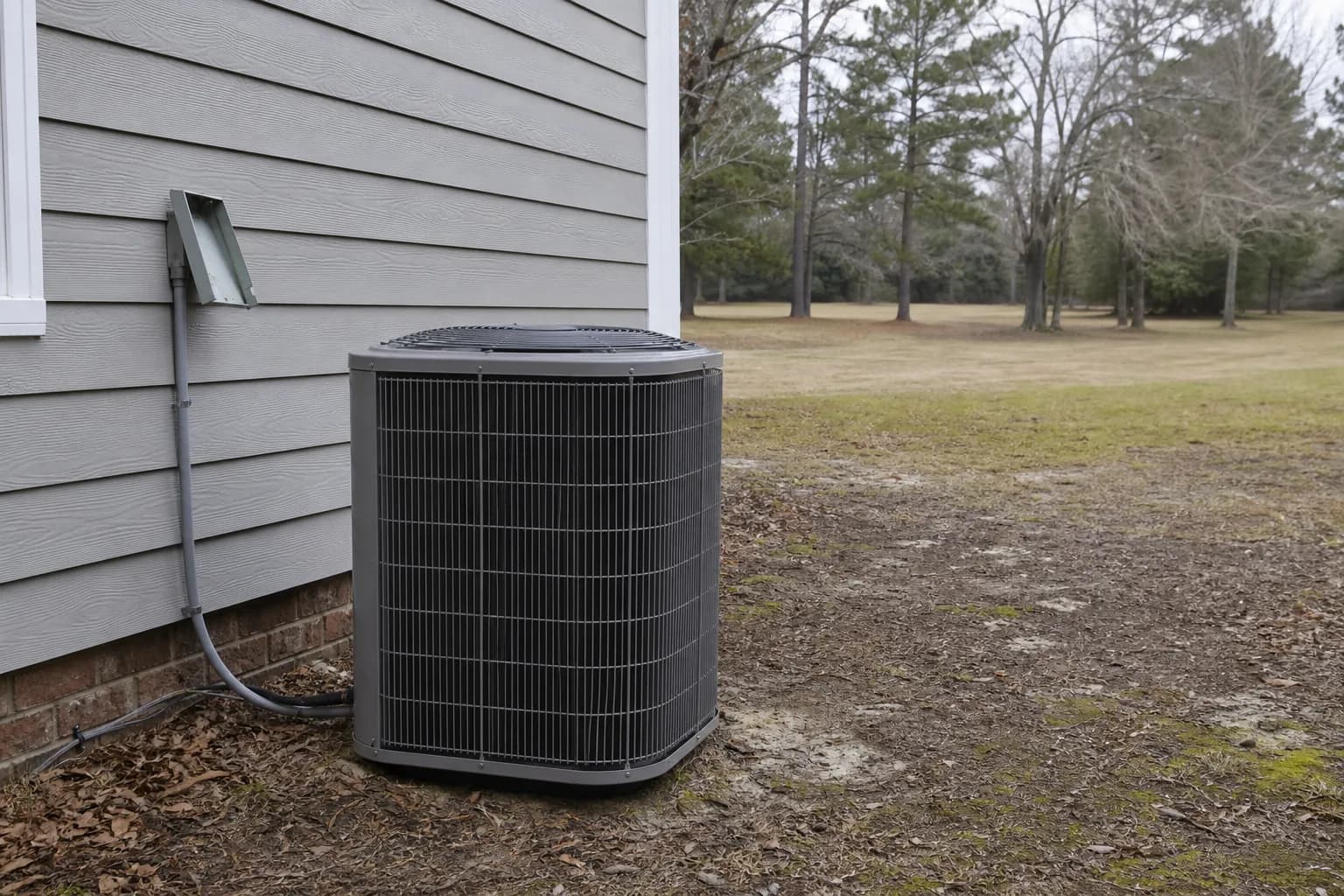
Why Summerdale Single-Stage Heat Pumps Fail in a Christmas Cold Snap
Single-stage heat pumps in Summerdale share a failure pattern during multi-day sub-freezing events. The design choice behind it and what to do first.
Published 2025-12-16 · Updated 2025-12-16
Author: Landon Jahnke | ACExperts251
Reviewed by: Landon Jahnke · Owner · Alabama HVAC License AL #16117 · EPA 608 Certified
The single most predictable cause of Christmas-week heat pump failure in Summerdale is a design choice the homeowner usually didn't realize they made when they bought the equipment: a single-stage compressor in a climate that occasionally needs much more graceful behavior than single-stage can deliver.
Over 13 years working Baldwin County HVAC, I've watched this pattern repeat across cold snaps. The same shape every time — single-stage units running flat-out for days against outdoor temps below their effective operating range, defrost cycles firing aggressively, components stressed at levels two-stage and variable-speed equipment would have absorbed. This post walks through why the pattern shows up, what fails first, and what to do before the next sub-freezing event lands.
Why Summerdale runs into this at all
Hard-freeze events that hit Baldwin County are rare but not exceptional. The historical pattern: a multi-day sub-freezing window every couple of winters where overnight lows drop into the high teens and daytime highs fail to climb above freezing. Summerdale, about twelve miles inland and with less coastal moderation than Fairhope or Daphne, runs a degree or two colder than the Eastern Shore during those events.
Standard residential HVAC sizing calculations for this climate use a 28-30°F design temperature. Equipment specified to that standard handles a 32°F night with margin to spare, but starts running into trouble around 20°F as the compressor is asked to extract heat from outdoor air that contains very little of it. Below 18°F most residential heat pumps simply cannot provide their nameplate capacity, and the auxiliary electric heat strips inside the air handler have to do the heavy lifting.
That's the underlying physics. Heat-pump failures during sub-freezing events split into roughly two timing groups: failures during the cold itself, when compressors run flat-out against outdoor temps below their effective operating range, and failures in the recovery week, when components that had been stressed during the event finally give up.
The common factor: single-stage compressors
Single-stage means the compressor has one operating mode: full capacity, on or off. When the thermostat calls for heat, the compressor runs at 100%. When the call is satisfied, it shuts off. There's no in-between. That works fine in mild weather where short, intermittent cycles match the load, and it works fine in summer cooling where Summerdale's hot afternoons keep the system running steadily anyway. It does not work fine in a multi-day sub-freezing event.
Two things go wrong with single-stage equipment under those conditions. First, the cycle pattern shifts from intermittent to nearly continuous, with very brief off-windows in which the system tries to satisfy a setpoint it can't actually reach. Second, the defrost cycle — the periodic reverse-valve operation that melts frost off the outdoor coil — fires more often as outdoor temperature drops and humidity stays in the band that produces frost on the coil. Each defrost cycle puts thermal and mechanical stress on the reversing valve, the compressor, and the suction-line components.
Two-stage and variable-speed compressors can run at reduced capacity during off-peak demand and ramp up only when needed. During a cold snap they spend most of their time at first-stage or low-speed, which means lower amp draw, lower mechanical stress, and longer compressor life over the lifetime of the unit. The cost premium at install is real — typically $1,200-$2,400 for a two-stage over an equivalent single-stage, and another $800-$1,500 for variable-speed over two-stage. In Summerdale's climate, the long-term operating-savings argument is mild — there isn't enough cold weather for the math to be dramatic — but the catastrophic-event survival argument is decisive.
Failure modes I've seen over the years
Three patterns repeat:
Compressor lock from sustained run. A single-stage unit running flat-out for 60+ hours at outdoor temps in the high teens stresses the compressor windings and the run capacitor. Eventually the high-pressure cutout starts tripping repeatedly through late evening before a final lockout, and by morning the system is on aux strips alone with the indoor temp slipping through the night.
Defrost-board failure. This one is brutal because it cascades. The defrost board goes out, the outdoor coil freezes into a solid ice block, and the system continues running until the high-pressure switch finally opens the circuit. By the time the homeowner notices, the unit has been beating itself up for hours. Diagnostic and parts on a defrost-board call typically run several hundred dollars even if the compressor survives.
Recovery-week compressor burnout. A unit survives the cold snap itself but the windings have degraded from the sustained continuous run. When the system tries to restart after a normal off-cycle a few days later, it draws locked-rotor amperage and burns out the compressor entirely. This becomes a full system replacement.
The pattern is consistent across cases: single-stage equipment, asked to run at 100% capacity through extended sub-freezing demand, failing at component levels that two-stage equipment would have absorbed. The Bay Minette Christmas Eve HVAC failures post covers the gas-furnace side of the same Christmas-week story in agricultural Baldwin.
What aux heat strips are doing during the failures
Aux strips are the safety net for heat pump performance below the unit's effective range. Most modern Summerdale installations include 10kW of strip heat in the air handler — adequate for a 1,500-2,000 sq ft home down to about 20°F outdoor, marginal below that. Older installations in mobile and manufactured homes around Summerdale's secondary roads frequently have only 5kW of strip heat, which is nowhere near enough to maintain temperature below 25°F.
When the heat pump can't keep up and the strips kick in, the strips are doing exactly what they were designed to do — but the electric bill comes as a shock. A 10kW strip running for sixteen hours a day across a multi-day event adds meaningfully to the daily electricity cost, and Baldwin EMC bills landing in mid-January after a cold snap routinely run several times normal. That's the cost of the safety net working. The failure-mode households pay that and the equipment-replacement bill on top.
For Summerdale homes still running 5kW strip heat — common in older manufactured housing along the Highway 59 corridor — a hard freeze means aux strips can't keep up, indoor temperatures drop through the night, and pipes can freeze. The pipe-freeze bill is its own line item. Worth knowing what your strip rating is; the data plate on the air handler tells you in the model number.
The fix forward
If you're considering replacement on aging Summerdale equipment, the recommendations on the heating installation page reflect the cold-event reality:
For homes year-round occupied with budget flexibility, two-stage equipment is the right default recommendation rather than an upgrade. The cost premium at install is real, but the catastrophic-event protection matters given that major cold events show up roughly every two to three winters.
For homes with strict budget constraints, single-stage remains a viable choice — but with a load calculation that accounts for the unit running aux strips for forty-eight to seventy-two hours at a stretch, and with strip-heat capacity sized to maintain setpoint independent of compressor performance. That's different sizing math than most contractors run, and it's why a free in-home estimate matters more than a sight-unseen quote. ACExperts gives free estimates on replacements as standard.
For snowbird and absentee homes — meaningful in Summerdale though not as concentrated as in Fort Morgan or Gulf Shores — the calculation tilts harder toward two-stage or variable-speed. An unattended house failing during a cold snap means burst pipes, mold remediation, and an insurance claim nobody wanted. The seasonal-prep logic in why furnace calls spike on December 24 maps cleanly to Summerdale heat pumps too — the dormancy problem is the same shape.
What to do this December
If you're reading this with a single-stage heat pump in Summerdale and a cold snap forecast on the horizon, the practical advice is:
Test your aux strips this week. Drop the thermostat 5°F below room temp, raise it 6°F above, watch for the AUX or EM HEAT indicator, feel the supply-register temperature change. If the strips don't engage, that's a heating repair call that needs to happen before Christmas, not after.
Pull and replace the air filter. A clogged filter under cold-snap demand is the single most common reason aux heat trips a high-limit switch and shuts down the supplemental side of the system entirely.
Confirm your outdoor unit is clear of debris, leaves, and any stacked firewood within three feet. Heat pumps need clear airflow around the outdoor coil to function in heating mode; restricted airflow during a freeze is one of the fastest paths to a defrost-cycle failure.
Schedule a service visit if anything seems off. The Summerdale service area page covers routing details. Comfort Plan members get $0 service fees and prioritized routing on cold-weather emergencies — during a true sub-25°F event in Baldwin County that can be the difference between a Tuesday-morning fix and a Friday-afternoon fix.
For homes that do see a failure during the cold itself, the Daphne summer-storm AC recovery post covers the same kind of structured restart logic on the cooling side; the principle for cold-event heat pump restarts is similar — wait for stable conditions, walk the equipment, restart in a controlled order, listen for what doesn't sound right.
If you're a single-stage Summerdale homeowner reading this with the forecast looking ugly for next week, now is the right time to call. Emergency calls answered day or night, every day at 251-383-HVAC.
FAQ
- What does single-stage vs two-stage mean for a heat pump in Summerdale?
- Single-stage means the compressor runs at one fixed capacity — full on or full off. Two-stage means it can modulate between roughly 60-70% capacity and 100%, and variable-speed (sometimes called inverter-driven) means continuous modulation. In Summerdale's mild climate the difference rarely matters in summer, but during a sustained sub-freezing event the single-stage unit cycles harder, defrosts more aggressively, and suffers more compressor stress over the course of a multi-day cold snap. Cold-snap heat-pump failures across Baldwin County skew heavily toward single-stage equipment.
- Should I replace my single-stage heat pump now even though it works fine in summer?
- Not necessarily. The Summerdale climate hits sub-freezing conditions only a handful of nights per year, and the cumulative damage to a healthy single-stage compressor over its lifetime here is real but slow. The replacement-now math makes sense if your unit is already in years 10-15, if your aux heat strips are undersized, or if you're a snowbird leaving the house unattended through January. For a 5-year-old single-stage unit in a year-round home, the math typically says ride it and address it at end of life.
- Why don't older heat pumps in my neighborhood seem to fail in cold snaps as often?
- Older units from the 1990s and early 2000s were often oversized for the cooling load, and that excess capacity gives them margin during winter peak demand. Newer high-efficiency single-stage equipment is designed around mild-climate cycling and runs much harder under the same cold load. Older systems do still fail — usually from age-related component fatigue in the months following a freeze rather than during it.
- Are emergency heat pump repairs available on Christmas Eve in Summerdale?
- Yes — call 251-383-HVAC. ACExperts answers emergency calls around the clock, any day of the week, no Saturday upcharge during regular hours. Routing prioritizes true no-heat situations in occupied homes. Common parts ride on the truck — capacitors, contactors, defrost boards, low-voltage transformers — so single-component repairs often happen on the same call without a return trip.
Need this handled?
Straight to the service page for your town — pricing, local details and a form that reaches a technician.
More from Christmas Emergency

ACExperts HVAC
We Take The Heat So You Don't Have To
Fast, honest heating and air service across Baldwin County. Speak with a technician and get on the schedule today.