
Bay Minette Christmas Eve HVAC Failures: Patterns from the Field
Repeat failure modes on Christmas Eve calls across Bay Minette and north Baldwin — drawn from 13 years working HVAC in this part of the state.
Published 2025-12-02 · Updated 2025-12-02
Author: Landon Jahnke | ACExperts251
Reviewed by: Landon Jahnke · Owner · Alabama HVAC License AL #16117 · EPA 608 Certified
Christmas Eve no-heat calls in Bay Minette and north Baldwin County have a pattern. Over 13 years working HVAC in this part of the state, I've watched the same handful of failure modes show up on freeze nights — across Bay Minette, Stapleton, Stockton, and down toward Daphne — year after year. What follows isn't a single dispatch log. It's a composite of the failures I've seen most consistently when the temperature drops below 30°F and the in-laws are arriving in the morning.
If you've ever wondered what actually goes wrong on a Christmas Eve no-heat call in north Baldwin, this is the short list.
Pattern 1: flame sensor oxidation on the first hard freeze
This is the most common Christmas-week call in Bay Minette, and it's almost always the same diagnosis. The furnace fires for a few seconds, shuts down, tries again, and locks out after three attempts. The hot-surface igniter glows orange, the burners light briefly — but the flame sensor reading is well below the 2.0 microamps the control board needs to confirm flame.
The cause is accumulated black oxide film on the sensor. It builds slowly across multiple seasons. Last year's perfectly-working sensor may have been on its last 50 ignition cycles when the heat went off in April. The first sustained cold snap of December — when the furnace runs nearly continuously for 24-36 hours — uses up the remaining life.
The fix is fast: pull the sensor, sand it with fine emery cloth, reseat, and verify the flame current jumps back into spec. 15-20 minutes once the truck is on site. The annoying part is that a properly-timed October tune-up catches it before it strands anybody.
Pattern 2: heat pumps stuck mid-defrost on freeze nights
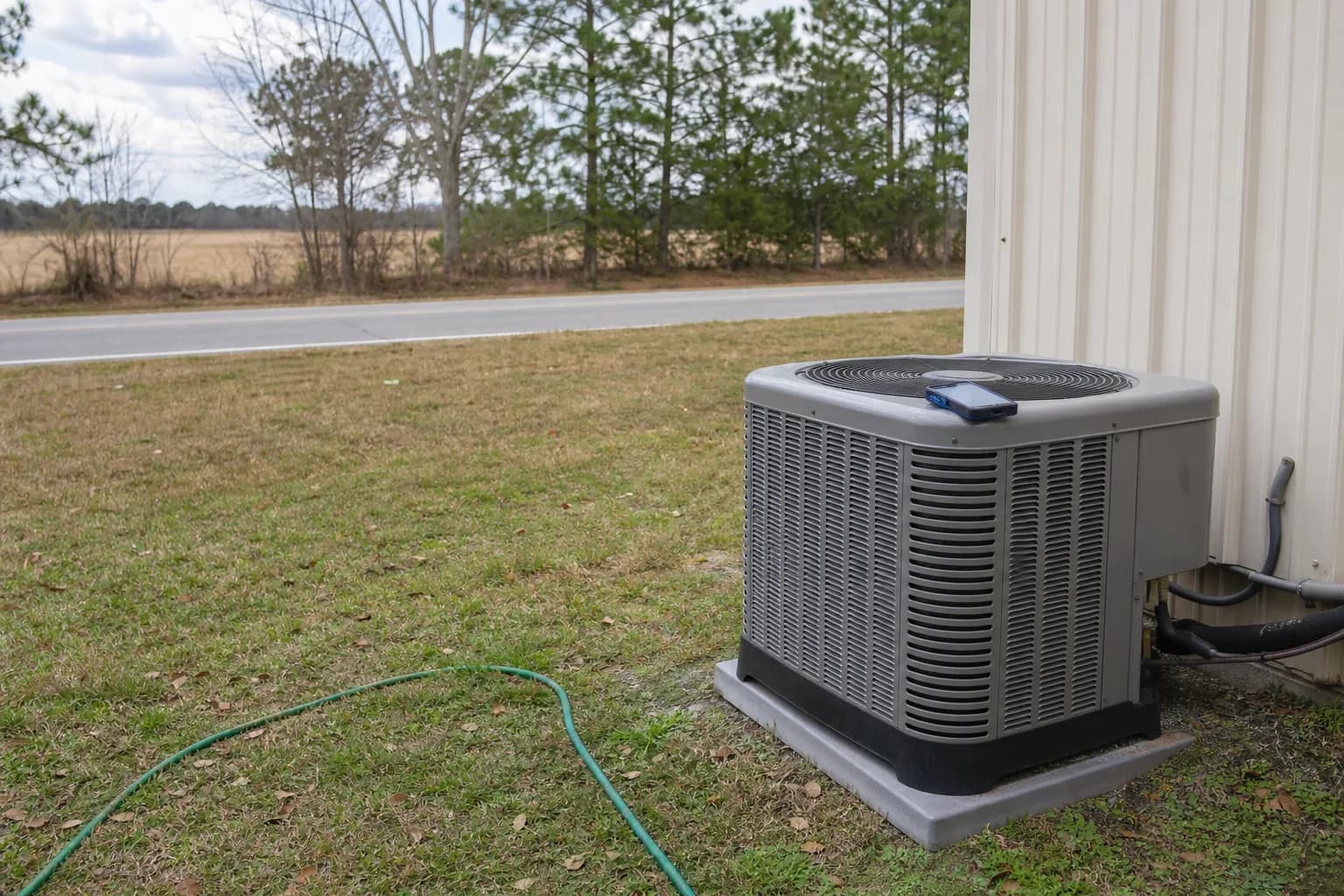
Stapleton, Stockton, and rural Bay Minette have a meaningful stock of all-electric heat pumps installed during the 2010s. Most of them work fine in 90% of Baldwin County weather. The hard-freeze nights are where the failures show up.
The setup looks like this: outdoor unit caked in two inches of frost, indoor temp drifting down despite continuous runtime. Heat pumps frost up at outdoor temps below about 35°F when humidity is high — that part is normal. The defrost cycle should clear that frost every 30-90 minutes. When it doesn't, you've usually got a reversing valve solenoid issue, a defrost board sensor problem, or a stuck reversing valve.
Without the reversing valve flipping, the system can't pump hot refrigerant through the outdoor coil to melt frost. The unit just runs and runs against an iced-over coil, the supply air gets colder, and the indoor temp slips. A solenoid coil swap is a 30-45 minute repair if the part is on the truck — and on freeze nights, it absolutely should be.
The bigger issue under this pattern is auxiliary heat that was never properly configured. A heat pump with no electric backup is a setup that falls apart on the hardest-freeze nights of the year. The Fort Morgan no-backup post covers why this configuration is a problem in coastal Alabama, and the same logic applies just as much in north Baldwin.
Pattern 3: static pressure exposed under cold load
Older Bay Minette housing stock — anything from the 1950s and 1960s with retrofit ductwork — runs into a different problem during a freeze. The furnace is running, but supply-air temperature at the registers is barely warm.
A static pressure test usually tells the story fast. When measured static is nearly double the system's design spec, the air handler is fighting the duct system to move air. On a heat exchanger, that means inadequate airflow, which means the heat exchanger overheats, which means the high-limit switch trips and shuts the burners down before the air can warm properly.
The two repeat causes: a filter that was last changed in spring (loads to capacity over 8-9 months and chokes airflow), and a duct boot that's separated from a joist hanger and is venting most of its air into the attic insulation. Neither failure is technically "emergency" work, but on a Christmas Eve with arctic temperatures, fixing it right the first time beats fixing it twice.
Pattern 4: mobile-home package unit regulator freeze
Bay Minette and Stapleton both have meaningful mobile-home housing stock, and these calls run heavier in cold weather than people expect. The package unit lives on the roof or on a slab, fully exposed to weather year-round, and freeze damage at the gas valve regulator is a known failure mode when wind-driven precipitation hits the venting wrong.
The diagnostic sequence: warm the regulator gently (never direct flame), watch the system try to fire, and when it locks out on igniter fault check the igniter for a hairline crack. Cracked igniters are common on package units that have seen multiple thermal-shock cycles. The repair is straightforward; the longer-term recommendation is usually a venting modification before next winter.
Pattern 5: dead 24V transformer on a long-dormant furnace
The last category is the random one. Furnace is completely silent — no inducer start, no igniter glow, nothing. Stepping through the diagnostic, you find no 24V at the gas valve, no signal at the control board outputs, no voltage at the transformer secondary. Transformer is dead.
This is the second-most-common dead-furnace call I see during cold snaps, and the worst part about it is the timing. Transformers can sit at the edge of failure for months and pop the first time the furnace is asked to run hard. There's no good way to predict it from the homeowner side. From the tech side, weak transformer voltage in a fall tune-up is a leading indicator — but if no one ran a fall tune-up, the failure shows up at 7 PM on December 24.
What the pattern tells you
Christmas Eve no-heat calls in Bay Minette mostly trace back to a small list of failure modes:
-
Flame sensor oxidation — universal failure mode for gas furnaces during the first sustained cold snap.
-
Heat pump configurations without auxiliary heat — not a failure of the equipment, but a failure of the original install or homeowner education. The Summerdale Christmas cold-snap post goes deeper on this exact pattern in newer south Baldwin construction.
-
Static pressure / duct issues exposing themselves under cold load — not strictly an emergency, but a problem that compounds during a freeze.
-
Mobile-home package unit regulator freeze — specific to manufactured housing exposure.
-
Dead 24V transformer — random component failure that tends to happen at the worst possible time.
If you're a Bay Minette homeowner with any of these systems, the time to address them isn't December 23rd at 9 p.m. The Silverhill Christmas-furnace-spike post covers similar patterns just south of here. Our emergency HVAC service page has the holiday call protocol, and the AC repair page covers the cooling-side equivalent for the summer hurricane window. The Bay Minette service overview and Daphne service page have city-specific notes.
A fall maintenance tune-up — done in October — would have caught most of these: the flame sensors, the weak transformer, and at least flagged the heat-pump auxiliary configuration questions. ACExperts runs a flat $79 service-fee diagnostic and the Comfort Plan ($20/month or $240/year) includes 2 tune-ups annually with $0 service fees. The math against a December emergency repair is not subtle.
If the in-laws arrive tomorrow and the heat just went out, the line is 251-383-HVAC. Emergency calls answered day or night, every day.
FAQ
- What's the most common Christmas-week HVAC failure in Bay Minette?
- Gas furnace ignition failures, specifically on retrofit furnaces installed in older Bay Minette housing stock. The combination of seven months of dormancy, a sudden cold-load demand from a freeze night, and aging hot-surface igniters or flame sensors produces the same failure mode over and over. Heat pump auxiliary failures are a close second — homeowners with all-electric systems discover that the heat strips weren't actually working when the heat pump alone couldn't keep up below 30°F.
- Are emergency calls available on Christmas Eve and Christmas Day in Bay Minette?
- Yes. ACExperts answers emergency calls 24/7, any day of the week, with no Saturday upcharge during regular hours. The $79 service-fee structure applies as usual; you'll know what the visit costs before the truck rolls. Comfort Plan members get $0 service fees and no overtime fees as part of the plan.
- My Bay Minette furnace ran fine last Christmas. Why would it fail this year?
- Hot-surface igniters and flame sensors fail through accumulated thermal cycles and corrosion film, not through any single event. Last year's perfectly working igniter may have been on its last 50 ignition cycles. The first hard freeze of the season — when the furnace runs nearly continuously for 24-36 hours — uses up the remaining life. The failure isn't sudden; the visibility of the failure is.
- If I lose heat at 2 a.m. on Christmas morning, what should I do first?
- Pull the furnace front cover and look for an obvious lockout indicator (most modern furnaces have an LED that flashes a fault code). Check the thermostat is set to heat, the breaker hasn't tripped, and the gas valve at the unit is open. Set space heaters to safe locations away from curtains and bedding, run them on lower settings rather than max, and call 251-383-HVAC. Emergency calls are answered around the clock, any day of the week, including holidays.
Need this handled?
Straight to the service page for your town — pricing, local details and a form that reaches a technician.
More from Christmas Emergency

ACExperts HVAC
We Take The Heat So You Don't Have To
Fast, honest heating and air service across Baldwin County. Speak with a technician and get on the schedule today.