
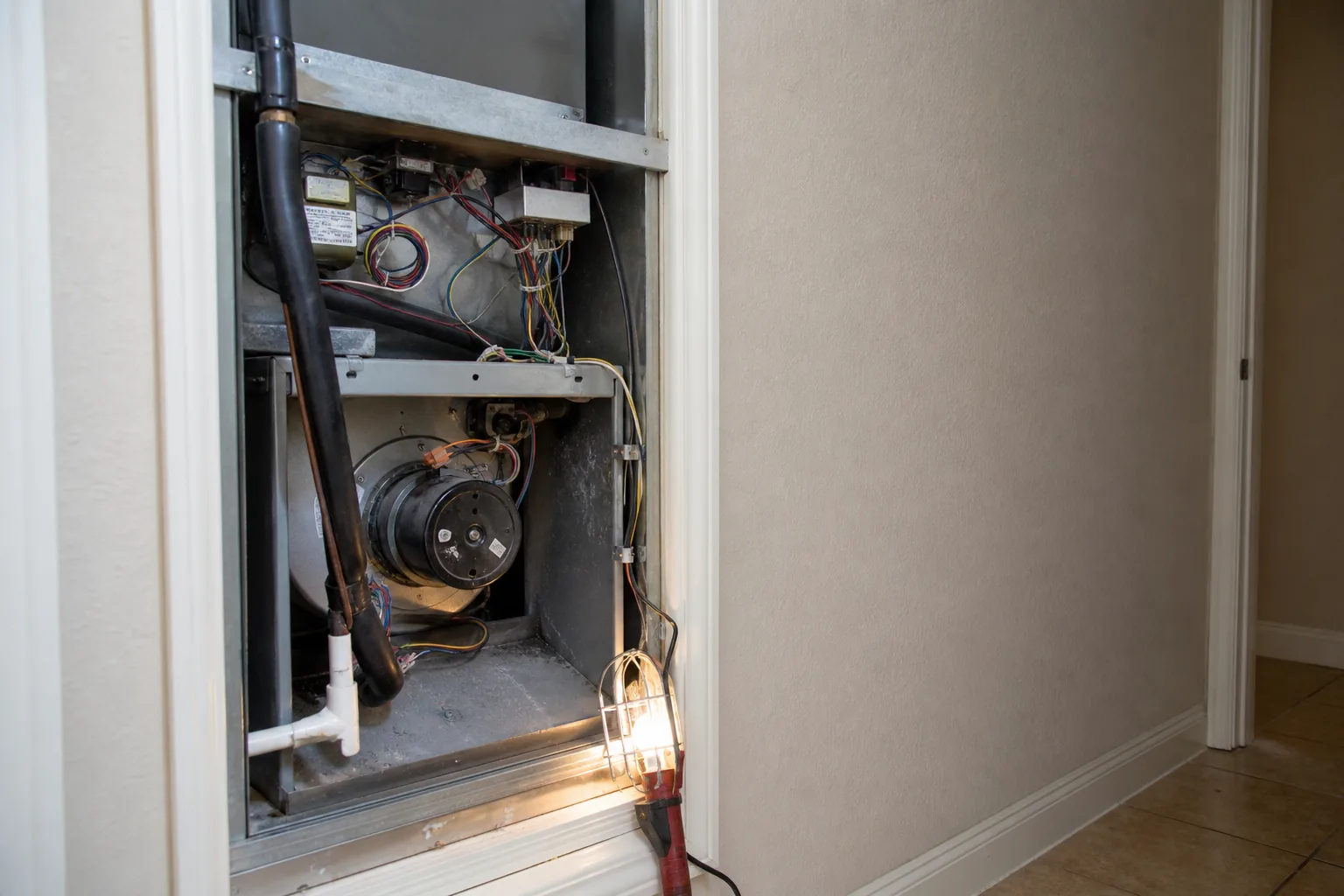
Should a Bay Minette Homeowner Cover the Outdoor Unit Before a Hurricane?
No — covering the outdoor condenser before a hurricane causes more damage than the storm. Here's the real Bay Minette pre-storm checklist.
Published 2025-09-08 · Updated 2025-09-08
Author: Landon Jahnke | ACExperts251
Reviewed by: Landon Jahnke · Owner · Alabama HVAC License AL #16117 · EPA 608 Certified
No. The tarp does more damage than the storm.
Every Bay Minette homeowner you'll meet at the Lowe's on Highway 31 the day a hurricane gets named will be standing in the contractor aisle picking up a 10x12 blue poly tarp and a bundle of bungee cords. Some of them will be wrapping their grill, which is fine. Some of them will be wrapping their outdoor AC condenser, which is not fine. I've spent enough Septembers pulling shredded tarps out of fan blades, fishing waterlogged fiberglass insulation out of electrical compartments, and explaining to homeowners why their two-year-old condenser now has rust streaks down a brand-new cabinet, that I want to write this one out properly so people stop guessing.
Outdoor condensers are engineered for this weather. They sit outside in driving rain every summer afternoon already. The cabinets are galvanized, the fan motors are sealed, the electrical compartments have weep paths designed for water intrusion. What kills them isn't water — it's voltage chaos coming through the wires when the grid comes back up. That's the part homeowners can't see, and that's the part the tarp doesn't help with at all.
What actually fails in Bay Minette during a named storm
Bay Minette sits about 25 miles north of Mobile Bay, far enough that you're not going to see direct storm surge or 130-mph sustained sea-level wind. By the time a system pushes that far inland, it's usually a tropical storm with embedded tornadic cells. Those cells are the real local threat — narrow corridors of 90-mph rotational wind that tear through a couple of streets, drop a pine branch through a roof or onto a condenser pad, and move on. The pine canopy north of downtown and around Steelwood, Stockton Road, and the Tensaw Heights area drops branches in any sustained 50-mph wind, and once a 3-inch hardwood limb lands on top of a condenser fan, the unit is done until the fan blade is replaced.
The second failure mode is power-cycling damage during the recovery period. Alabama Power and Baldwin EMC restore feeders one block at a time, and every restart slugs the compressor with a refrigerant load it can't immediately handle. Each flicker burns the run capacitor a little, pits the contactor a little, stresses the start windings. By the third or fourth flicker — which is normal during a multi-day restoration — you've shortened the equipment's life by years without knowing it.
The third is lightning. Direct strikes within a few hundred yards of the home induce voltage spikes through the service entrance that can fry the control board, the thermostat, the contactor, and sometimes the compressor itself. Whole-home surge protection at the panel mitigates a lot of that, and individual HVAC surge protectors at the disconnect catch the rest. We talk about that math in our Robertsdale surge protector breakdown — the calculation is similar for Bay Minette.
Why the tarp is actively worse
Picture a 10x12 blue tarp wrapped around a condenser, secured with bungee cords. Sustained wind hits it from one direction. The tarp pulls taut, the bungees stretch, and one of three things happens. The bungees give way and the tarp launches across the yard, possibly through a window or into your neighbor's truck. The tarp tears at a grommet and rips itself off in pieces, half of it ending up wedged into the fan grille. Or — the worst version — the tarp holds, and the wind drives sideways rain underneath it, where it sits trapped against the electrical compartment for the next 36 hours with no air movement to dry it out.
A condenser that's been rained on dries out in a few hours of normal sun. A condenser that's been wrapped in a wet tarp for two days has corrosion starting on every electrical contact. The tarp didn't protect anything. It created the failure mode.
The same goes for wrapping the unit in trash bags, plastic sheeting, or moving blankets. None of those are designed for outdoor use in 90-mph wind. They all become projectiles or moisture traps. The condenser is fine without them.
What to actually do before the storm
The pre-storm checklist for a Bay Minette home is shorter than people expect:
- Turn the thermostat off about 12 hours before the storm hits, then flip the outdoor disconnect at the unit and the indoor air handler breaker at the panel. This isolates the system from grid voltage during the restoration period.
- Walk around the condenser and clear loose debris within about 15 feet — pine cones, fallen branches, lawn furniture, the kid's bicycle. Anything light enough to become a missile in 70-mph wind goes in the garage.
- Check that the condensate drain line at the side of the house is clear. After the storm passes, the air handler will dump a lot of water once you restart it, and a clogged drain line backs up into the home.
- If you have a generator and you're thinking of running the AC off it, stop. Standard household generators don't deliver clean enough power to safely run a residential compressor, and the inrush current alone exceeds what most portable units can supply. Inverter-style units rated 5,000 watts continuous and above are the minimum. The math is covered in more detail on the emergency HVAC service page.
- Take a phone photo of the condenser from each side, including the model and serial plate. If the unit is damaged in the storm, that photo is what your insurance adjuster needs to see.
That's it. No tarps, no plywood frames, no foam padding. The condenser is built for what's coming.
After the storm: the part that actually matters
This is where most preventable damage happens, and it's the part the tarp crowd never thinks about. After the wind passes and the rain stops and the power eventually comes back on — sometimes in stages over 24 to 48 hours in north Baldwin County — the temptation is to immediately turn the AC back on because the house is already 84°F and climbing. Don't.
Wait until power has been stable for at least 6 to 12 hours. The grid will continue to flicker as crews finish feeder work; each flicker is a hit on the compressor. While you're waiting, walk around the outdoor unit one more time. Look for: embedded sticks in the fan grille, pine straw mat across the top of the coil, a shifted concrete pad, downed limbs leaning against the cabinet, water visibly pooled inside the electrical compartment, or any cabinet panel that's been displaced.
If anything looks off, leave the breaker off and call someone. ACExperts answers emergency calls 24/7, every day of the week, including Saturdays at no extra charge, and the truck carries extra inventory of the most common post-storm failure parts. Comfort Plan members get priority routing in the 48 to 72 hours after a named-storm event because that's when call volume across Bay Minette, Fairhope, Foley, and Gulf Shores spikes hard.
When you do restart, start with the outdoor disconnect first, wait two minutes, then flip the indoor air handler breaker. Set the thermostat 8 to 10°F above current room temperature. Let the equipment ease into the load over a couple of hours. A house at 88°F asking for 72°F immediately is asking the compressor to do something it shouldn't have to do on day one of recovery. There's a longer post-storm restart sequence in our Silverhill restart guide — same procedure applies in Bay Minette.
The Bay Minette specifics
A few things make the inland north-Baldwin storm profile different from what folks at the coast deal with. Salt corrosion isn't the dominant failure mode for outdoor equipment up here, so the post-storm coil-rinse step that matters in Orange Beach and Gulf Shores is less urgent in Bay Minette — you're dealing with rainwater, not a salt-spray bath. But debris is worse. The pine canopy in Lakeview, around the Hand Park area, and out toward Stockton Road drops more material in a single thunderstorm than coastal yards see all season, and pine straw packed into the top of a coil traps moisture and accelerates corrosion underneath.
Power restoration also takes longer in north Baldwin than down at the coast. Crews prioritize population density and critical infrastructure, and Bay Minette sits at the end of feeder runs that have to be cleared before they can be re-energized. Plan on a longer outage than the bay cities, which means more food in coolers, a generator strategy that doesn't include the AC, and patience on the restart.
If you've got an aging system — anything past about 12 years on a brand like Carrier, Trane, or Rheem in this climate — a named storm is the moment its weak components find out they're weak. Capacitors fail first, contactors second, control boards third. The truck carries all three. If you're already past replacement age and considering whether to ride out one more season, the repair vs. replace calculator is worth running before the storm shows up on the National Hurricane Center map.
The short version
Don't tarp it. Cut power before the storm, walk the unit after, wait for stable grid power, restart in sequence. That's the whole playbook for an inland Bay Minette home. The hardware is built for what's coming — your job is to keep it isolated from the bad voltage and the falling debris, not to wrap it in a poly sheet and hope.
Insurance coverage varies by policy. For storm-damage claims and adjuster procedures specific to your situation, consult your insurance carrier.
FAQ
- Will wrapping my outdoor AC unit in a tarp protect it during a hurricane?
- No. The tarp traps moisture against the cabinet, holds water against electrical components, and almost always tears loose in the storm — at which point it becomes a flying projectile that can damage the unit, the house, or a neighbor's property. The condenser itself is built to handle 100+ mph wind and rain. The actual threat is power-cycling damage, not water.
- Bay Minette is 25 miles inland — do I really need to worry about hurricanes here?
- Yes, but for different reasons than a Gulf Shores or Orange Beach homeowner. Bay Minette rarely sees direct storm surge, but tornadic spinoffs from the storm bands and falling pine branches cause most of the local HVAC damage. Power flickers from Alabama Power and Baldwin EMC restoring feeders also drive compressor failures. The risk profile is different, but it's real.
- Should I shut off power to my AC before the storm?
- Yes — flip the outdoor disconnect and the indoor air handler breaker before the worst of the wind arrives. This protects the compressor and control board from voltage spikes during the grid's restoration cycle. Wait until utility power has been stable for at least 6 to 12 hours after the storm before restoring power, outdoor breaker first.
- What about hail or flying debris in Bay Minette?
- Hail damage to coil fins is real but cosmetic in most cases — bent fins reduce efficiency a few percent, not a system killer. Flying branches from the pine canopy north of town do more damage than hail. After the storm, walk around the unit before flipping the breaker and look for embedded sticks, pine cones lodged in the fan, or a shifted concrete pad.
Need this handled?
Straight to the service page for your town — pricing, local details and a form that reaches a technician.
More from Hurricane Prep

ACExperts HVAC
We Take The Heat So You Don't Have To
Fast, honest heating and air service across Baldwin County. Speak with a technician and get on the schedule today.