
How One Bay Minette Homeowner Caught Spooky HVAC Noises Early
A composite from 13 years working Baldwin County HVAC: catching a Bay Minette gas furnace rattle early can mean planned replacement, not emergency.
Published 2025-10-20 · Updated 2025-10-20
Author: Landon Jahnke | ACExperts251
Reviewed by: Landon Jahnke · Owner · Alabama HVAC License AL #16117 · EPA 608 Certified
This is a composite illustration drawn from 13 years working Baldwin County HVAC — the kind of fall noise call I've handled enough times in north Baldwin gas-furnace homes that the pattern is worth walking through in one piece. The setup: an older homeowner off a Bay Minette county road hears a rattling on the first cold cycle of the season — "sounds like there's something loose, and it didn't make this sound last year." Eleven-year-old gas furnace. Retrofit gas through ductwork from the late 1970s. She didn't keep running it through the weekend hoping the noise would go away — she called.
What that kind of call looks like, what it tends to cost, and what it would cost if a homeowner ignored it is what I want to walk through, because it's the cleanest illustration of a homeowner doing exactly the right thing with a noise complaint.
What that kind of rattle sounds like
Homeowners describe it as "a rattle, like a metal pencil rolling around in a tin can, but only sometimes — not every cycle, maybe one in three." It typically shows up during the third or fourth cold morning of the season, around the time the overnight lows drop into the high 30s. Often paired with a note that the burner sounds "a little different than usual when it lights, but maybe I'm imagining it."
You're not imagining it. On the failure mode I'm describing, the burner sound and the rattle are the same problem. But that's not obvious until a tech has eyes on the equipment.
Two things this kind of homeowner does right before the truck even arrives. First: they trust their own ear. Second: they don't keep running it through the weekend hoping the noise will go away. Both of those decisions are worth more, in retrospect, than any single piece of equipment in the house.
What gets found
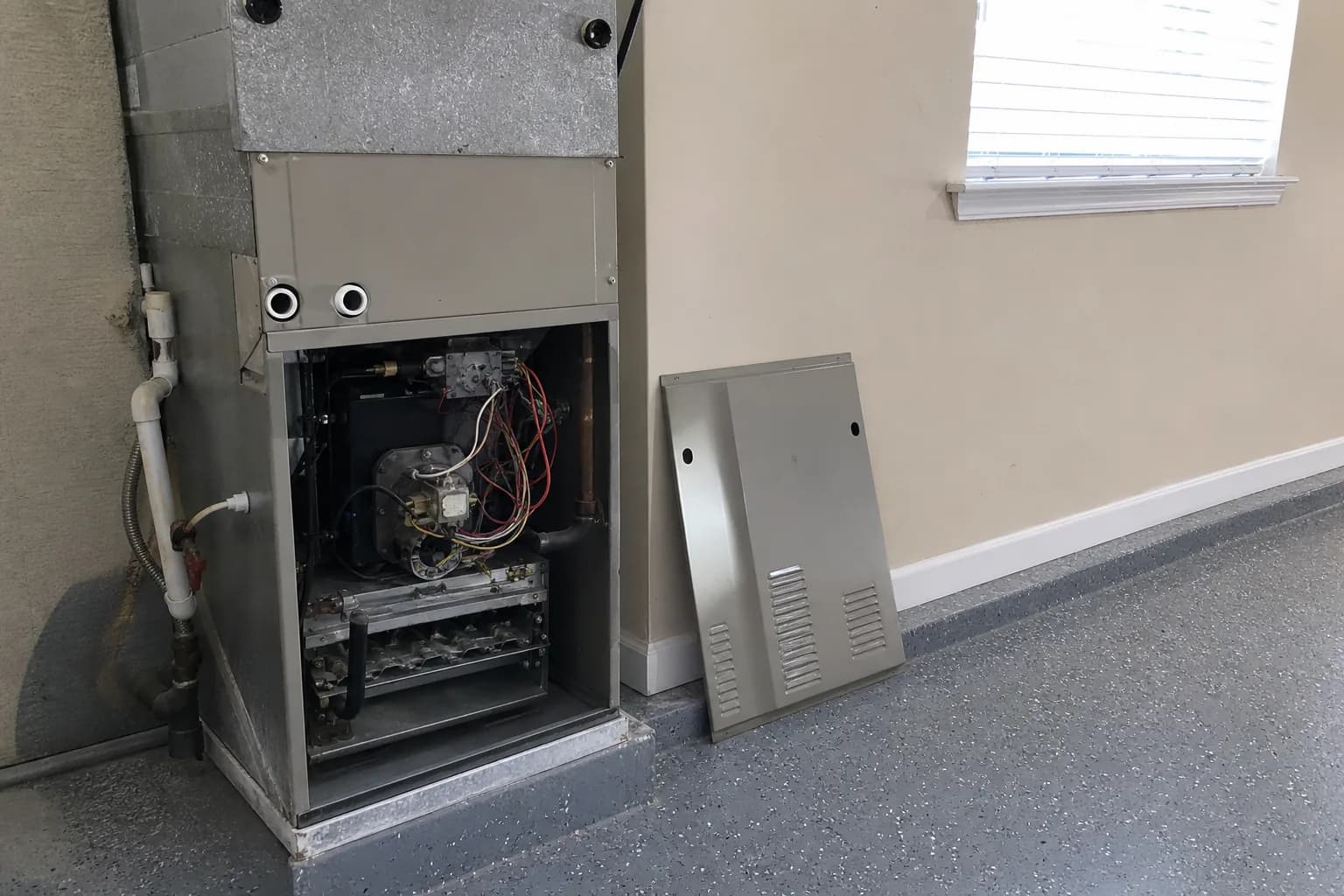
A builder-grade 80% efficiency gas furnace, ten or eleven years old, sitting in a closet off the laundry room. Bay Minette Utilities natural gas service. Single-stage burner, PSC blower motor — the kind of installation common in north Baldwin homes from that vintage where central air was added in the late 1970s or early 1980s and the gas furnace was swapped in during a later replacement cycle.
Pull the burner cover and the inducer cover, run a heating cycle with the panels off, watch what happens. On the calls I'm describing, the rattle traces back to a piece of corroded metal — a tab from one of the burner shields — that has partially separated from its weld and is vibrating against the burner manifold during ignition. That alone is a fifteen-minute fix.
But while you're in there, you run a combustion analyzer up the flue and inspect the heat exchanger with a borescope. That's where the real story is.
A hairline crack on the secondary cell, about the length of a fingernail, right at one of the flame impingement points. Eleven years of cycle-thermal-stress on a builder-grade exchanger, plus a recent run of cold-then-warm-then-cold weather typical of Bay Minette's transitional fall. The crack isn't through-and-through yet — the combustion analyzer isn't reading elevated CO at the supply registers, consistent with a partial-thickness crack that hasn't fully opened — but it's on its way. Two to four more weeks of operation, especially during the colder cycles a north Baldwin December brings, and that crack would open.
Why heat exchanger cracks matter especially in Bay Minette
A cracked heat exchanger leaks combustion gas into the supply air. That includes carbon monoxide. The blower then distributes the contaminated air throughout every supply register in the house.
Bay Minette housing stock leans toward tighter envelopes than the coastal cities — older homes that have had insulation upgrades and air-sealing improvements over the years, plus newer construction in Lakeview, Aubrey Estates, and Hidden Cove that was built tight from the start. Tight homes don't dilute CO the way leaky 1950s farmhouses do. A small steady CO leak from a cracked heat exchanger in a tight home will accumulate to dangerous levels overnight when the system runs harder during sustained cold.
Every gas-fired home in our service area should have CO detectors on every floor, and they should be the kind that read out actual ppm values, not just the chirpy alarm-only models. Cheap alarm-only detectors only trigger above 70 ppm sustained. The continuous low-level exposure that does cumulative health damage happens at 30-50 ppm — below the trigger point.
If a home like this has CO detectors that are old and battery-dead, replace them on the spot. That's not a service call line item; that's just what you do.
How the economics tend to play out
A documented heat exchanger fault on an eleven-year-old gas furnace isn't safe to keep running through the winter, even with the burner shield repaired, because the crack will still propagate. The right answer is planned replacement before the next cold week.
A typical replacement here is a 96% high-efficiency gas furnace matched to a new variable-speed air handler, properly sized for the house with a Manual J load calc instead of just swapping equivalent tonnage for the old unit. Comfort Plan members get 10% off repairs and replacements. Manufacturer rebates and utility rebates can layer additional savings on top — note that the federal 25C heat-pump tax credit expired December 31, 2025 and no longer applies to new installs; for gas furnace replacements specifically, the utility and manufacturer incentive programs are the relevant stack.
What ignoring the rattle costs
This is the part I tell every homeowner who hesitates to call about a sound they're not sure about.
Two more weeks of operation, into a cold snap, and a hairline crack opens. Once it's open, three things happen in fast succession.
First: CO migrates into the supply air at meaningful levels. Best case, the CO detectors catch it and alarm. Worst case, there are no working detectors and the call comes from a family member who couldn't reach the homeowner.
Second: the heat exchanger failure trips the high-limit safety on the furnace and the system locks out. Now there's no heat during the coldest week of the year and an emergency replacement of the furnace — and emergency replacements during cold weeks always cost more, because every contractor in north Baldwin is scrambling to source equipment that's in short supply.
Third: depending on how the crack opened, the entire ductwork system has been distributing combustion residue. Soot in the supply registers, deposit on the indoor coil, contamination of the blower wheel. Add the duct and component cleaning to the replacement cost.
The asymmetry between a planned replacement the homeowner controls and an emergency replacement during a cold week is large enough — measured in thousands of dollars, plus the safety risk that doesn't have a dollar figure attached — that the diagnostic call is the most cost-effective phone call a homeowner can make in October.
What this story teaches
A few patterns I want Bay Minette homeowners to take from this:
Trust your ear. If you've lived in the house multiple winters and the heat sounds different than it did last year, that difference matters. You don't have to diagnose it. You just have to call.
The first cold-snap cycle is the diagnostic moment. Heating systems have been sitting unused since March. Components corrode, dust accumulates, gaskets harden, mice happen. The first 5-15 cycles of the season are when problems reveal themselves. That's the window to listen carefully.
Gas systems get a different scrutiny than heat pumps. Gas furnaces have a failure mode — heat exchanger cracks — that doesn't exist on a heat pump. Bay Minette has more gas furnaces in service than coastal cities do, both because of the existing Bay Minette Utilities gas service infrastructure and because the older housing stock here was retrofit during decades when gas was the obvious choice. If you're on gas, the annual heat exchanger inspection isn't optional; it's the thing that catches what almost happened to this homeowner.
Don't wait for the system to actually fail. The economic asymmetry between scheduled maintenance and emergency replacement is enormous, and it gets worse the colder the week you're caught in. Bay Minette in November has a real shortage of available equipment when an emergency replacement hits during a cold snap. Planned replacements get the equipment you want; emergency replacements get whatever's on the truck.
Spanish Fort homeowners run into related problems on a slightly different timeline — the housing mix is different but the fall noise patterns rhyme. And I covered the bucketing logic for Daphne homeowners if you want a side-by-side reference for figuring out whether the sound you're hearing is actually a problem.
What we do on a heat-season diagnostic visit
For context, so you know what you're getting if you call:
We arrive within the booked window — same-day if scheduling and routing allow, otherwise next-day. We diagnose the noise specifically. We pull the burner cover (gas) or the access panels (heat pump) and run the system in heating mode while we watch and listen. We run a combustion analyzer if it's gas. We borescope the heat exchanger if there's any indication of stress. We test the heating system's controls and safeties, and we document everything with photos that go to your file.
If the answer is "this is normal first-of-season noise, nothing to fix," that's what we'll tell you. We don't bill more for not finding a problem. The diagnostic fee is the diagnostic fee, and a clean diagnosis is a perfectly valid outcome.
If we find something, we explain it in plain language with photos, give you a written quote before any work starts, and let you decide. No high-pressure pitch, no scare tactics, no "you have to fix this today" unless it's actually a safety issue — in which case we'll tell you it's a safety issue, document it, and recommend you not run the system until it's addressed.
Every now and then someone calls and isn't sure whether their rattle is worth the diagnostic fee. The answer, after 13 years of these calls, is the same every time.
The diagnostic fee is always worth it. Always.
FAQ
- How does a homeowner know to call before the system actually fails?
- Pay attention to a sound you've never heard before. Most heating systems give you 2-6 weeks of warning sounds before a real failure. The mistake homeowners make is waiting until the system actually quits — by then, what was a small part replacement is often a much bigger component or full replacement.
- Is gas furnace heat exchanger failure dangerous in a Bay Minette home?
- Yes. A cracked heat exchanger can leak combustion gases — including carbon monoxide — into the supply air the blower distributes through the house. Bay Minette homes with sealed crawlspaces and tight envelopes are especially at risk because the CO doesn't dilute. Every gas-fired home should have working CO detectors on every floor, and any time the burner sounds different we want to test the heat exchanger before next ignition.
- What does a heat exchanger inspection involve in Bay Minette?
- On any maintenance visit or diagnostic on a gas furnace, the heat exchanger gets a visual inspection plus flame pattern check plus combustion analysis. The diagnostic service fee is $79. If we find a crack we document it with photos and a written inspection report and walk through replacement options before any work.
- Should Bay Minette homeowners on natural gas switch to a heat pump on the next replacement?
- Maybe. Depends on whether you already have gas service running, your system's age, and your design heating load. We run a Manual J load calc and quote both options when we replace a furnace. Heat pumps have gotten meaningfully better for Climate Zone 2A north Baldwin homes; gas still wins in some cases.
Need this handled?
Straight to the service page for your town — pricing, local details and a form that reaches a technician.
More from Halloween Noises

ACExperts HVAC
We Take The Heat So You Don't Have To
Fast, honest heating and air service across Baldwin County. Speak with a technician and get on the schedule today.