
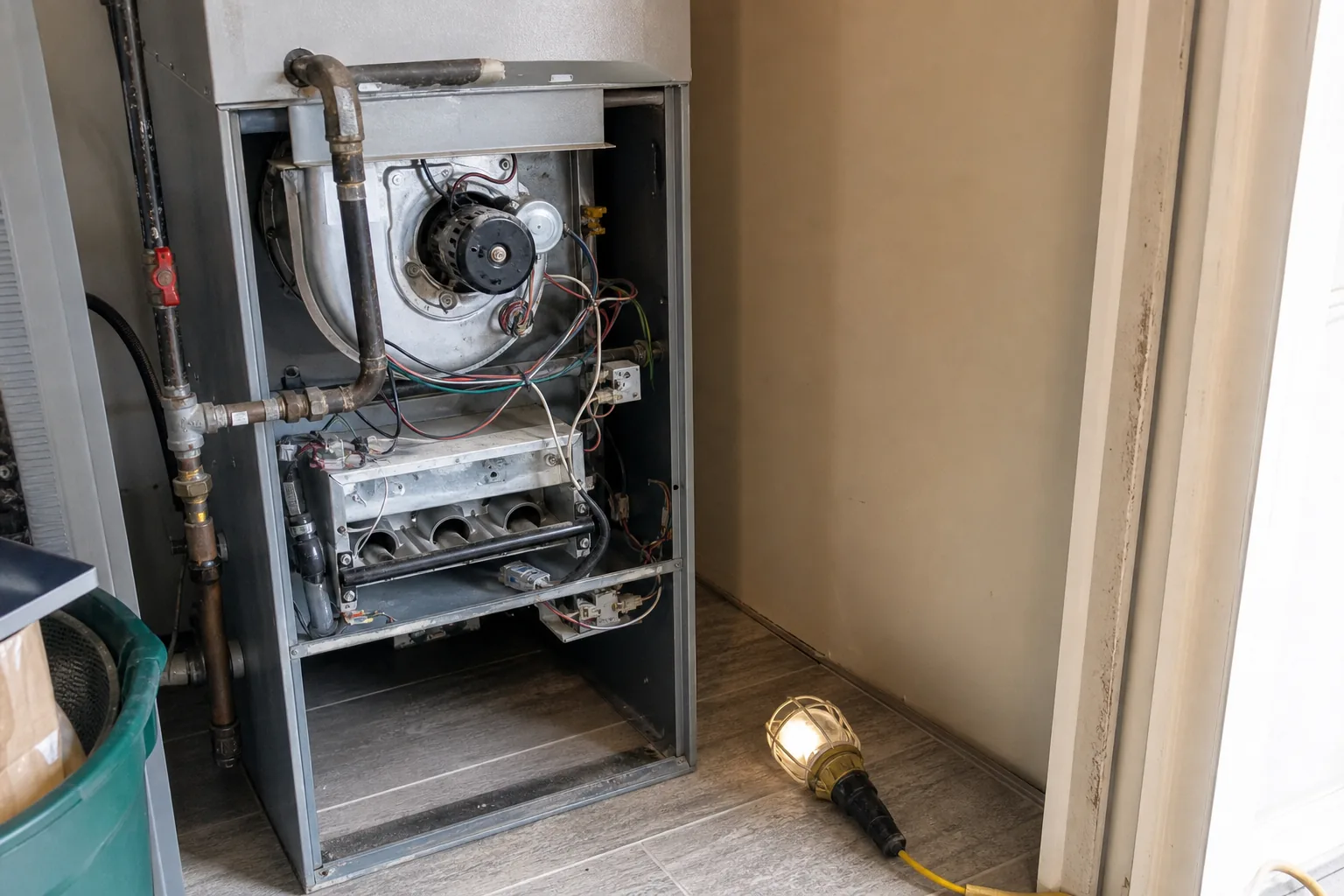
Why Spanish Fort Furnaces Make Their Spookiest Sounds in Late October
Late October is the first time most Spanish Fort heating runs all year. Burner residue, dormant bearings, and contracted ductwork sound like ghosts.
Published 2025-10-08 · Updated 2025-10-08
Author: Landon Jahnke | ACExperts251
Reviewed by: Landon Jahnke · Owner · Alabama HVAC License AL #16117 · EPA 608 Certified
The first hard cold front of the season usually hits Spanish Fort somewhere between October 18 and the first week of November. One night you're still running the AC because the upstairs is sitting at 76°F at 8 p.m., and the next morning the kitchen thermostat reads 64°F and the furnace cycles on for the first time since maybe last February. That first cycle is when the noises start, and Spanish Fort's particular housing stock makes them louder and stranger than what you'd hear in an older home.
Most of the heating equipment in Stillwater, TimberCreek, Rayne Plantation, Stonebridge, Churchill, and the Audubon corridor was installed within the last 20 years. A meaningful share of those homes run heat pumps as primary heat with electric or gas backup, which means the equipment hasn't done much work since the last brief cold snap. Eight months of dormant operation is enough to let dust settle on every surface, lubrication migrate away from bearing contact points, and ductwork find its summer rest position. When the system fires up in late October, all of that wakes up at once.
The first-run dust burn
This is the smell that drives the most "is my house on fire" calls in the first week of cool weather. It's not your house. It's residue burning off the heat exchanger and burner assembly.
Over the course of a Gulf Coast summer, household dust, pet dander, pollen from the spring oak drop, residual sealant outgassing from the original installation, and any insulation fibers that have migrated through the duct system all settle on the hottest surfaces of the furnace — the steel of the heat exchanger and the burner crowns. When the gas valve opens and the burners light, surface temperatures hit 1,200°F or higher in the combustion zone, and that organic material vaporizes and burns. The smell is unmistakable: a hot, slightly acrid, dusty odor that fills the supply registers for the first 15 to 30 minutes the system runs.
Normal. Annoying, but normal. It clears once the residue is gone. If it persists past about an hour, or if the smell turns chemical, sulfurous, oily, or burnt-plastic, shut the system off and call us — that's a different signature and could indicate a control board issue, a wiring fault, or a heat exchanger problem.
The same effect happens on heat pumps in heat mode, just less dramatic. The auxiliary electric resistance coils inside the air handler also collect dust over the off-season, and they go through their own short burn-off the first time they engage. Less smell, more of a warm electric odor for a few minutes.
The bearing whine and the blower wake-up
Eight months is long enough for lubrication to redistribute on a blower motor bearing. Most modern PSC and ECM blower motors are sealed and don't strictly need re-lubrication, but the oil still migrates under gravity, and the first time the bearing spins after a long rest you'll often hear a brief whine or chirp for the first 30 to 60 seconds. It usually clears as the oil redistributes around the bearing race.
If the whine doesn't clear, or if it gets louder over the first heating week, the bearing is worn. That's a noise to take seriously — a failing blower motor on a heat pump or gas furnace is a same-week repair, not a wait-it-out item, because once the bearing seizes the motor draws locked-rotor current and either trips the breaker or cooks the windings. We diagnose this by ear and by amperage measurement on the motor leads. The fix is either bearing replacement (rare on modern equipment, most aren't serviceable) or motor replacement.
A different noise altogether is the blower wheel imbalance — a heavier whump-whump-whump rather than a steady whine. That's a wheel that's collected dust unevenly across the blades over the cooling season. It usually clears with a cleaning during a fall heating tune-up. If you've never had your blower wheel cleaned and the system is over five years old, this is one of the higher-value maintenance items in Spanish Fort's tight-build subdivisions, where indoor dust accumulates faster than people expect.
Ductwork pops, ticks, and the sound of metal remembering it's metal
This is the one that scares the kids on Halloween night.
Modern Spanish Fort homes are built tight. Spray-foam attics, sealed duct chases, and aggressive duct sizing to fit equipment into smaller mechanical closets all create a system where supply air arrives at registers fast and hot. The sheet metal of the supply trunk sits at maybe 65°F before the system kicks on, and 30 seconds later it's pushing 110°F air. The metal has to expand, and it expands audibly. Pops and ticks travel through the wall cavities, sometimes loud enough to wake people up from a 2 a.m. cycle.
In Stillwater and Stonebridge specifically, where ductwork often runs through finished bonus rooms and over conditioned spaces, those pops carry into the bedroom rather than dissipating in an attic. It's harmless. It's the same physics as a wood-frame house creaking in the cold. If the popping is constant or rhythmic in a way that doesn't match heating cycles, that's worth a look — it could be a loose hanger or a damper actuator working against itself — but the typical seasonal popping resolves on its own once the duct metal reaches steady-state operating temperature.
Older retrofitted homes in Bay Minette or out in Loxley make different noises because their duct construction is different. Tight-build Spanish Fort makes pops; older retrofit systems make groans and rattles. Different housing stock, different sound signature, similar root cause: metal moving against itself. Our colleagues out east cover the Stockton noise catalog for those older systems.
The CO detector chirp and what it actually means
This one matters. If you have a gas furnace — common in Spanish Fort but not universal, since many of the newer subdivisions are heat-pump dominant — the first heating cycle of the season is when carbon monoxide alarms occasionally trigger. Three categories of cause, and they're not all equal:
The first is a low-battery chirp that happens to coincide with the first cold morning. Replace the battery, the chirp stops, you move on.
The second is a transient combustion event during burner ignition — sometimes the first light-off produces a brief puff of incomplete combustion before the flame stabilizes, and a sensitive detector picks it up. This usually happens once and doesn't recur. Worth noting, not necessarily worth a service call.
The third is a real CO release from a compromised heat exchanger. Spanish Fort homes with furnaces 12 years and older are squarely in the age range where heat exchanger cracking starts to show up. A dormant summer is when those cracks form — thermal stress cycles plus humidity create micro-fractures that don't leak measurably until the burner fires hot in fall. If the alarm sounds continuously or repeats across multiple heating cycles, leave the home and call the fire department before calling us. We'll come out for combustion analysis afterward and verify the heat exchanger condition with a borescope inspection.
This is one of the reasons we strongly recommend a fall heating tune-up before the first hard cold front, especially on systems past 10 years. It's covered under the preventive maintenance plan and includes combustion analysis on every gas-fired system we service.
Heat pump weirdness specifically
A lot of Spanish Fort homes run heat pumps, and heat pumps make sounds in heating mode that they never make in cooling mode. The biggest one is the reversing valve — the component that flips refrigerant flow from cooling to heating. When it shifts, you'll hear a whoosh and sometimes a metallic thump from the outdoor unit. Normal. It happens at the start of every heating cycle and again when the system enters defrost mode.
Defrost is the other one that scares people. Every 30 to 90 minutes during cold-and-damp weather, the outdoor unit briefly reverses to melt frost off the outdoor coil. From outside, it looks like the unit is steaming and hissing — sometimes with visible water vapor rising from the cabinet. That's the system working as designed. The indoor air will get briefly cooler during defrost, and the auxiliary heat strips will kick in to compensate.
If the outdoor unit is making a heavy clatter rather than a whoosh, or if you hear continuous hissing for more than a few minutes, that's a different problem. Refrigerant leaks, a stuck reversing valve, or a failed defrost board all sound similar from across the yard. We cover the diagnostic on the heat pumps and mini-splits hub.
What's worth calling about and what isn't
Short list of seasonal noises that resolve on their own within the first week of operation: dust burn-off smell at startup, brief blower whine in the first minute, supply duct popping during temperature ramp, condensate drip from the outdoor heat pump unit during defrost, and the reversing valve whoosh at cycle start.
Short list of noises that don't resolve and warrant a call: continuous CO alarm activity, persistent burning smells past the first hour, blower whine that gets louder over the first week, rhythmic clicking or buzzing from the indoor unit when nothing is running, gas smells of any kind ever, or the system not coming on at all when you call for heat. The last one sounds obvious but it's worth saying — a furnace that "ran fine last winter" and now does nothing usually has a control board, igniter, or thermocouple issue, and those parts are routine fall replacements. Some of them we keep on the truck.
Spanish Fort homeowners specifically
The folks I see in Stillwater, TimberCreek, and the Stonebridge area tend to be detail-oriented and tend to ask good questions, so I'm going to spend a sentence on the thing that comes up most often in late October: yes, it's worth scheduling the fall heating tune-up before you actually need heat. Not because we're trying to sell visits — but because diagnosing a heating issue at 6 a.m. on a 28°F morning when the kids are getting ready for school is a different conversation than diagnosing it on a Tuesday afternoon in mid-October when the house is still comfortable. We've got the scheduling page live, and the Comfort Plan covers the fall visit plus the spring AC visit. There's also a Bay Minette early-detection write-up that covers a similar pattern from the inland-housing-stock side.
The first cycle of the season is when systems tell you what they need. Listen to them.
FAQ
- Why does my Spanish Fort furnace smell like burning dust the first time I turn it on?
- Because that's literally what's happening. Six to eight months of household dust, pollen, and HVAC sealant residue have settled on the heat exchanger and burner assembly. When the burners light up for the first time in fall, that material burns off. It's normal for the first 15 to 30 minutes of operation. If the smell persists past an hour or you smell anything chemical, sulfurous, or oily, shut the system off and call us.
- Is the popping sound in my ductwork dangerous?
- Almost always no — it's the sheet metal expanding as warm supply air moves through cold ducts. In tight Spanish Fort subdivisions like Stillwater and Stonebridge, the duct runs are often sized aggressively and lack expansion joints, so the metal pops audibly when temperatures change. If the popping is paired with a burning smell or visible smoke, that's a different problem and needs immediate attention.
- My CO detector chirped during the first heating cycle. Should I be worried?
- Yes — verify it's a CO alarm and not a low-battery chirp first, but don't dismiss it. Heat exchangers that have sat dormant 8+ months can develop micro-cracks that release combustion byproducts when the burner first fires. We can perform a combustion analysis to verify the heat exchanger integrity. If the alarm sounds continuously, leave the home and call the fire department before calling us.
- Can a heat pump make these same noises?
- Some of them. Heat pumps in heat mode reverse refrigerant flow, which causes a whoosh and sometimes a thump from the reversing valve. Defrost cycles also produce hissing and steam from the outdoor unit that can look alarming at 5 a.m. but is normal operation. The first cold morning of the season is when most of these sounds show up at once.
Need this handled?
Straight to the service page for your town — pricing, local details and a form that reaches a technician.
More from Halloween Noises

ACExperts HVAC
We Take The Heat So You Don't Have To
Fast, honest heating and air service across Baldwin County. Speak with a technician and get on the schedule today.