
Should Spanish Fort Homeowners Worry About July 4 Rental HVAC?
July 4 rental HVAC calls in Spanish Fort cluster on the same failures. The real problem isn't the missed pre-check, it's the system that lets pre-checks slip.
Published 2026-07-06 · Updated 2026-07-06
Author: Landon Jahnke | ACExperts251
Reviewed by: Landon Jahnke · Owner · Alabama HVAC License AL #16117 · EPA 608 Certified
Across 13 years of working Baldwin County HVAC, July 4 rental calls in Spanish Fort cluster around a predictable pattern — and the lesson isn't the one most people draw from it.
The homeowner who calls is usually going to tell you she "didn't have time" to do a pre-check. The instinct is to wonder why she didn't. The honest answer is almost always: she's busy, she owns multiple rental properties, her property management company was supposed to handle the spring tune-up, and the spring tune-up didn't happen because something dropped between the cracks of two separate scheduling systems. Nobody owned it. The lesson isn't "pre-check matters." It's that the system that lets pre-checks fall through cracks is the actual problem.
Here's what I wish I'd understood earlier about Spanish Fort July 4 rental HVAC. Some of it is technical. Most of it isn't. Almost none of it is about the equipment.
The frame that actually works
The temptation is to think the rental owner is careless. She isn't. She's busy, the property management company she's paying is supposed to handle the spring tune-up, and there's almost always a process failure somewhere upstream — a scheduling software migration, a personnel turnover, an audit step that didn't happen — that nobody upstream has caught yet either.
Walk in, don't lecture about pre-checks. Don't even mention them in the first conversation. Fix the contactor, do the things that need to be done, hand the owner a written report that lays out exactly what you observed, and leave with a Comfort Plan recommendation in writing. The fastest path from a July 3 emergency call to a long-term maintenance relationship is competence, not commentary.
The contractor who shows up irritated on a 95-degree July afternoon and tells the customer what she should have done loses the relationship. The contractor who shows up, fixes it, and writes a clean report earns the next call.
What you're actually walking into
A typical Spanish Fort rental in early July is a Stillwater estate, a Stonebridge home, or a TimberCreek property — built between 2003 and 2014, with a 14-SEER builder-grade system that the original homeowner accepted because the high-efficiency upgrade carried a real upcharge and the spec didn't seem important at signing. The household behind it has changed once or twice since then. The current owner often bought the property as a rental in the past few years and has never met the contractor who installed the unit or seen the equipment up close.
That history matters because you're not diagnosing a homeowner's relationship with their system. You're diagnosing a system that's been operating in benign neglect for a decade. The maintenance gap isn't this owner's fault. The maintenance gap is structural — built into the way investment properties get bought and sold and managed in Baldwin County.
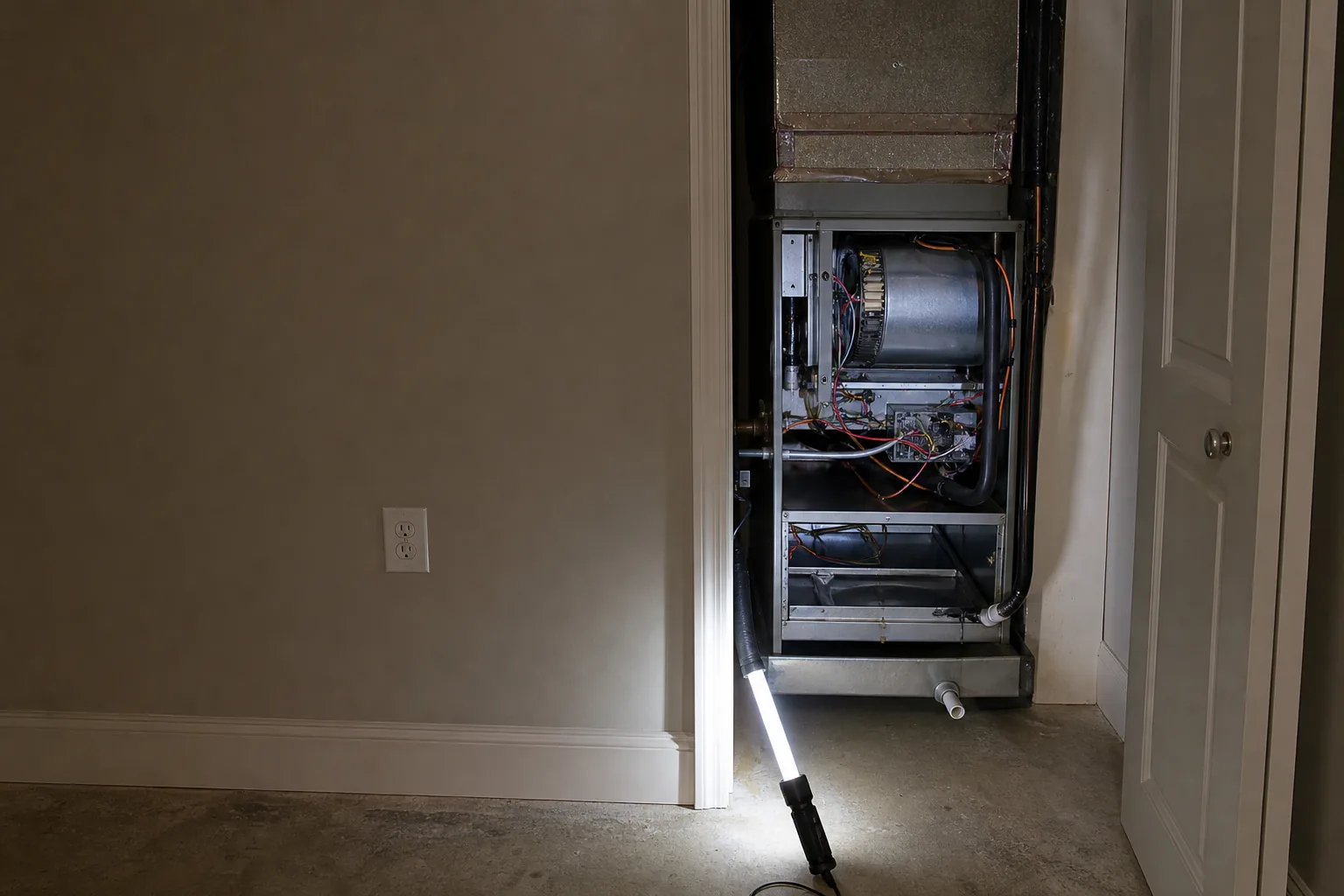
When you walk into the equipment closet or to the outdoor pad, expect:
- A contactor with measurable pitting on the contacts (the thing you're about to swap)
- A run capacitor reading 6-10% below its rated microfarads
- An evaporator coil with two seasons of dust embedded in the upstream face
- A drain line that's been working but has a biofilm starting to constrict it
- A blower wheel with a thin gray coating across all the blade surfaces
None of those individually is a failure. All of them together are one heat-load week away from a failure. July 4 is that week.
The conversation worth having on the phone
When the call comes in, the booking time is the easy part. What matters more is the intake — four questions that shape the truck loadout:
- Is the rental currently occupied, and if so, when do guests check out?
- When was the last documented service visit on the equipment? (Even "I don't know" is useful information.)
- What did you observe when you noticed the problem — warm air at the registers, no air at all, or something else?
- Is there a property manager involved, and do they have access to the equipment closet?
Those four questions surface whether you're walking into a contactor swap, a capacitor swap, a refrigerant issue, or a control board failure. They flag whether guest access needs to be coordinated. They identify whether the conversation will be with a property manager, the owner, or both. And they signal to the homeowner that you know what you're doing before you arrive.
The 90 seconds saved by skipping intake is the 30 minutes lost at the property figuring out what's actually being solved.
What the pre-check would have caught
I want to be precise about this because the lesson hides in the specifics.
A 30-minute pre-check on this property in early June would have caught:
- The contactor pitting (visual inspection, obvious arcing scarring)
- The drifting capacitor (meter reading, takes 90 seconds)
- The dust load on the evaporator face (borescope through the access plate)
- The drain biofilm (visual, plus a quick clear with vinegar)
Same parts ultimately get swapped either way. The difference is timeline: scheduled in June at the convenience of everyone involved, or emergency-dispatched on July 3 with guests checking in Friday. The emergency-window version layers on guest displacement risk, review damage exposure, and the cortisol hit of a phone call on a holiday week.
Same parts. Different timeline. Different stakes.
The structural problem
The deeper pattern: pre-checks fall through cracks because the system that's supposed to catch them isn't designed to catch them. The property management company's job is occupancy and turnover. Their HVAC line item is reactive: they call when a guest complains. The homeowner's job is the financial performance of the rental. Her HVAC line item is also reactive: it's a budget category for when invoices arrive.
Nobody owns "the equipment is going to fail in 14 days because the contactor is pitting." That's a sentence that requires somebody to look at the equipment and care about it. The PM doesn't have an incentive to look. The homeowner can't see it. The HVAC contractor only sees it on emergency calls — which, by definition, is too late.
The fix isn't telling homeowners to pay attention. The fix is putting their property on a maintenance schedule that puts a competent set of eyes on the equipment twice a year, generates a written report, and flags developing failures while they're cheap to address. That's what a maintenance plan actually is. Not a discount program. A scheduling commitment that makes sure the system is checked.
The Comfort Plan runs $20/month or $240/year and includes two tune-ups, 10% off repairs and replacements, $0 service fees, and no overtime fees. For a multi-property rental owner with units across Spanish Fort, Magnolia Springs, Fort Morgan, or Lillian, the math is straightforward: a single peak-season emergency that doesn't happen pays for the plan across the rest of the year.
Spanish Fort specifically
A few things worth getting right:
Spanish Fort rentals are not Gulf Shores rentals. The corrosion environment is moderate, not aggressive. The failure modes lean electrical and airflow, not coastal coil decay. Walk into a Spanish Fort rental call expecting contactor, capacitor, coil-load, and drain issues — not the Gulf-front-grade salt damage you'd see at the beach.
The household income demographic shapes the conversation. Spanish Fort homeowners typically have already done the math on their property's cash flow. They want to understand what they're paying for, why it's worth it, and how it compares to alternatives. Show your work. Bring readings, photos, and a written quote. Don't oversell.
The bay proximity matters less than you think for the rental subset. Spanish Fort coastal exposure is meaningful for full-time waterfront homes east of Highway 31. For the inland subdivisions where most rentals sit, it's a secondary concern relative to airflow, ductwork, and equipment age.
Trust the PM company until they earn distrust. Most Eastern Shore property managers are competent. The one whose scheduling software dropped this homeowner's properties wasn't malicious — they were busy and a process failed. Treat them as collaborators on a fix, not as the cause of the problem.
Closing the loop
If you're a Spanish Fort rental owner reading this, here's the practical takeaway: ask your PM company when your equipment was last serviced and ask for the written report. If they can't produce one from the past 12 months, that's the gap. Either get a tune-up scheduled before the next peak window, or put the property on a maintenance plan that takes the scheduling responsibility off your PM's plate entirely. Call 251-383-HVAC.
If you're a Baldwin County HVAC technician reading this — the customer who didn't pre-check isn't your enemy. The system that didn't pre-check is. Fix the equipment, document the visit, and earn the maintenance-plan signature. Lecture nobody.
The contractor worth being is the one who comes back for the next ten years. Not the one who's right about today.
— Landon
This post is general guidance, not a tax, insurance, or financing recommendation. Talk to a licensed advisor for your specific situation.
FAQ
- Why are July 4 rental calls in Spanish Fort different from calls earlier in the year?
- Two things converge. First, the holiday week is the highest-occupancy short-term rental window of the year for the Eastern Shore corridor — bay-view properties and Stillwater rentals run at full bookings with back-to-back check-ins. Second, the equipment has been carrying late-spring loads since April but hasn't been pushed to true peak yet. A weak contactor or marginal capacitor that survived May at moderate runtime now faces 14-hour duty cycles in 95-degree heat with the indoor setpoint locked at 70 because the renter is from somewhere cooler. Components that were going to fail in August fail on July 3 instead.
- What's the single most useful pre-check before July 4 weekend in Spanish Fort?
- Run the system continuously for four hours during the late afternoon window — the hottest, highest-load conditions you'll see — and verify it holds the setpoint. Most weak components reveal themselves under sustained load, not during the 20-minute test runs that property managers and pre-arrival cleaners typically perform. If your system can hold 72 with the outdoor air at 94 from 3 p.m. to 7 p.m., you're in good shape. If indoor temperature drifts upward during that window, something is starting to fail.
- Does ACExperts prioritize Spanish Fort rental calls during July 4?
- Occupied-property emergencies and imminent check-in situations get priority across the Baldwin County footprint during peak holiday weekends. Spanish Fort is part of the regular Eastern Shore routing, so travel time is generally favorable. Be specific when you call about whether guests are currently in the unit or whether there's a check-in within the next 24 hours — that's the information used to sequence the day. Office hours are Monday-Saturday 8am-6pm with emergency calls answered around the clock, every day at no Saturday upcharge.
- What does an honest July 4 emergency repair look like?
- Service fee is $79. Common July 4 failures include contactor replacement, dual-run capacitor swap, and condenser fan motor replacement — each gets quoted with photos before work begins. I'll be honest about whether a 12-year-old system is worth a major repair or whether the math points toward replacement scheduling for after the holiday window. Free second opinions on quoted repairs and free estimates on replacements. Full diagnostic flow lives on the emergency HVAC page.
Need this handled?
Straight to the service page for your town — pricing, local details and a form that reaches a technician.
More from July 4 Vacation Rental

ACExperts HVAC
We Take The Heat So You Don't Have To
Fast, honest heating and air service across Baldwin County. Speak with a technician and get on the schedule today.