
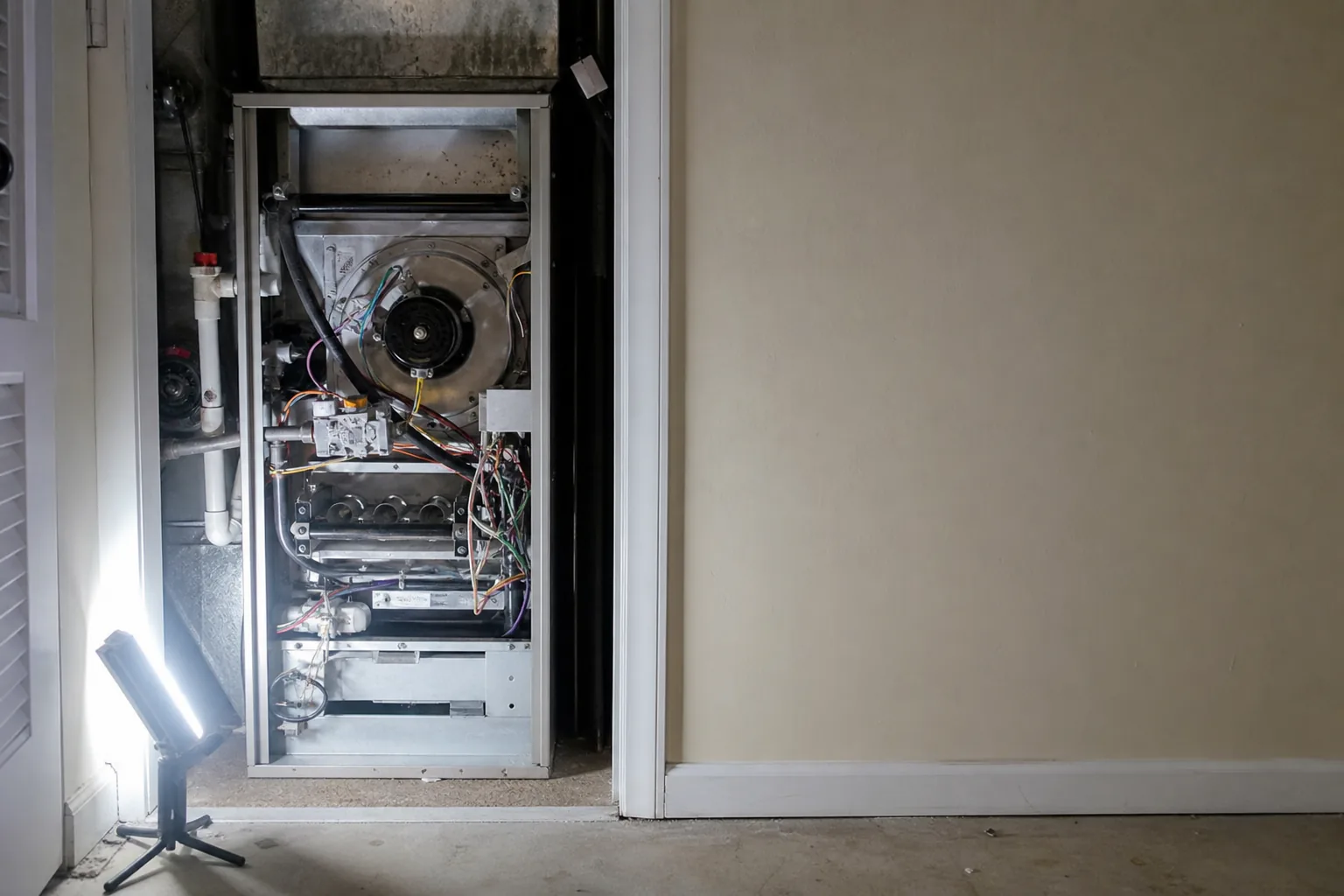
Robertsdale July 4 Rentals: Failure Patterns From 13 Years of Baldwin County HVAC
July 4 weekend brings a predictable failure mix on Robertsdale rentals — capacitors, frozen coils, contactors, drift. Most stopped by a 30-minute pre-check.
Published 2026-07-07 · Updated 2026-07-07
Author: Landon Jahnke | ACExperts251
Reviewed by: Landon Jahnke · Owner · Alabama HVAC License AL #16117 · EPA 608 Certified
Robertsdale July 4 weekend, composite from 13 years working Baldwin County HVAC: the failure mix on rental properties is predictable — capacitors, frozen coils, contactors, thermostat drift, condensate float trips. Most are preventable with 30 minutes of pre-check the week before. A small number share one diagnostic signature and aren't preventable on a spring tune-up alone. Here's the pattern and how to get ahead of it.
The typical July weekend breakdown
Across the kind of emergency rental calls that cluster between July 2 evening and July 5 morning in Baldwin County, the failure mix runs roughly like this:
- Capacitor failures (the largest single category). Outdoor condensers between 6 and 11 years old, with run-cap microfarad readings well below rated value when measured. Most have never received a recent tune-up.
- Frozen evaporator coils. Driven by clogged filters left in place for months, or by low refrigerant charge from a slow leak at a flare connection.
- Contactor failures. Visible arc pitting on the contact surfaces. Sometimes ant infiltration, more often end-of-life pitting on an 8-to-10-year-old contactor.
- Thermostat failures. Wi-Fi connectivity drops that revert smart thermostats to a default schedule mismatched with the rental program. Corroded battery contacts on traditional units.
- Condensate float trips. Drain line backed up with biofilm, float switch opens the safety circuit, system shuts down. Same outcome as a real failure but a 5-minute fix.
Total repair cost on any one call is the cheap part. The expensive part is the booking exposure — partial refunds, full cancellations, bad reviews — which routinely runs several times the invoice. That's the asymmetry that justifies preventive work in March or April.
Which failures are preventable
A pre-summer tune-up in March or April catches the bulk of this list:
Capacitors. Microfarad readings on every outdoor condenser take 90 seconds with a meter. Any reading below 95% of rated value goes on the watch list; anything below 90% gets replaced. Most July capacitor failures were already measurable in spring if anyone had checked.
Frozen coils. Filter-clogged ones get caught in any tune-up that includes a filter check. Leak-driven ones show subcool readings outside spec on a properly executed refrigerant-charge check.
Thermostat batteries and contacts. Corroded contacts are visible during a thermostat inspection.
Condensate float trips. Any tune-up that includes a condensate-line vacuum/clear catches this before it trips.
Roughly three-quarters of the holiday emergency calls fall in this preventable bucket. The cost of a tune-up is less than a single emergency dispatch.
The failures that don't get caught in spring
Two categories slip through a March or April tune-up.
Contactors with accelerating end-of-life pitting. A contactor that measures clean in March can be visibly arced by July. A June pre-summer touch-up sometimes catches them, but a spring tune-up alone isn't always enough.
Smart thermostat connectivity failures. That one's a process issue, not a tune-up issue. If property management software relies on a Wi-Fi-connected thermostat to maintain schedule, a router cycle on a Friday evening can revert the thermostat to default and run the system at low set point for hours, which freezes the coil.
These share a diagnostic signature: failures that occur during operation rather than at startup. A capacitor or a clogged drain typically fails when the system tries to engage. A contactor or a Wi-Fi-dropped thermostat fails while the system is already running, often deep into a long cooling cycle on a hot afternoon. Different failure window, different prevention strategy.
What's different about Robertsdale specifically
Robertsdale is the county seat — the practical, working center of Baldwin County. It doesn't get the beach-tourism HVAC pressure that Gulf Shores and Orange Beach get. But it has a growing rental presence, particularly:
- Older homes near downtown converted to short-term rentals
- Hunting and fishing properties on the rural corridors east toward the Tensaw
- Family compound rentals near Lake Forest and the Highway 90 corridor
The HVAC profile of these properties skews older than the dedicated beach rentals further south — more 12-to-15-year-old systems than 5-to-7-year-old systems. That age band is exactly the range where capacitor and contactor failures cluster.
Robertsdale also sits roughly 21 to 26 miles from the Gulf, far enough that aggressive salt-air corrosion isn't the leading failure mode. What is leading: aging equipment with deferred maintenance, retrofit ductwork that doesn't move enough air to keep coils above their freeze threshold under heavy load, and old single-stage outdoor units that run long duty cycles without ever cycling off when the house is full.
The holiday-weekend load multiplier
Here's the pattern that turns a borderline-functional system into a holiday emergency:
A rental that books at 4 occupants normally hosts 6 to 8 over July 4 weekend. Family photo, kids in town, multi-generational stays. Each additional body is roughly 250 to 400 BTU/hr of latent and sensible load. Two extra adults plus two kids is roughly 1,500 BTU/hr — about 8 to 12% of a 3-ton system's capacity, sustained for the entire stay.
The doors open more. Pool access, grill setup, smokers in the yard, kids in and out. Each door cycle dumps cooled air and pulls in 90°F humid air.
The kitchen runs hot. Cooking for a crowd dumps heat and humidity into the indoor envelope. A 3-ton system that handles a slow-cooked dinner for two has to fight a Fourth of July spread for twelve.
A system at 85% of factory capacity (because of a slow refrigerant leak, dirty coil, weak capacitor, or undersized return) handles normal occupancy fine and falls apart under holiday load. Most of the failures I worked on holiday weekends were already at the edge — the holiday load just pushed them over.
The pre-July checklist for a Robertsdale rental
If you own a rental property in Robertsdale and you haven't done this yet for this year, run it now:
- Filter check. Pull the filter, look at it. If it's gray-dark or has visible bowing, replace it. Buy 12 spares at once and stock them in a closet so a turnover cleaner can swap mid-season.
- Outdoor unit visual. Walk around the condenser. Pull leaves, pinestraw, and grass clippings off the coil fins. Hose the coil from the inside out (gentle stream, not pressure washer) for 30 seconds. Look for damaged fins or any signs of refrigerant oil staining around the service ports.
- Indoor coil access panel. If the air handler has a viewing panel, check the coil for visible biofilm (slimy gray-green film). Heavy biofilm is a chemical-wash recommendation — book it before summer.
- Condensate drain. Locate the drain line outside. Run a wet/dry vac on it for 90 seconds to pull any biofilm out. Pour a cup of plain water down the indoor primary line and confirm it drains within 60 seconds.
- Thermostat batteries. If it's a battery-powered thermostat, replace the batteries with fresh lithium AA or AAA. If it's hardwired, no action.
- Smart thermostat schedule lock. If you use a smart thermostat with remote management, enable schedule lock so renters can't adjust below 70°F. Coil freezes from set-point abuse account for a meaningful share of summer rental calls.
- Capacitor measurement. This one needs a meter and isn't a homeowner DIY. The $79 service fee covers a diagnostic visit; the capacitor check takes minutes and addresses the largest single failure category.
If items 1 through 6 are clean and item 7 reads above 95% of rated capacitance, your odds of a holiday-weekend emergency drop substantially.
What to do if you're reading this on a holiday weekend with a failure in progress
Emergency calls are answered 24/7, every day of the week at 251-383-HVAC, including Saturdays at no extra charge. Robertsdale is on the regular route between Foley and the Eastern Shore, so response time is generally quicker than the north-county runs to Stockton or Stapleton.
If you're a property manager or absentee owner with renters reporting a failure:
Get the renters' temperature and indoor reading first. A house at 78°F is a problem to fix Monday. A house at 86°F with kids inside is a same-day call.
Confirm the system is actually off, not throttled. Renters sometimes report "the AC isn't working" when actually the thermostat got bumped to fan-only or someone closed all the registers. A 30-second phone walkthrough resolves this a meaningful share of the time before we dispatch.
Plan the renter conversation before we arrive. A partial-night refund credited proactively is usually cheaper than a full-stay refund demanded after the fact. We'll tell you what we find as soon as we find it so you can structure the renter conversation in real time.
For more on the related diagnostic side of holiday-weekend HVAC, our Stockton July 4 triage guide walks through the same six-factor decision process from the homeowner's side. The Gulf Shores vacation rental HVAC checklist covers the beach-rental version of the same checklist with salt-air-specific additions. And the Daphne summer storm AC recovery guide handles the storm-driven version of these failures, which is its own category of holiday weekend pain.
Final pricing on parts, labor, financing terms, and any applicable tax or insurance treatment is provided in writing on each job; this post is general guidance from 13 years of career experience, not a property-specific quote.
The pattern is consistent. The fix is mostly preventive. The data tells you what to do before next weekend.
FAQ
- What's the single most preventable July 4 rental HVAC failure in Robertsdale?
- Capacitor failure on outdoor condensers between 6 and 11 years old. In the failure mix I worked over 13 years in Baldwin County, capacitor failures consistently led the July holiday list and almost always had measurable degradation in spring tune-up readings — if anyone had measured. A capacitor swap during a March or April tune-up bridges the unit through peak summer. The same part installed at midnight on July 4 with renters threatening a refund costs substantially more, plus the booking-cancellation exposure. Final figures vary with the part and labor; we'll quote in writing.
- How early before July 4 should a Robertsdale rental property be inspected?
- Two windows work. The optimal window is mid-March to mid-April — capacitor health, refrigerant charge, condensate drain integrity, and contactor condition all baseline cleanly when ambient temperatures are mild. The fallback window is the second or third week of June, which still catches most issues but doesn't give enough buffer to order specialty parts if something needs replacement. Anything inside the last 10 days of June is reactive rather than preventive.
- Are vacation rental HVAC calls priced differently than owner-occupied calls?
- No. Same $79 service fee, same parts pricing, same labor structure. We don't run a rental-specific premium. What changes is response priority during peak weekends — properties on our Comfort Plan or with documented commercial-rental status get prioritized routing because we know the booking economics, but the line-item pricing on the invoice is identical to a residential service call. Final pricing is provided in writing on each job.
- Should I install a smart thermostat with remote alerts on a Robertsdale rental?
- Yes, and tie it to a temperature alert (not occupancy detection). Set the alert at 82°F indoor temperature with a 30-minute confirmation window — meaning the alert only fires if the temperature stays at or above 82°F for 30 continuous minutes. That filters out renters opening doors during arrival. With a 30-minute window, an alert that fires at 9 p.m. on a Friday gives you Saturday morning to dispatch a technician before the renters wake up and demand a refund.
Need this handled?
Straight to the service page for your town — pricing, local details and a form that reaches a technician.
More from July 4 Vacation Rental

ACExperts HVAC
We Take The Heat So You Don't Have To
Fast, honest heating and air service across Baldwin County. Speak with a technician and get on the schedule today.