
Why Fort Morgan Heat Pumps Struggle Below 32°F Without a Backup
Heat pump runs nonstop. Aux strips stuck on. House at 62°F with thermostat set to 68°F. Why Fort Morgan's geography makes 28°F days so brutal.
Published 2026-01-08 · Updated 2026-01-08
Author: Landon Jahnke | ACExperts251
Reviewed by: Landon Jahnke · Owner · Alabama HVAC License AL #16117 · EPA 608 Certified
The heat pump runs continuously. Auxiliary heat strips engage and stay engaged. The house holds at 62°F when the thermostat reads 68°F. Outside it's 28°F at noon and the wind off the Gulf is steady at 14 mph. Here's exactly what's happening below the surface, why Fort Morgan's geography makes it worse than thirty miles north, and what the diagnostic walk-through reveals about whether this is a repair call, a design problem, or a piece of equipment that was never going to handle this peninsula in winter.
The forecast pattern around MLK weekend in Baldwin County typically calls for overnight lows in the mid-20s with daytime highs that don't break 35°F. The diagnostic spine for every Fort Morgan no-heat call during those events is the same — worth writing down so homeowners and property managers reading this can run the first half themselves before they call.
The symptom trace, step one: continuous compressor operation
A heat pump compressor running continuously below freezing isn't necessarily broken. It's doing what it was designed to do — extract whatever heat is available from outdoor air at 28°F and move it indoors. The problem is that the available heat in 28°F outdoor air is roughly 40% of what's available in 50°F outdoor air, so the compressor has to work much harder to deliver the same indoor heat output. Capacity drops, run time extends, and the system shifts from intermittent cycling to near-continuous operation.
What you should hear and see when you walk to the outdoor unit during this kind of weather: the compressor humming steadily, the fan spinning at full speed, and — every thirty to ninety minutes — a defrost cycle in which the fan stops, the compressor reverses direction briefly, and steam rises off the outdoor coil as accumulated frost melts. The defrost cycle is a normal part of cold-weather operation; the compressor is supposed to do this. If you hear the defrost cycle never firing, or firing every ten minutes back-to-back, that's a defrost board or sensor issue and that's a heating repair call.
What you should not see: an outdoor coil entirely encased in ice with no defrost cycle visibly happening. That's the failure mode that ends in a seized compressor or a snapped reversing valve, and that's the moment to kill the breaker and call. The same failure shape shows up during multi-day Baldwin County cold events — the Summerdale Christmas cold snap post covers the single-stage compressor pattern in detail, and the mechanics carry over directly to peninsula installations.
Step two: aux strips engaged and stuck on
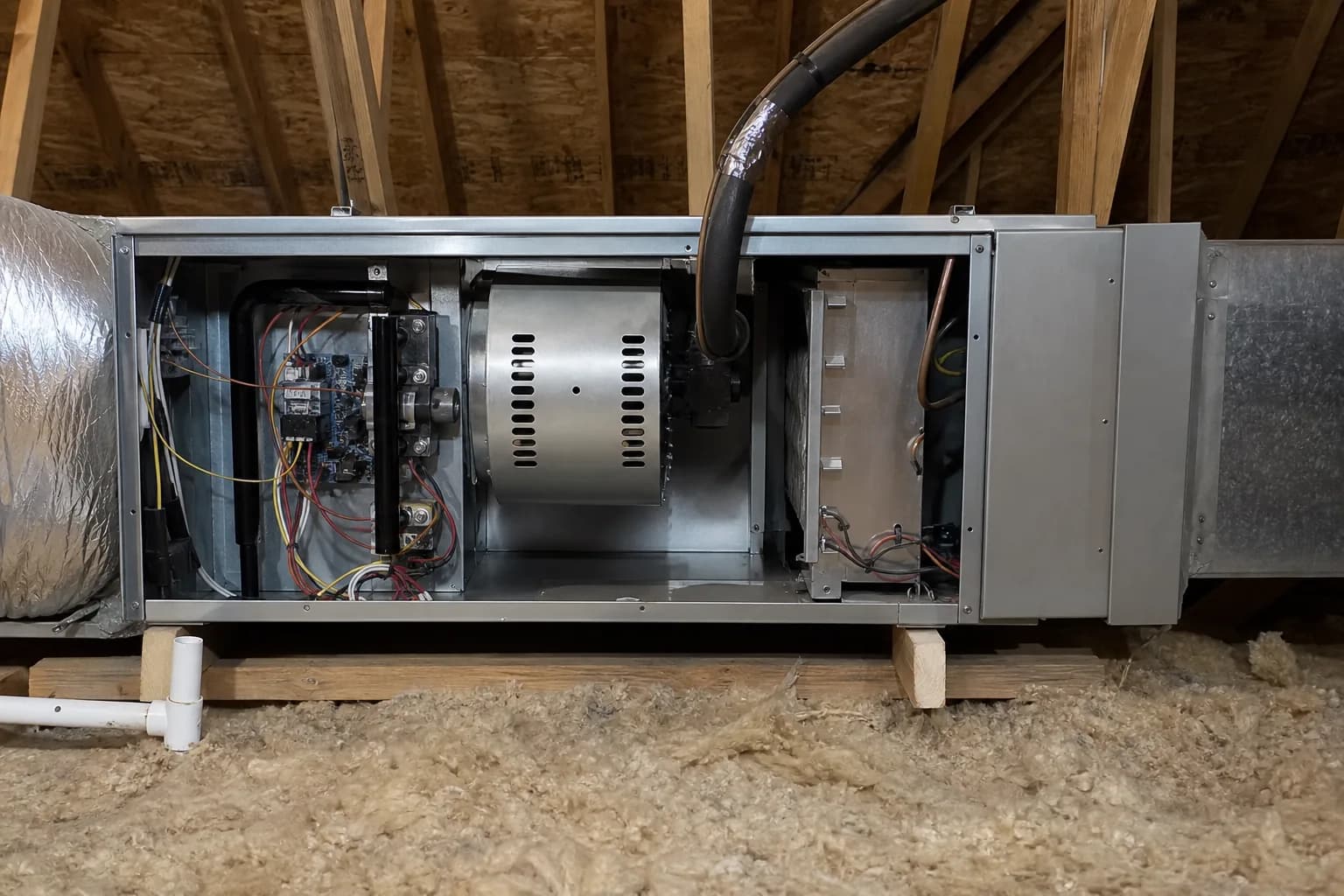
Auxiliary electric resistance heat strips inside the air handler are the safety net for heat pump performance below the unit's effective range. In Baldwin County standard installations they engage when the heat pump alone can't keep up — usually at outdoor temperatures below 35°F, or when indoor temperature lags more than 3°F below thermostat setpoint. They cycle in stages: first stage of strips, then second stage if first stage isn't adequate, then occasionally a third stage on larger systems.
During a Fort Morgan cold snap, aux strips engaging is correct behavior. Aux strips engaged for hours at a time without the indoor temperature catching up — that's the diagnostic signal. It points to one of three things, and walking through which one is happening is most of the diagnostic call.
Possibility one: the strip heat capacity is undersized for the home's heating load at the actual outdoor design temp. This is the most common finding on Fort Morgan emergency calls during peninsula cold events. A 2,000 sq ft beach house with 10kW of strip heat — the manufacturer default for this latitude — will struggle to maintain 68°F when outdoor is 24°F and there's a 14 mph Gulf wind driving a 35°F wind chill across single-pane windows and a slab on grade. The math just doesn't close. The fix is either upsizing the strip heat capacity (a heating installation quote covers this) or accepting a lower setpoint during peak cold and adding backup heat sources for occupancy comfort.
Possibility two: the home has air-leakage issues that the strip heat is trying to overcome. Fort Morgan's vacation rental and second-home inventory leans heavily on construction patterns from the late 1990s and early 2000s, and the building envelope quality on those homes varies wildly. Direct Gulf-front exposure means weather strips degrade faster, window seals fail earlier, and wind-driven infiltration moves more conditioned air outside than the same house would lose thirty miles north. Strip heat fights an air-leakage battle until it loses; a blower-door test would tell you what fraction of your peak heating load is going to envelope leakage rather than usable indoor air.
Possibility three: an actual equipment fault. A high-limit switch tripping intermittently on the air handler, a sequencer relay that engages the second stage of strips inconsistently, a thermostat configuration that's calling for aux heat in a logic the manufacturer didn't intend. These are the calls that produce a same-visit fix once the panel is open.
Step three: the 6°F differential that won't close
When the indoor reads 62°F and the thermostat is set to 68°F, the system has a 6°F deficit it can't close. That's the hardest symptom to interpret because it could be any of the three possibilities above, all of them stacked, or a fourth issue specific to the building.
Time to closure is the diagnostic. A properly sized system on a properly sealed house should close a 6°F deficit in two to four hours when outdoor is 28°F. If you've been running the system for six-plus hours and the indoor is still six degrees below setpoint, the system is undersized for the actual heating load — either by equipment selection, by strip heat sizing, or by building envelope leakage that's effectively making the system "smaller" than its rated capacity.
The Fort Morgan-specific wrinkle here is that vacation rental occupancy patterns make this worse. A house that's been allowed to drift to 50°F indoor during a two-week empty period is starting from an 18°F deficit when the renter arrives Friday at 4 p.m. expecting 68°F by dinner. That math is not going to close on a heat-pump-only system with stock strip capacity, and the Saturday morning emergency call that follows is the consequence of an occupancy pattern, not an equipment failure. The standard advice for Fort Morgan property managers is consistent: minimum thermostat setting during empty windows is 60°F, not 50°F, and recovery time from any setpoint expects an hour per degree of deficit at temperatures below 35°F.
Why peninsula geography makes it worse than Spanish Fort or Bay Minette
Fort Morgan looks moderate on a map. Water on three sides should mean ocean-moderated air temperatures, milder winters than the inland mainland, and an HVAC environment that's easier than thirty miles north in central Baldwin. In practice it doesn't work that way during cold events.
Two things go against the peninsula. First, the body of land itself is narrow — at the fort, less than half a mile wide — and the thermal mass of that strip of sand and coastal scrub is very small. Once nighttime sky clears and any onshore breeze shifts offshore (which is the typical pattern during the high-pressure systems that produce hard cold snaps in Baldwin County), the peninsula loses heat rapidly to the open sky and to the surrounding water, which during a cold event is actually colder than the air. Overnight lows on the peninsula during clear-sky cold events typically run 2-4°F below comparable readings at Gulf Shores proper and 3-5°F below the Spanish Fort tight-build winter pattern.
Second, the wind. Wind off the Gulf during a cold snap is a sustained 12-18 mph rather than the breezy variability of normal weather, and that wind drives infiltration through every weather strip and window seal in the house. A heat pump rated for 28°F design conditions performs differently against 28°F still air than against 28°F with a 16 mph wind on a Gulf-front beach house. The wind chill matters less for the equipment (compressors don't care about wind chill — they care about actual air temperature across the outdoor coil) than for the building envelope and the occupant comfort calculation.
The result is that Fort Morgan's effective design winter temperature for HVAC sizing should be 22-24°F, not the 28-30°F that mainland Baldwin uses. Equipment specified to mainland design temps will run undersized on the peninsula during real cold events, and that's a meaningful share of why Fort Morgan emergency call volume during cold snaps disproportionately exceeds what the housing density alone would predict.
What typically gets found when the panel is open
For a $79 service-fee diagnostic on a Fort Morgan home running the symptoms above, the most common findings:
A 2,000-2,400 sq ft beach house with 10kW strip heat and a 2.5-ton heat pump, properly installed and maintained, that's simply outsized by the load on a 24°F day with Gulf wind. No equipment fault. Recommendation: upsize to 15kW strips, or upgrade to dual-fuel with a small gas furnace as backup, or accept the cold-snap performance limit and plan for it during occupancy.
A heat pump in years 8-12 of service life with a tired compressor that's lost 15-20% of its rated capacity through normal aging. The same unit performs adequately in 35°F+ weather but can't bridge the gap during peninsula cold events. Repair is typically a refrigerant top-off and capacitor replacement, and the conversation pivots to whether the unit is a good candidate for full replacement given the salt-air corrosion that affects most Fort Morgan condensers around year 10-12. Free replacement estimates as standard.
A defrost board failure on the outdoor unit causing the system to either skip defrost cycles entirely (icing failure) or fire defrost too aggressively (excessive backward operation that drains indoor heat). Defrost board replacement is the fix. The same defrost-cycle pattern shows up in heat pumps inland — see the Summerdale MLK weekend defrost behavior post for the diagnostic — but the peninsula sees it more often because cold events here run colder.
An undersized aux heat sequencer that engages first-stage strips reliably but won't bring on second-stage when first stage isn't adequate. Replacement is straightforward, and the immediate effect is dramatic — a system that couldn't close a 6°F deficit suddenly closes it in two hours.
What to do this MLK weekend
If you're reading this Wednesday or Thursday before the forecast cold and you've got a Fort Morgan property — owner-occupied or rental — the practical checklist for the next 48 hours:
Run the system to setpoint today, before the cold arrives. If aux strips don't engage during the test, that's a Thursday call, not a Saturday call. Same logic the Fairhope MLK weekend defrost behavior post walks through for inland properties.
Walk the outdoor unit. Confirm it's clear of accumulated leaves, fronds, and storm debris. The peninsula's salt-air environment plus winter wind means outdoor coils accumulate debris faster than inland units; airflow restriction during a cold snap is one of the faster paths to a defrost failure.
Check the strip heat data plate on your air handler. Model number includes the kW rating. If you're running 10kW on a property over 2,000 sq ft and you've had cold-weather performance issues before, this is the time to upsize — a strip heat upgrade typically fits in a single half-day visit.
For absentee and rental properties, set the minimum holding temperature at 60-62°F, not 50°F, and plan for a multi-hour recovery if the property has been empty. Tell incoming guests the house will be warming up when they arrive Friday evening and won't reach setpoint until late Friday or early Saturday. The frustration that comes from setting it to 72°F at check-in and getting 64°F by midnight is a misunderstanding of physics, not an equipment failure.
If you do see a failure — outdoor coil iced solid, breaker tripping, no warm air at the registers despite continuous operation — call 251-383-HVAC. The peninsula is a single-road service area; routing time matters and triage runs by severity. Fort Morgan rental occupancy emergencies during cold events get prioritized routing the same way they do during summer peak season. The Fort Morgan service-area page covers peninsula coverage in more detail. Emergency calls answered 24/7, every day of the week, including holidays, no Saturday upcharge during regular hours.
A heat pump on a Fort Morgan beach house in mid-January earns its money — or finds out it isn't going to.
FAQ
- Why is Fort Morgan colder at night than Gulf Shores or Orange Beach during a cold snap?
- Peninsula radiative cooling. Fort Morgan is bounded by water on three sides, but the peninsula itself is a narrow strip of land that loses heat rapidly to the open sky once nighttime cloud cover clears and ocean influence shifts to leeward. Overnight low temperatures on the peninsula during clear-sky cold events typically run 2-4°F below comparable readings at Gulf Shores and 3-5°F below Orange Beach. That's enough to push borderline heat pump performance into outright failure for a unit not sized for the lower design temp.
- What size aux heat strip do I need in a Fort Morgan beach house?
- Bigger than the manufacturer default for our latitude. A 2,000 sq ft Fort Morgan home running 10kW of strip heat will hold setpoint down to about 22°F outdoor, which is below most Baldwin Co. design temps but realistic for a peninsula cold-snap event. The right spec is typically 15kW for Fort Morgan homes over 2,000 sq ft and 20kW for vacation rentals where occupancy patterns are unpredictable. The strip heat upgrade is meaningfully cheaper at install than the alternative of frozen pipes during an unattended cold event.
- My Fort Morgan rental sat empty for two weeks before I drove down for MLK weekend and the heat pump won't catch up. What's wrong?
- Probably nothing's wrong with the unit — it's the catch-up math. A 2,000 sq ft beach house allowed to drop to 50°F internal during an empty period needs roughly 18-30 hours to recover to 68°F if outdoor is 32°F, and longer if outdoor is colder. Heat pump capacity falls off rapidly below freezing and aux strips alone can take a long time to make up a 15-18°F differential. The fix isn't usually equipment failure; it's setting the thermostat to 60-62°F minimum during empty windows so recovery starts from a smaller deficit.
- Should Fort Morgan rentals invest in dual-fuel or backup gas heat?
- For year-round-rented properties, increasingly yes. Dual-fuel systems pair a heat pump for normal-weather operation with a gas furnace that takes over below a balance-point temperature. The capital cost is significant, but the cold-snap reliability is dramatically better and the pipe-freeze risk during peak winter rental weeks drops to near-zero. ACExperts gives free estimates on replacements and walks through the dual-fuel cost-benefit during the in-home visit.
Need this handled?
Straight to the service page for your town — pricing, local details and a form that reaches a technician.
More from Mlk Cold Snap

ACExperts HVAC
We Take The Heat So You Don't Have To
Fast, honest heating and air service across Baldwin County. Speak with a technician and get on the schedule today.