
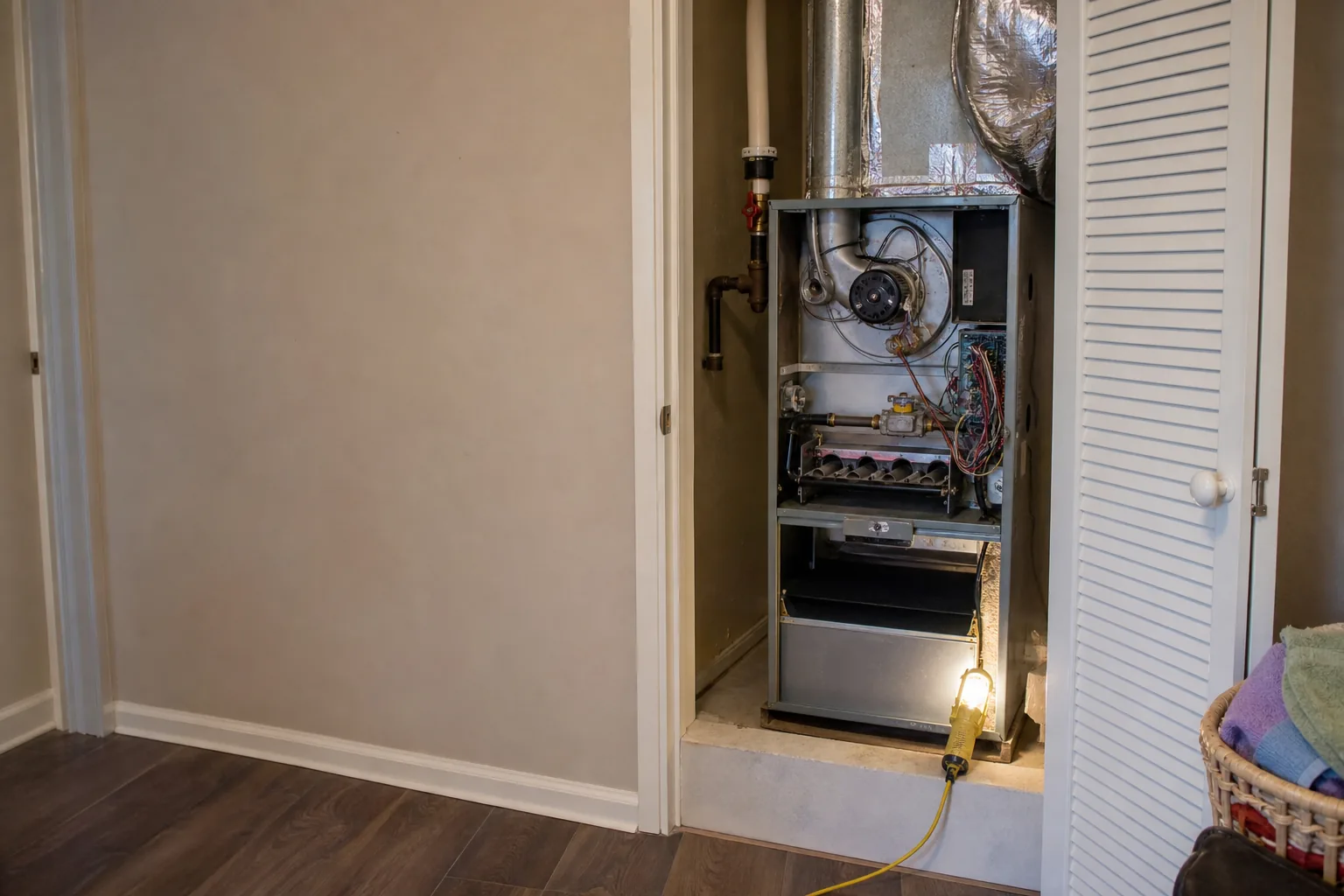
5 Thanksgiving Prep Mistakes Elberta Homeowners Keep Making
5 Thanksgiving HVAC prep mistakes Elberta homeowners make — when a system that's been off all week picks the worst afternoon to fail, and how to avoid each one.
Published 2026-11-04 · Updated 2026-11-04
Author: Landon Jahnke | ACExperts251
Reviewed by: Landon Jahnke · Owner · Alabama HVAC License AL #16117 · EPA 608 Certified
We've all done this — and I include myself when I'm not in HVAC mode. Three days before Thanksgiving with twelve people coming for dinner, you walk past the thermostat, drop the heat from 70°F to 67°F to "save some money before the bill hits," and then crank it back up Wednesday afternoon when guests start arriving. The system that's been off for 11 hours and is suddenly asked to deliver 12,000 BTU of heat at peak load? It picks Wednesday afternoon to fail.
We've all done it. Here are the five Elberta-specific versions of that mistake — and how to avoid them.
Mistake 1: skipping the fall heating check because "it ran fine last year"
This is the same logic as the spring AC tune-up mistake, but with sharper consequences. A heating system that ran fine in March is not necessarily a heating system that will run fine in November. Eight months of dormancy do things to mechanical and electrical components that you can't see by glancing at the thermostat:
- Capacitors degrade in storage. A run capacitor sitting unused through Elberta summer humidity will drop microfarad capacity. Heat pumps depend on the same capacitor for cooling and heating cycles, so if your AC ran fine in October, the capacitor might still be marginal — and a marginal capacitor under heating load with auxiliary strip demand is exactly what causes Wednesday-afternoon failures.
- Heat exchangers crack invisibly. Gas furnaces in older Elberta homes — particularly the post-war construction in Old Elberta and the German Heritage District — have heat exchangers that develop hairline cracks from thermal cycling. A cracked heat exchanger can leak carbon monoxide into the supply airstream. You won't see it. Your guests won't know. CO detector readings climb slowly through the holiday weekend.
- Inducer motors seize. The small motor that pulls combustion gases through a furnace heat exchanger sits idle from April to November in Elberta. Bearings without lubrication during 6-8 months of summer humidity often need attention before the first sustained heating cycle.
- Igniters fail on first call. Hot-surface igniters have a finite cycle count, and the highest-stress cycle is the first ignition of the season after months of dormancy. In 13 years working Baldwin County HVAC, I've found November is a common month for igniter failures.
A fall heating check catches these marginal components before guests arrive. The heating repair service page covers what's looked at during a fall visit; the Comfort Plan membership ($20/month or $240/year) covers two tune-ups per year — one in spring, one in fall — and gives plan customers priority scheduling, which matters most in November.
Mistake 2: aggressive setback during the week guests are in the house
Energy-efficiency advice tells you to set back the thermostat 7-10°F when you're asleep or away. That advice was developed for steady-state household occupancy and well-tuned modern HVAC. In an Elberta home with 1970s retrofit ductwork, marginal insulation in unconditioned attics, and a heat pump or furnace that's already working harder than spec, aggressive setback during a high-occupancy holiday weekend is a recipe for system failure.
Here's the actual physics of what happens:
- Setback to 62°F at 11pm. System cycles off, house cools toward setpoint over 4-5 hours.
- At 6am, thermostat calls for 70°F recovery. The heat pump comes on at full capacity. If outdoor temperature is below 35°F, auxiliary heat strips engage to supplement. Total electrical load at recovery is 4-6x the steady-state load.
- Twelve guests in the house add 1,200-1,800 BTU of body heat. That sounds like it helps — but it actually slows recovery in some rooms (kitchen overheats while guest bedrooms lag) and creates uneven thermostat readings that confuse the system.
- Sustained high-amperage operation for 60-90 minutes. Components that were marginal coming out of summer dormancy now run at their highest stress condition of the year. Capacitors, contactors, heat strips, and inducer motors fail at this load.
The smarter strategy: hold steady at 68-69°F throughout the holiday weekend. The energy savings of aggressive setback are dwarfed by the cost of a Wednesday or Thursday emergency service call, and the comfort difference for guests is meaningful.
Mistake 3: ignoring filter status because it's "not summer"
Filter changes are summer behavior in many Elberta households. The cooling system runs hard from May through September, the filter loads visibly with dust and pollen, and the homeowner remembers to swap it. Then the AC stops running in late October, the filter looks "still good," and it stays in place through the heating season.
The problem with that pattern: heating-mode airflow runs through the same filter, and the static pressure from a partially-loaded filter affects heating performance differently than cooling performance.
- Furnace heat exchangers depend on adequate airflow to dissipate combustion heat. A restricted filter raises temperature differential across the heat exchanger and accelerates metal fatigue. Cracked heat exchangers in 8-12 year furnaces frequently trace back to chronic filter restriction.
- Heat pump auxiliary strips need full airflow to deliver design heat output. A restricted filter strangles airflow, keeps the strips on longer, raises electrical bills, and stresses the components.
- The filter you couldn't quite see through in October is fully blocked by Thanksgiving. Pollen and dust load is cumulative. A filter at 70% capacity in October is at 90% capacity by mid-November after six weeks of furnace runtime.
Replace the filter in early November before Thanksgiving prep starts. Mark the date on the frame. Plan to replace again in late January and again in March. The indoor air quality service page covers filter strategy in more detail.
Mistake 4: stacking holiday cooking heat on top of HVAC demand without thinking through it
This one is unique to holiday weekends. Thanksgiving cooking generates significant heat in the kitchen — turkey roasting at 325°F for 4 hours, multiple sides on the cooktop, oven open intermittently for basting and timing. A typical Thanksgiving kitchen runs 8-12°F warmer than the rest of the house during peak cooking hours.
The thermostat — which is almost always located in a hallway or central living area, not the kitchen — sees the warmth bleed from the kitchen and decides the house is satisfied. The heating system stops calling. Bedrooms and bathrooms at the far end of the duct run start dropping 4-6°F below setpoint. Guests get cold. Someone walks to the thermostat and overrides to 75°F. The system kicks on hard, the kitchen is already 80°F from the oven, and now the system is fighting to satisfy a thermostat that's reading the wrong room.
The Elberta-specific version of this mistake: older homes with retrofit ductwork from the 1970s often have airflow imbalance between rooms even before holiday cooking adds variable thermal loads. In Stonewood, Pinewood Estates, and similar neighborhoods, master bedrooms can run noticeably colder than the kitchen on a steady-state day — and Thanksgiving makes that gap worse.
The fix is operational, not equipment-based:
- Open interior doors to circulate air between cooking and non-cooking zones.
- Run kitchen exhaust fan during heavy cooking to vent excess heat outside instead of letting it skew the thermostat reading.
- Use a portable thermometer in the bedrooms and bathrooms and adjust based on those readings, not on the central thermostat.
- Hold setpoint at 68-69°F instead of overriding to 75°F when cold guests complain — the override is what cascades into oven heat fighting heat-strip output and shutting the system into protective lockout.
Mistake 5: assuming the heat pump can handle the holiday weekend cold snap without preparation
Baldwin County weather is unpredictable. Most Thanksgivings run 60-70°F daytime, mid-40s overnight — comfortable for heat pump operation without aggressive auxiliary heat. But every 4-5 years, a Thanksgiving cold front pushes through with overnight lows in the upper 20s and daytime highs barely cracking 50°F. When that happens, the heat pump shifts from primary heating to assistance mode, and auxiliary strips carry the bulk of the load.
In Elberta specifically, the Elberta service area page covers the housing context — modest construction on generous lots, 1970s-era central heat retrofits in many properties, mid-century brick ranches with original ductwork — and the heat-pump-plus-strip configuration is the most common installed system. When the strip is asked to do real work for the first time of the season, three failure modes show up regularly:
- Strip element failure. The resistive element has burned out from prior cycling. Breaker trips. House drops to heat-pump-only output, which lags during cold snap.
- Sequencer failure. The mechanical or electronic sequencer that staggers strip activation has stuck. Either all strips engage simultaneously (overcurrent trip) or no strips engage (insufficient heat output).
- Limit switch trip. A safety switch in the air handler trips because supply air temperature exceeded design due to airflow restriction. System locks out and won't reset without manual intervention or a service call.
A pre-Thanksgiving heating check tests all of this before holiday cold demands it — strip current draw against nameplate, sequencer staging, limit switch operation, baseline documented. The heating installation service page covers what proper system commissioning looks like — many of the issues found at fall checks trace back to commissioning gaps that a current service visit can document.
What to do this week if Thanksgiving is in three weeks
Three weeks out from Thanksgiving, your prep checklist is short but specific:
- Schedule a fall heating check for the next 10-14 days. Slots fill quickly through November.
- Replace the filter today. Mark the install date on the frame.
- Run the heating system for 30 minutes on a cool morning to confirm it operates correctly. Listen, smell, walk the registers.
- Decide your thermostat strategy now — steady 68-69°F is the right answer for high-occupancy weekends. Lock it in.
- Walk the house for any rooms that consistently run colder or hotter than the thermostat reading. If there's a meaningful imbalance, that's a separate diagnostic worth running before guests arrive.
For nearby cities running similar heating-prep timing, the Foley city page covers the inland heating-load profile, the Lillian service area page covers bay-front rental properties where pre-Thanksgiving turnover demands the same attention, and the Magnolia Springs city page covers the river-corridor humidity context for shoulder-season heating.
Phone line runs Monday-Saturday 8am-6pm; emergency calls at any hour, every day with no Saturday upcharge. Fall heating checks book up fast in November — don't wait. Same-day service in Elberta when routing allows. Diagnostic visit is $79. Comfort Plan members get $0 service fees and priority scheduling, which matters more in the week before Thanksgiving than any other week of the year.
FAQ
- Is a Wednesday-before-Thanksgiving service call really that hard to get?
- Yes. The week before Thanksgiving is the single busiest week of fall for heating service across Baldwin County. Every contractor in the area is running double-routed days, and the calls that come in Wednesday morning often can't be scheduled until the following Monday. Saturday-of-Thanksgiving slots fill by Tuesday evening. The smart play in Elberta and similar small towns is to schedule a fall heating check in early-to-mid November when slots are still open, rather than calling Wednesday at noon when twelve people are arriving in three hours.
- Why does the heat strip burn out the first time the heat pump runs after a long-off period?
- Because heat strips are resistive electric elements that pull significant amperage when energized, and they're often the first thing to fail when a marginal heat pump can't reach setpoint quickly. When a homeowner sets back to 60°F overnight or while away for the weekend, the heat pump struggles to recover at the morning setpoint of 70°F, the auxiliary heat strips kick in to assist, and a strip that was already marginal from corrosion or thermal cycling fails under the sudden load. The breaker trips, and the homeowner is left with heat-pump-only operation that cycles longer than the family expects. The fix is replacing the strip — but the better path is annual inspection that catches the marginal strip before peak usage.
- What's the right thermostat strategy for a Thanksgiving full-house weekend in Elberta?
- Set the thermostat where you want it and leave it there. Don't aggressively setback overnight when guests are in the house. Don't crank up Wednesday afternoon expecting the system to recover quickly with twelve bodies adding heat load. Don't override to 75°F because someone is cold — adjust airflow or add layers instead. The most reliable Thanksgiving HVAC strategy in Elberta homes with older retrofit ductwork is steady-state operation: 68-70°F set point, no setbacks, supplemental space heat in any room that's underperforming. The goal is to never demand a sudden recovery from the system.
- Should I run my furnace a few times before Thanksgiving as a test?
- Yes — this is one of the highest-value pre-holiday actions you can take. Two weeks before Thanksgiving, on a cool morning, set the thermostat to 72°F and let the heating system run for at least 30 minutes. Listen for unusual noises. Smell for the burning-dust smell that's normal in the first run of the season. Walk to each register and confirm warm air is delivering. If anything is wrong — no warm air, strange noises, smoke, gas smell, breaker trips — you have time to address it before guests arrive. If the system runs clean, you've established a baseline and confirmed Thanksgiving readiness.
Need this handled?
Straight to the service page for your town — pricing, local details and a form that reaches a technician.
More from Thanksgiving Prep

ACExperts HVAC
We Take The Heat So You Don't Have To
Fast, honest heating and air service across Baldwin County. Speak with a technician and get on the schedule today.