
Why Elberta IAQ Matters More in February Than You'd Think
A composite from 13 years working Baldwin County HVAC: when the February smell complaint isn't HVAC, and the weekend IAQ fix before calling a tech.
Published 2026-02-09 · Updated 2026-02-09
Author: Landon Jahnke | ACExperts251
Reviewed by: Landon Jahnke · Owner · Alabama HVAC License AL #16117 · EPA 608 Certified
Here's a composite illustration drawn from 13 years working Baldwin County HVAC — a February smell call I've handled enough times that the pattern is worth walking through in one piece. The homeowner's note usually opens something like: "My wife says the house smells like an old hotel room. We just had the AC serviced in the fall. What did the tech miss?"
The honest answer is usually that the tech hadn't missed anything. The fall service report is clean. Capacitors in spec. Refrigerant charge correct. Drain flowing. Filter changed. Coil wiped down. Nothing on that ticket explains why the house smells like a 1987 Holiday Inn four months later.
The kind of home this happens in: 1990s ranch, heat pump, snowbird occupancy. Twelve minutes inside the house is usually enough to identify what's going on, and once it's named the homeowner can fix it themselves in about 90 minutes that weekend. The smell isn't HVAC equipment failure. It's indoor air quality — a different problem with a different fix, and the difference matters.
Here's how that diagnostic typically goes, what gets found, and why February in Elberta is the worst month of the year for this specific complaint.
What gets ruled out first
Before any HVAC tech worth their license calls something an IAQ problem instead of an HVAC problem, the equipment side gets ruled out. The order:
Coil condition. Pull the access panel on the air handler, shine a light at the indoor coil. You're looking for biofilm or slime. A clean fall service typically leaves the fins white and dry.
Drain pan and condensate line. A float-switch reservoir should be dry in February — a heat pump in heating mode isn't producing condensate. Drain line should be clear, P-trap should have water in it (that's what blocks sewer gas from migrating up through the line).
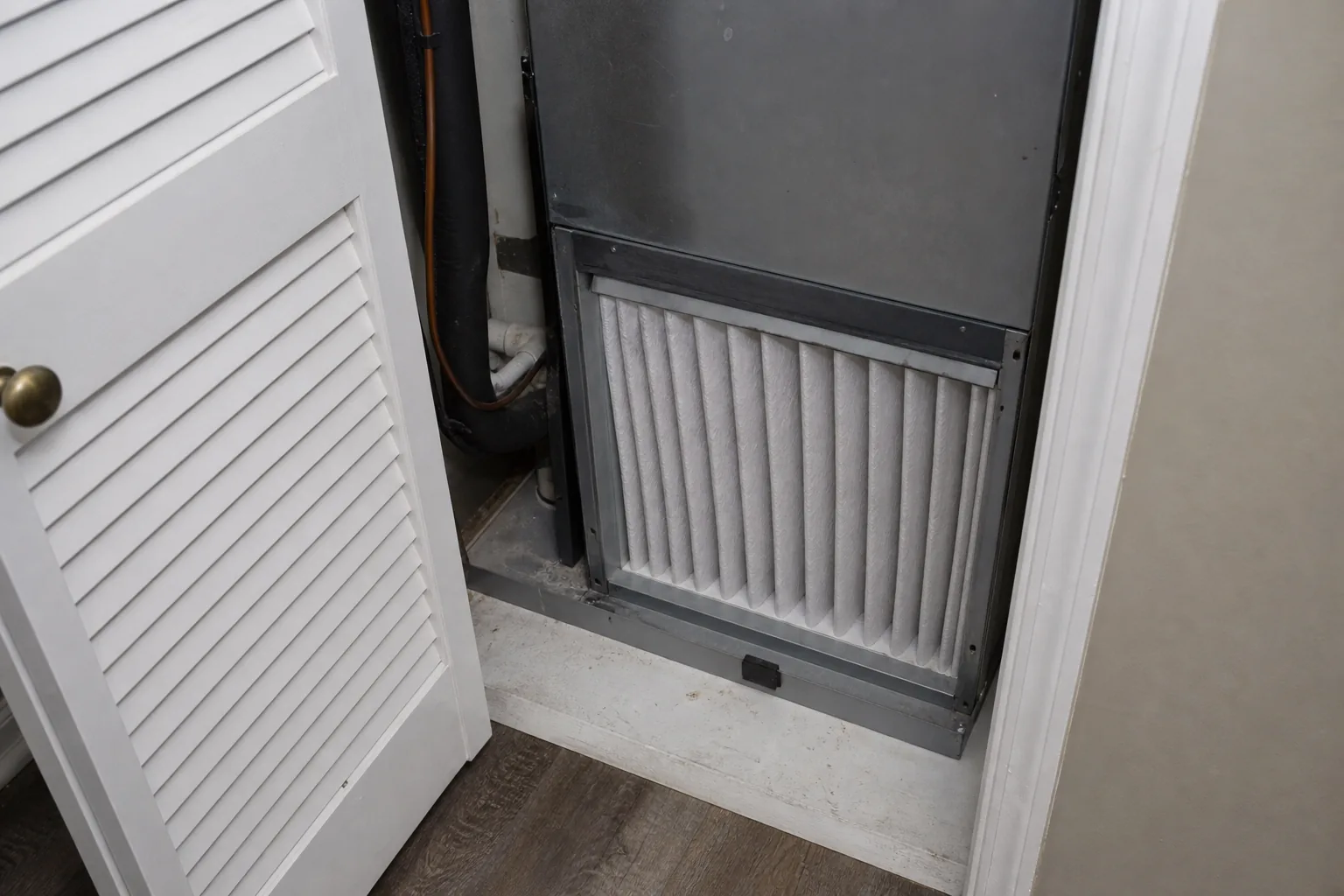
Filter. Pull the media filter, check loading. Replace as a baseline reset even if it looks serviceable.
Refrigerant temps and pressures. Heat pump in heating mode, outdoor temp in the 40s, indoor coil temps reading appropriately. No short-cycling, no defrost issues, no refrigerant migration symptoms.
Air handler housing. This is where stale-smell calls usually trace back when the source is HVAC — the foam insulation inside the cabinet absorbs moisture over years, becomes a substrate for organic growth, and the smell is released every time the blower starts. A clean cabinet rules this out.
When the equipment checks clean, it's time to ask different questions.
The questions that actually matter
The three questions I'll ask a homeowner once the equipment checks clean:
- When did the smell start, and was it gradual or sudden?
- Has anyone been doing laundry less often than usual?
- When was the last time you ran a load through the dishwasher with the door left cracked open afterward?
A gradual 7-to-14-day onset usually points away from HVAC and toward something accumulating in the house. Backed-up laundry, occasionally compounded by a wet load left in the washer overnight, is a routine contributor. Dishwasher seals holding standing water between runs is another. And nobody runs the dishwasher and then leaves the door cracked — why would they.
The combination, on a typical call like this:
- Damp laundry sitting in a hamper in a closet for over a week, plus a load that's been left in the washer overnight more than once.
- A dishwasher whose internal seals have been holding standing water for weeks because the unit hasn't run in long enough cycles to flush.
- A kitchen-sink P-trap that's partially dried out because that sink has been used less often than the bathroom sinks during a stretch of low occupancy or travel.
Three sources, all biological, all releasing gas-phase volatiles into the air, all being recirculated by an HVAC system that's working perfectly to distribute the smell evenly throughout the house.
Why February is the worst month for this in Elberta
This is the part that connects to your house specifically.
Elberta sits about 8 miles inland from the Gulf and roughly 18 miles south of Mobile Bay. The Elberta service area page gets into the housing-stock context, but the climate piece matters here too. February in Elberta means:
Outdoor temps in the 40s and 50s. Heat pumps run in short cycles. The indoor coil stays around 95-105°F when the system is in heating mode, which is too warm to condense moisture. So whatever's in the air stays in the air.
Tight house, low ventilation. Windows have been closed since November. Whatever volatiles get released — laundry, dishwasher, a P-trap, a dog bed, the rug under the dining table — accumulate. There's no makeup air dilution.
Snowbird occupancy peak. The seasonal residents have been here since October, and the houses that were lightly used between June and September have had four months of continuous occupancy. Cumulative load on every absorbent surface in the house — upholstery, drapes, area rugs, mattresses — is at its annual peak.
Valentine's weekend visitors. Families come in for the long weekend. Houses go from two-person to five-person overnight. The IAQ baseline doubles. Anything that was borderline-tolerable becomes obvious.
In summer, all of this is masked by the AC running 14-18 hours a day, dehumidifying the envelope, condensing volatiles out of the air across the cold coil, and exchanging air through the system at a high rate. In February, the heat pump is doing maybe 4-6 hours of run time on a moderate day, and the indoor air just sits.
The 90-minute fix the homeowner can do themselves
Here's the weekend playbook, in order:
1. Run the dishwasher empty on the hottest cycle, then leave the door cracked for two hours. This flushes the seals and lets the interior dry. Repeat once a week as ongoing maintenance.
2. Empty every laundry hamper in the house. Do all the laundry. Don't leave wet clothes in the washer overnight ever again. The washer drum and gasket dry properly only when the machine isn't holding wet fabric.
3. Pour about a half-gallon of warm water down every sink, tub, and floor drain in the house, including the laundry drain and the kitchen sink. This refills any P-trap that's dried out and re-establishes the water seal that blocks sewer gas.
4. Pull the rugs and run them through the cleaner. Rugs absorb moisture and hold it. After four months of winter occupancy they need a reset.
5. Run the HVAC fan in continuous mode for 24 hours. This circulates the air through the filter at a steady rate, gives the new filter a chance to capture what's airborne, and helps equalize the air across the house rather than letting smelly zones concentrate.
When the underlying source was non-HVAC, the house usually smells like a different house by Sunday night. Diagnostic visit fee, $79. That's it — no equipment was broken.
What I want Elberta homeowners to take from this
The HVAC system is an air distribution system. It moves whatever is in your house around your house. If your house has an IAQ problem, the HVAC will faithfully spread that problem to every room. That's not the system failing — that's the system doing its job, on a problem the system isn't designed to solve.
When somebody calls about a stale or strange smell in February, the diagnostic order is:
- Rule out coil, drain pan, and air handler housing as biofilm sources.
- Verify the filter is current and appropriately MERV-rated for the system.
- Check the condensate trap and the P-traps in every plumbing fixture.
- Ask about laundry, dishwasher, and trash habits in the previous two weeks.
- Ask about pets, especially in carpeted bedrooms.
- Check whether any humidifier has been added during winter (these are a major IAQ culprit when not maintained).
Most of the time the source ends up in non-HVAC territory. The remaining cases usually trace back to a real coil or drain or housing issue that wasn't fully addressed in the previous service. Both outcomes are worth knowing before you spend money on equipment.
For Elberta homes specifically, the indoor air quality service overview gets into what the integrated solutions look like — UV-C, polarized media, whole-home dehumidification — when the basic fix doesn't hold. The preventive maintenance service page explains what we actually do during a tune-up beyond just changing a filter. And the Loxley Valentine's IAQ reset post walks through a similar weekend playbook for inland Loxley homes that have a slightly different occupancy and humidity pattern. The Daphne Valentine's air quality post covers the bay-side variant.
If you're closer to Loxley or Bay Minette than to Elberta, the pattern still holds — see the Bay Minette city page for context on inland-county housing stock, or the Summerdale page for the rural-mid-county profile. The fundamentals are the same: in February, your HVAC is the messenger, not the message.
When you should actually call us
Call us when you've ruled out the obvious sources and the smell is still there after a 24-hour reset. Call us if the smell is musty or earthy in a way that suggests biofilm or mold. Call us if there's a chemical or burning smell — that's an electrical issue that needs same-day attention. Call us if the smell intensifies dramatically every time the system kicks on (that points to coil or drain pan biofilm specifically).
Don't call before you've done the simple stuff. Save yourself the diagnostic fee and the half-day of having a tech in the house. The homeowner in the composite above had it right — they asked the question. The answer just turned out to be on their side of the air handler, not ours.
Hours are Monday through Saturday, 8am to 6pm, with emergency calls answered 24/7, any day of the week, including Saturdays at no extra charge. Same-day response in Elberta when routing allows. Diagnostic visit is $79, credited toward repair if you proceed. We bill out-of-state owners directly when needed. And if your February smell is laundry, dishwasher, and a dry P-trap, we'll tell you that and charge you for one visit — not a system you don't need.
FAQ
- Why does my Elberta house smell stale in February but fine in summer?
- Because in summer your AC runs long enough to dehumidify, the windows are closed but the system is exchanging air across a cold coil that condenses moisture and pulls particulates out of circulation. In February, the heat pump runs in short cycles, the indoor coil stays warm, and any biofilm or organic load on the coil and drain pan re-volatilizes into the airstream every time the blower starts. The smell isn't new — it's been there. It's just being released differently.
- Will a better filter fix a stale-house smell in Elberta?
- A better filter helps with airborne particulates, but a MERV 11 filter doesn't capture the gas-phase volatile organic compounds that produce the 'old hotel room' smell. Those come from biofilm on the coil, water sitting in the drain pan, or off-gassing from soft furnishings that have absorbed moisture. The filter is one part of a three-part fix: filter, coil, drain. Skip any one and the smell comes back.
- Is Valentine's weekend a real spike for HVAC service calls in Elberta?
- It's not the highest-volume weekend of the year — that's the days around Christmas Eve in cold years — but it's a meaningful local spike. Snowbird residents are at peak occupancy, families are hosting visitors, and the indoor air quality complaints peak when houses go from low-occupancy to four or five bodies overnight. IAQ-specific call volume in the second week of February runs noticeably higher than other February weeks.
- Should I run an air purifier in addition to my HVAC system?
- Standalone room purifiers help in the room they're in. Whole-home solutions integrated into the duct system — UV-C on the coil, polarized media filtration, or a dedicated bypass HEPA — address the source rather than the symptom. For most Elberta homes the coil-and-drain fix solves 80% of the smell complaint, and only persistent issues need the integrated equipment.
Need this handled?
Straight to the service page for your town — pricing, local details and a form that reaches a technician.
More from Valentines IAQ

ACExperts HVAC
We Take The Heat So You Don't Have To
Fast, honest heating and air service across Baldwin County. Speak with a technician and get on the schedule today.