
Should Daphne Homeowners Worry About Valentine's Weekend Air Quality?
A Daphne IAQ walkthrough for the Feb 14 weekend — Mobile Bay microclimate, mixed-mode heating, CO risk, and four checks before Friday night.
Published 2026-02-13 · Updated 2026-02-13
Author: Landon Jahnke | ACExperts251
Reviewed by: Landon Jahnke · Owner · Alabama HVAC License AL #16117 · EPA 608 Certified
The risk on a holiday weekend in Daphne usually isn't a dramatic furnace failure. It's the quiet one: low-level carbon monoxide from a combustion appliance, in a closed-up house, on a weekend when nobody's paying attention to the air.
That's the point worth keeping in mind every February. Not because CO emergencies are common — they aren't — but because the underlying point is the right one. Weekend indoor air quality matters more than weekend air temperature, and Daphne homes have a specific cluster of problems that show up right around Valentine's weekend.
This isn't a horror-story post. It's a walk-through of the four things I'd want my own family checking before Friday night, framed around what's actually going on inside a Daphne house in mid-February.
The Mobile Bay microclimate is the whole reason this matters
Daphne sits on Mobile Bay's eastern shore. That changes the math in two ways most homeowners don't think about.
First: the bay moderates temperature. A 30-degree night in Robertsdale lands at maybe 35 along Scenic 98 because the bay is still holding warmth from the prior day. That sounds nice — and it mostly is — except it produces the temperature pattern that wrecks IAQ. Lows in the 30s, highs flirting with 70, sometimes inside the same 24 hours. The system fires the gas furnace overnight, then the AC kicks on by 2 PM. That mixed-mode operation is normal for Daphne in February. It's not normal for a system to handle gracefully.
Second: the bay is a humidity reservoir. Even in February. The air coming off the water carries more moisture than the air a few miles inland in Summerdale or Elberta, and that moisture has to go somewhere. In a tight modern home in The Reserve at Daphne or Hope Vineyard, "somewhere" usually means the indoor coil and the air handler cabinet — because the envelope doesn't let it escape outside.
So you've got a system cycling between heating and cooling on the same day, an indoor coil that gets wet during the afternoon AC cycle and never fully dries, and an envelope that holds humidity against the components longer than the manufacturer assumed when they spec'd the coil coating. The result, by mid-February, is a system that's been running biofilm conditions for three months without anyone noticing.
That biofilm is the substrate for the musty smell that shows up the first weekend you stop running the system long enough to come back to a closed-up house. Which, for Daphne couples, is often Valentine's weekend.
What to actually check before Friday night
Four checks. None of them require us. All of them I'd want my own parents doing.
1. Pull the filter and look at it under good light
Not the porch light. Take it to a window. Daphne's mid-February IAQ problem is rarely large particulates — it's bioaerosol and combustion byproduct, both of which look like discoloration and faint streaking, not like fuzz. A filter that "looks fine" but is two months old is doing nothing for you. Replace it.
If you don't know what MERV your system is rated for, MERV 8 to 11 is the safe range for almost every Daphne home. MERV 13 sounds better and often is — but only if a tech has measured static pressure and confirmed the blower can handle it. Otherwise you starve the airflow, the coil freezes intermittently, and you've made the IAQ problem worse while feeling virtuous about it.
2. Test every CO detector and replace any older than five years
This is the boring one and it's the one I care about most.
Combustion appliances in Daphne homes: gas furnaces (less common than in Bay Minette but still here, especially in older Lake Forest homes), gas water heaters (common everywhere), gas ranges, gas fireplaces, and the occasional standalone propane heater someone bought during the January cold snap and didn't return. Any of those can produce CO. None of them produce dangerous levels under normal operation. All of them can shift to dangerous levels when something's wrong — a cracked heat exchanger, a clogged flue, a downdraft caused by a bath fan running with no makeup air.
Cheap CO detectors only alarm above 70 ppm sustained. The continuous low-level exposure that does cumulative health damage happens at 30-50 ppm — below the trigger point. Replace alarm-only detectors with low-level digital ppm-readout models on every floor. About $40 each. The math is not close.
If you've never had a combustion analyzer run on your system, that's the upgrade for next month. We bring one on every gas-fired diagnostic visit and the readout is the actual data, not a guess.
3. Walk the supply registers and feel the airflow
Stand at every supply register with the system running and put a hand in the airstream for ten seconds. You're checking three things: that air is actually moving (not all of them will be moving the same), that it's not noticeably colder or warmer than the others, and that it doesn't smell.
Smell is the one homeowners undertrain on. A musty supply register in February in a Daphne home almost always means the indoor coil is biofilmed up from the mixed-mode cycling I described earlier. That doesn't fix itself. It needs a coil cleaning. We do them as part of preventive maintenance visits and they're the difference between a Valentine's weekend that smells like the house and one that smells like the air handler.
4. Look at the return grille and the area around it
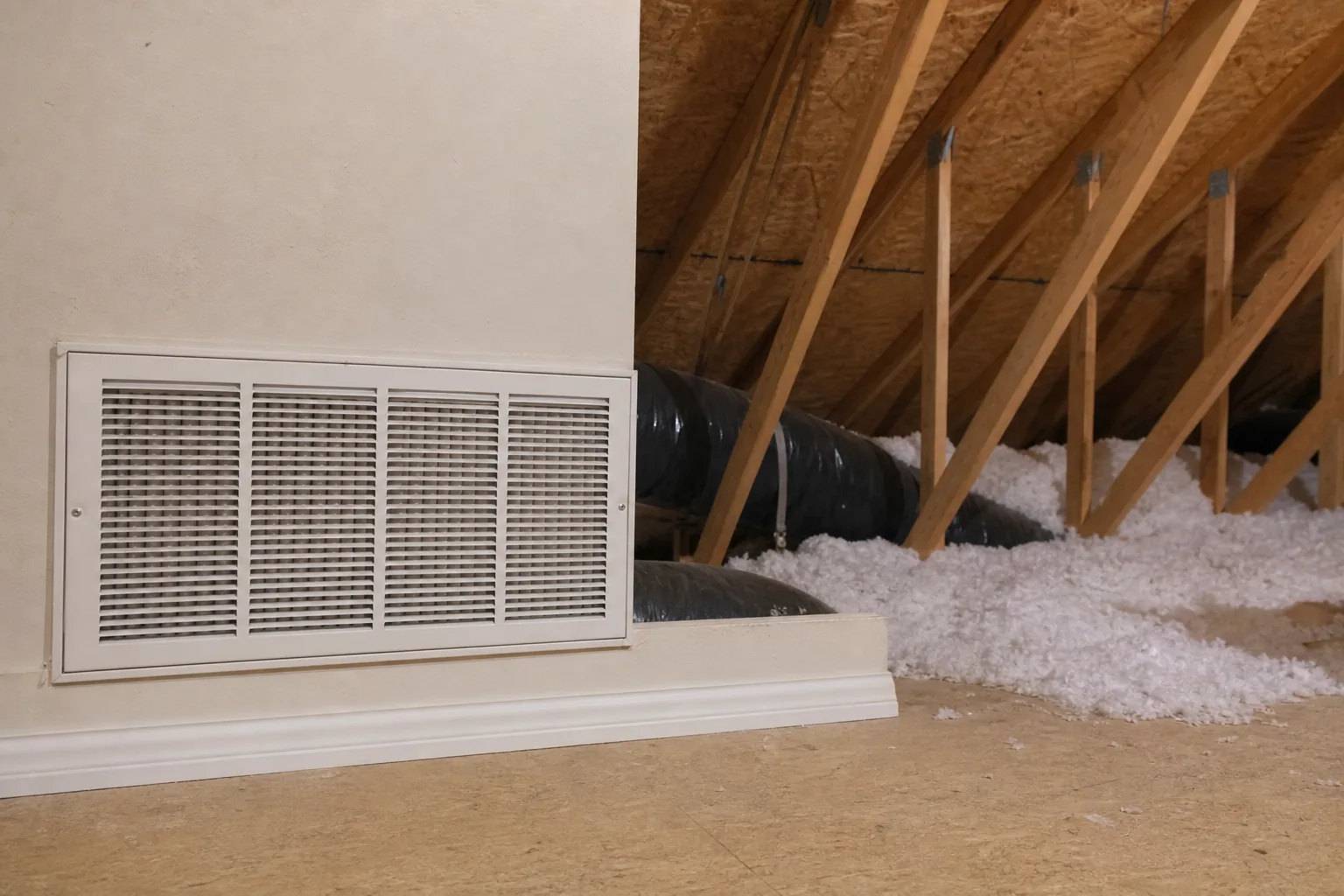
Returns get less attention than supplies because air goes in instead of out, but they tell you more about IAQ. Pull the return grille off (most are held in by two screws) and look at what's accumulated on the back side and on the inside of the duct just past it.
What you're looking for: pet hair (expected), dust (expected), and dark gray-green discoloration on the duct interior (not expected). The third one is biofilm growing in the return because humidity is condensing in the duct on cool nights. That's the Daphne special — tight envelope, mixed-mode operation, marginal duct insulation in attic runs. If you see it, that's a call worth making.
What gets missed every Valentine's weekend
A few things I see in the field every February that are worth flagging:
The fireplace IAQ load. Wood fires are romantic. They're also a particulate firehose. If you light the fireplace Friday night, the supply air for the next 48 hours is carrying combustion residue through the system. Run the system fan in "on" for the four hours after the fire dies down to filter it out instead of letting it settle on the coil.
Candles. Same problem, smaller scale, but cumulative if you burn them every night. Soy candles are meaningfully better than paraffin for indoor air. Either way, a HEPA-grade portable filter in the bedroom for the night they burn is worth $80.
The houseguest factor. If you've got family in town for the holiday weekend — and Daphne in February is mild enough that out-of-state in-laws find reasons to visit — you've got 30-50% more occupant load on a system that's been running on autopilot since Christmas. Filter changes get pushed back. Bath fans run more. Cooking is heavier. The system absorbs all of it. None of it shows up in the thermostat reading.
The Sunday-morning tell. If the house smells different to you Sunday morning than it did Friday morning when you left it, that's the IAQ sentinel. Trust your nose. The reset is usually a filter change plus a 30-minute fan-on cycle plus opening windows for 15 minutes if the day is mild — which in Daphne in February, it often is.
What we do if you call us this weekend
We answer emergency calls around the clock, every day in Daphne, including Saturdays at no extra charge. On a Valentine's weekend we'll prioritize anything that involves a CO alarm, a no-heat call, or a smell that's strong enough to drive someone out of a bedroom. Same-day where possible.
The diagnostic structure for an IAQ-flavored complaint in February:
We arrive within the booked window. We check filter condition, return cleanliness, and supply air at every register. We run the system through a heat cycle and a cool cycle (yes, both — that's the point) and watch for transitions. We borescope the heat exchanger if it's gas-fired. We measure indoor humidity at three points and outdoor humidity for comparison. We look at the indoor coil with a flashlight or a borescope through the access plate. If the coil is dirty enough to matter, we'll quote the cleaning before we touch it.
Diagnostic fee is the diagnostic fee. If the answer is "your filter's been in too long, change it monthly, you're fine," we'll tell you that. We don't bill more for not finding a problem.
For homeowners who want to think about this proactively rather than reactively, the indoor air quality service page walks through the full menu — coil cleaning, UV lamp installations for biofilm-prone systems, whole-home dehumidification for the tighter newer homes, and the testing protocols we use. And the Loxley two-hour reset post and the Elberta February IAQ post are the cluster siblings if you want to see how the same problem shifts across the county. Magnolia Springs has its own version of this with the river-driven humidity making things worse year-round.
The point underneath all of this
Mid-February IAQ in Daphne is the result of a system that's been doing the job it was engineered for for three months — and the design assumes a homeowner who's checking on it. The four checks above take 20 minutes total. They cost nothing if everything's fine. They cost a $79 diagnostic call if something's not.
The point I started with — low-level CO as the real holiday-weekend risk — is the one to hold onto. When a CO problem does surface, the outcome turns entirely on whether working detectors caught it early. And the broader lesson holds: the expensive emergencies on holiday weekends are almost never about cooling capacity. They're about air quality, combustion safety, and the fact that nobody was paying attention to the IAQ side of the system because the temperature was holding fine.
Pay attention this weekend. The system will tell you what it needs if you give it five minutes of your time.
FAQ
- Why does Valentine's weekend specifically matter for Daphne IAQ?
- Mid-February in Daphne is the worst-of-both-worlds week — overnight lows in the 30s push the heat hard, then a 70-degree afternoon flips the system into cooling. That mixed-mode operation traps humidity inside the envelope and re-wets the indoor coil, which in tight Eastern Shore homes feeds biofilm and odor by the time the weekend rolls around. It's also a holiday-weekend Daphne staple — couples staying home, fireplaces lit, candles burning, longer occupancy hours. All of that loads the indoor air.
- Do I need to test for carbon monoxide before Friday night?
- If you have any combustion appliance — gas furnace, gas water heater, fireplace, gas range — and you can't remember the last time you replaced the CO detector batteries, yes. The technician version is a combustion analyzer at the flue and a borescope on the heat exchanger. The homeowner version is a working low-level CO detector on every floor that reads ppm, not just the alarm-only kind. We cover the why on our indoor air quality page and we'll bring the analyzer if you want a documented check.
- What's the fastest IAQ improvement I can make in 24 hours in a Daphne home?
- Three things in this order. Replace the filter with the right MERV (8 to 11 for most Daphne systems — anything higher needs verified static pressure). Run the thermostat fan in 'on' rather than 'auto' for one full afternoon to mix and filter the air. Crack a single bathroom exhaust fan for 20 minutes after cooking or candle burning. That sequence usually drops particulate by half without buying anything new.
- Is annual maintenance enough for Eastern Shore homes or do I need quarterly?
- For most Daphne homes, two visits per year — spring and fall — is enough if you're changing filters monthly and you don't have heavy candle, fireplace, or pet load. Bay-front homes within a mile of Scenic 98 benefit from a third coil-cleaning visit because of salt deposition. We cover both cadences on our preventive maintenance page and the difference shows up in equipment lifespan more than monthly cost.
Need this handled?
Straight to the service page for your town — pricing, local details and a form that reaches a technician.
More from Valentines IAQ

ACExperts HVAC
We Take The Heat So You Don't Have To
Fast, honest heating and air service across Baldwin County. Speak with a technician and get on the schedule today.