
The Summerdale 'It Worked in October' Spring Surprise
What your Summerdale AC did all winter: a long quiet off-season and a slow buildup of dormancy damage the thermostat never showed. Why the spring surprise happens.
Published 2026-11-26 · Updated 2026-11-26
Author: Landon Jahnke | ACExperts251
Reviewed by: Landon Jahnke · Owner · Alabama HVAC License AL #16117 · EPA 608 Certified
What your Summerdale AC saw of you between mid-October and the start of April:
- A handful of brief heating startups when overnight lows hit the upper 30s and the heat pump kicked in for half an hour around dawn. The compressor came on, ran briefly, and shut off as the sun warmed the house. The system saw you exactly long enough to register that you existed.
- A few longer cycles in late February and early March when warm afternoons heated the house above your setpoint and the system swung into cooling mode for an hour or so. The system worked the way it's supposed to during these — pulled heat out of the house, dumped it outside, settled back to standby.
- A small number of emergency runs after winter storm power blips — forced restarts from a cold compressor with the homeowner not present and not noticing. The system handled them within design tolerance, but the inrush current on cold-start adds wear that doesn't show up on a runtime counter.
- No user-initiated maintenance interactions. No filter swap. No condensate drain check. No outdoor unit walk-around. No tune-up visit. No look at the breaker panel. No glance at the thermostat error log.
- No filter swaps. The filter you put in last October is still in there. It's been catching dust from months of intermittent operation and has accumulated more loading than you'd expect.
- No condensate drain checks. The drain line that handled summer condensate beautifully has spent the winter as a damp hollow tube, slowly accumulating biological growth that thrives in exactly that environment.
Your AC saw a long quiet winter and a homeowner who didn't visit. Then mid-April hit, you flipped the thermostat to COOL, and the system ran for twenty minutes and quit.
Here's why the spring surprise is what your AC was always going to do — and what to do about it before the first hot afternoon.
The reverse-look on what dormancy actually does to HVAC
We talk about HVAC from the homeowner's perspective: the system is something you control, that responds to your inputs, that delivers comfort when you ask for it. Useful framing for the user manual, less useful framing for understanding why systems fail in spring.
From the AC's perspective, your Summerdale system sees something different:
- Long stretches of standby with intermittent activations. Compressors are designed to run, not to sit. An inverter compressor that runs continuously at variable speed wears differently — and often better — than a single-stage compressor that sits idle for weeks and then starts cold.
- Humidity intrusion through dormant components. Capacitors, contactors, control boards, and motor windings all absorb ambient humidity during dormancy. Summerdale's inland climate runs high relative humidity through most of the winter. Months of that exposure does measurable damage to electrical components.
- Biological succession in condensate drain lines. A drain line that sees daily condensate flow stays clean by mechanical action — the water itself flushes the line. A drain line with no flow becomes a colonized environment within a few weeks. By April, the line is a partially-clogged tube of slime.
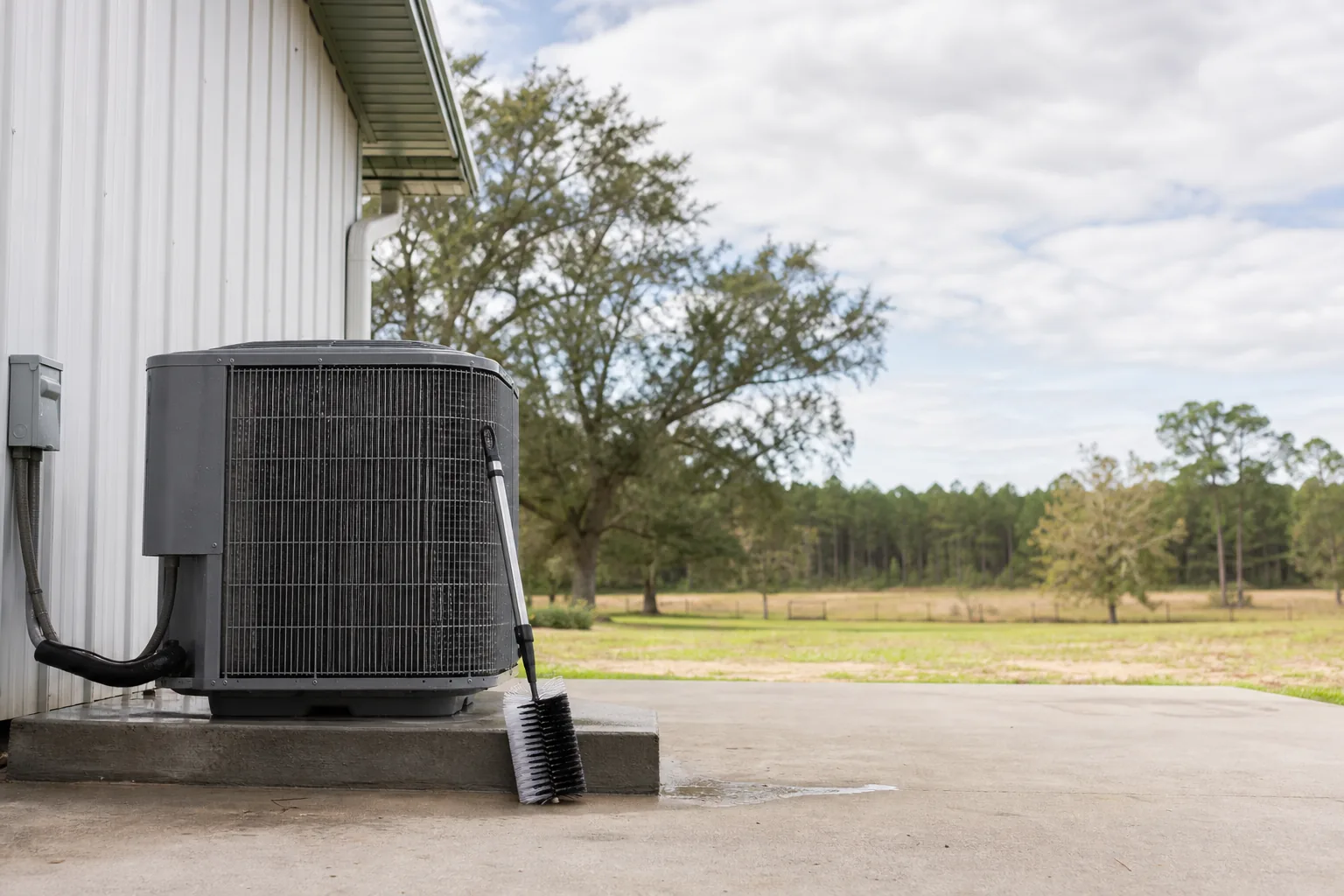
- Pest intrusion at outdoor cabinet penetrations. Mice, lizards, fire ants, and wasps all find HVAC cabinets attractive during winter. Spring service calls in Summerdale routinely turn up nests, casings, and corrosion damage from pest urine. The cabinets that look identical from ten feet away in October and April are often substantially different inside.
- Coil corrosion from inland soil-air interaction. Summerdale outdoor units sit on concrete pads or composite slabs, often with grass and irrigation around them. Months of rain, runoff, and soil splash leave deposits on outdoor coils that weren't there in October.
The system in mid-April is not the same system that worked in mid-October. It's a system that's been weathered, colonized, contaminated, and stressed in ways that don't show up on the thermostat display.
The Summerdale-specific spring surprise pattern
Summerdale homes lean toward two construction archetypes that both contribute to spring startup failures:
- 1970s-1990s ranch homes on half-acre lots. Standard split-system installs with outdoor condensers in side or back yards, decades-old original duct work, and homeowners who've been there long enough that the system has become "background equipment" — not consciously thought about until it fails.
- Mobile and manufactured housing along Highway 59 and the older parks. Package units on concrete pads, single-cabinet equipment that takes the full brunt of winter weather exposure, and tighter ownership budgets that often defer maintenance.
Both archetypes share a pattern that shows up year after year on April-to-mid-May service calls in Summerdale:
- Day 1: homeowner switches thermostat from HEAT to COOL. System cycles on, runs for fifteen or twenty minutes, cycles off, and won't restart.
- Day 1 evening: homeowner googles troubleshooting, resets the breaker, runs the system again for another short cycle, watches it shut off again.
- Day 2 morning: homeowner calls. The diagnostic almost always finds one of four root causes: failed run capacitor, blocked condensate drain, refrigerant pressure outside spec, or a contactor that welded itself partly shut during the last winter heating cycle.
- Day 2 afternoon: a moderate repair bill and the system back online by dinner.
The spring surprise isn't a surprise to anyone who's worked HVAC. It's the predictable outcome of how dormant equipment ages. The surprise is to the homeowner who thought "it ran fine in October" was a meaningful prediction about how it would run in April.
The specific failure modes the dormant winter produces
The four root causes above each have a distinct mechanism worth understanding.
Run capacitor degradation
Capacitors are electrical storage devices that provide the starting torque for compressor and fan motors. They have a finite microfarad capacity and a finite lifespan, and the lifespan is shortened by humidity, heat, and inrush events. A long stretch of Summerdale humidity exposure during dormancy ages a capacitor faster than continuous operation does. A capacitor that read close to its nameplate value in October can read meaningfully lower in April, which can drop the unit below the threshold where the equipment will reliably start.
The fix is a small part and a short visit. The catch is identifying it before the system fails — capacitor degradation is silent until the compressor can't start.
Condensate drain biological clog
A drain line that handled gallons per day of condensate flow during August summer use saw nothing from late October through mid-March. By spring, the line is colonized with mold and bacterial slime that constricts the inner diameter. The first cooling cycle of the season produces condensate at full flow rate, which can't pass through the constricted line, which backs up into the primary pan, which trips the float switch, which shuts the system off.
The fix is a wet-vac flush of the drain line and (often) a biocide treatment. Short visit. A system that fails this way usually reveals other problems worth addressing at the same time.
Refrigerant pressure drift
Slow refrigerant leaks accelerate during temperature cycling, and dormant equipment temperature-cycles every day during winter — outdoor temperatures swing widely between dawn and afternoon, and the equipment seals expand and contract with every cycle. Microleaks at flare connections, Schrader valves, and brazed joints all leak more during dormancy than during active operation.
A system that read a healthy head pressure at the October checkout might read meaningfully lower in April. That's not "the AC is broken" — it's a slow leak that's now meaningful enough to affect cooling performance. The fix depends on where the leak is, and the price varies accordingly.
Contactor weld
Contactors are electrical switches that close the high-voltage circuit to the compressor. They're rated for many thousands of cycles of normal operation, but they fail in two specific ways: weld-shut (the contacts fuse and won't open) and weld-open (the contacts pit and won't make full contact). The dormancy-aging problem is the second — the contact surfaces oxidize during months of standby, and the first heavy current cycle of the season pits the surface enough that subsequent cycles can't pass full current.
The fix is a contactor swap and a short visit. Like the capacitor, it's a silent degradation until the system fails.
For exact pricing on any of these repairs, call 251-383-HVAC. The service fee is $79 and the repair quote is in writing before any work happens.
How to prevent the spring surprise on a Summerdale schedule
The honest framework for Summerdale homeowners:
- Run a short cooling cycle in February or early March. Pick a 60°F+ afternoon, set the thermostat to COOL at 70°F, and let the system run for a quarter hour. Listen for unusual noises. Confirm air is moving at the registers. If anything is wrong, you have weeks to address it before peak demand.
- Replace the filter in early March. The filter that's been in place since October is loaded with months of intermittent dust accumulation. Fresh filter for the spring cooling season.
- Schedule a spring tune-up before April peak. Comfort Plan members get this scheduled automatically. Non-plan customers should call by mid-March; the schedule fills fast in April. Call 251-383-HVAC.
- Walk around the outdoor unit in late March. Look for storm debris, pest evidence, vegetation growth close to the unit, and visible cabinet corrosion. Anything unusual gets a phone call.
- Check the condensate drain line where it exits the house. A clean drain line shows a dry exit point or (during the first cooling cycle) a steady drip. A clogged line shows nothing, or shows water dripping from somewhere it shouldn't.
The preventive maintenance plan covers two annual tune-ups including the spring catch-everything-before-it-fails visit. The AC repair page walks through what gets checked during a spring startup diagnostic. The indoor air quality page covers filter strategy and humidity considerations specific to the older Summerdale housing stock.
Your AC saw the long quiet winter and the homeowner who didn't visit. The spring surprise wasn't random — it was the predictable consequence of dormancy. The homeowners who skip the surprise are the ones who treat October-through-March as preventive-maintenance season instead of leave-it-alone season. The system would prefer the visit.
FAQ
- Is the spring startup failure really that common in Summerdale?
- The pattern is real and Summerdale specifically sees it more than the bay-front cities. Summerdale's combination of older inland housing stock (mobile homes, 1970s-1990s ranch construction), longer-than-expected dormant winter periods, and inland heat load that ramps fast in mid-April makes the failure pattern especially common here. Every system has a runtime gap between October and April that creates exactly this window of degradation; the question is whether you catch it before peak demand.
- What's the minimum maintenance interaction I should have with my AC during the winter dormant period?
- At a baseline: change the filter on a regular rotation regardless of season, eyeball the outdoor unit monthly for storm debris or visible damage, and run the system in cooling mode for a short cycle once in February or early March as a wake-up test. Those three actions take a few minutes per month and catch most spring startup failures before they happen. The [Comfort Plan](/comfort-plan/) members get this baked in via the scheduled spring tune-up visit. Non-plan customers can self-administer, but the discipline tends to slip; that's part of why the plan is structured the way it is.
- How does the inland Summerdale heat load actually differ from the coastal cities in spring?
- Peak afternoon temperatures in Summerdale typically run a few degrees higher than Gulf Shores, Orange Beach, or Fairhope on the same day, because the bay-breeze moderation that cools the coastal cities doesn't reach a dozen miles inland with the same effect. That means a Summerdale system in mid-April is asked to handle a higher BTU load than a coastal system on the same day, and the spring transition from minimal usage to heavy usage happens faster. A system that was marginal coming out of winter dormancy gets pushed past failure threshold sooner inland than coastal.
- I have a mobile home in Summerdale with a package unit. Does the same advice apply?
- Yes, and arguably more so. Package units sit outside and take more weather exposure during the dormant period than split systems do. The single-cabinet design also means a single failure (corroded contactor, fan motor seizure, refrigerant leak in an exposed coil) takes the entire system offline rather than just one half. Mobile and manufactured housing in Summerdale should run a slightly tighter maintenance cadence than split-system installs — twice-annual tune-ups plus a midwinter visual inspection.
Need this handled?
Straight to the service page for your town — pricing, local details and a form that reaches a technician.
More from After Winter Startup

ACExperts HVAC
We Take The Heat So You Don't Have To
Fast, honest heating and air service across Baldwin County. Speak with a technician and get on the schedule today.