
Squeal, Hum, Silence: The Spanish Fort Condenser Fan Diagnostic Tree
Three failure modes, three different repair paths. Here's how a Spanish Fort homeowner can identify which one their condenser is showing — and what each one actually costs to fix.
Published 2026-09-11 · Updated 2026-09-11
Author: Landon Jahnke | ACExperts251
Reviewed by: Landon Jahnke · Owner · Alabama HVAC License AL #16117 · EPA 608 Certified
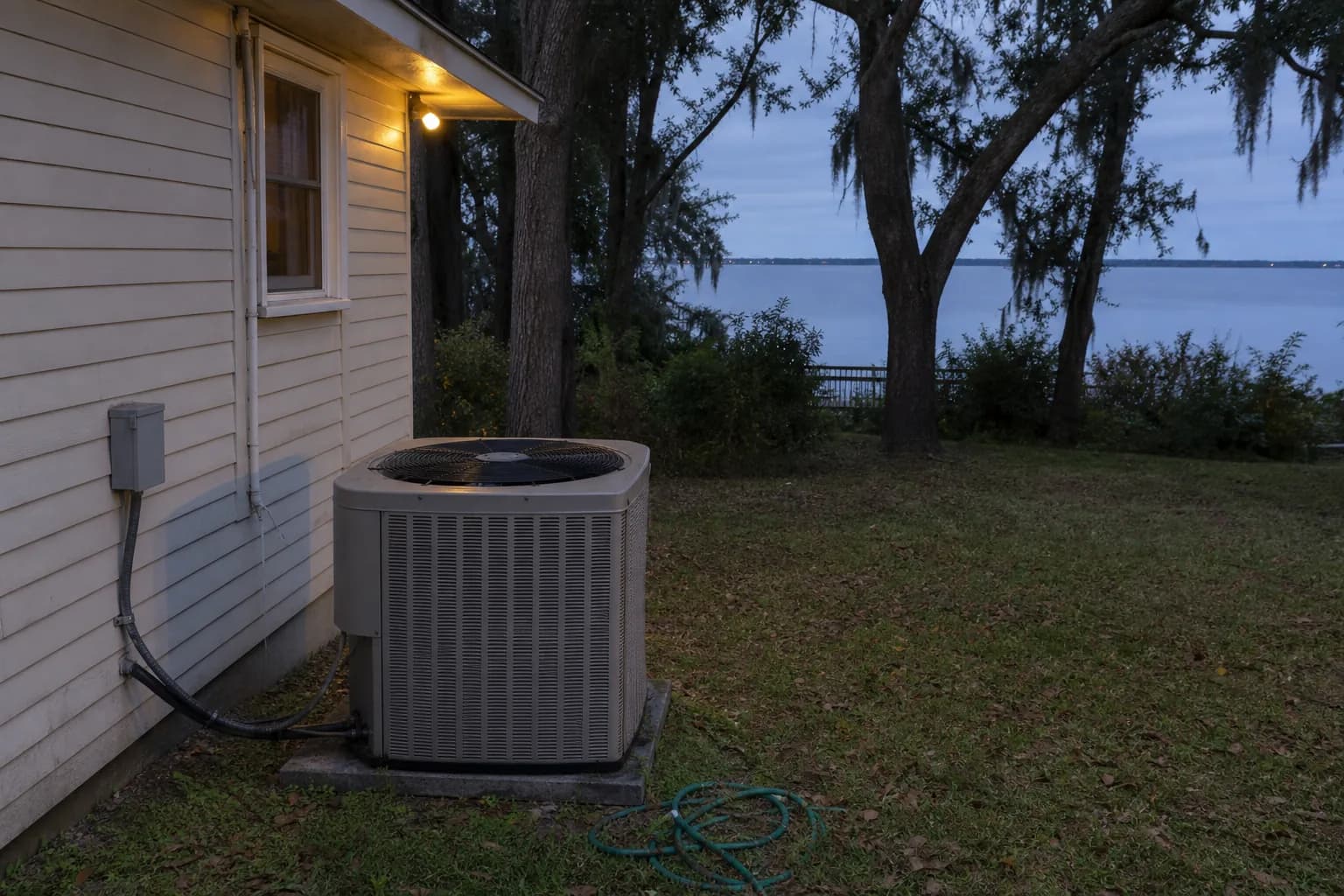
Three failure modes. Three different sounds. Three different repair paths. Walking up to the outdoor unit, the homeowner can usually narrow the diagnosis to one of three possibilities just from what they hear and see.
Squeal: high-pitched, intermittent, gets louder over weeks. The fan motor's bearings are dry. Visual: the fan blade still spins, sometimes wobbles. The system is still cooling, but the failure is progressing.
Hum: low-frequency drone, steady, never changes. The motor is energized but the rotor isn't turning. Visual: fan completely still, but you feel a vibration on the cabinet. This is the most dangerous of the three and needs immediate shutdown.
Silence: nothing. The contactor isn't closing or the capacitor died. Visual: fan still, no vibration, outdoor unit looks dead. Often the cheapest of the three to fix.
Three sounds, three different repair paths in a Spanish Fort home. Here's the diagnostic tree from each.
Branch one: the squeal
The squeal is the failure mode most homeowners notice first because it's the most audible — a high-pitched whine that starts faintly during steady-state operation and grows louder over a period of days or weeks.
What's happening physically: the fan motor in a residential condenser uses sealed bearings packed with grease at the factory. Over the motor's life — typically 10-15 years in Spanish Fort conditions — that grease degrades, the seals wear, moisture and dust infiltrate, and the bearings begin to run dry. Dry bearings produce friction. Friction produces heat and sound.
The sound is your warning shot. The motor is telling you it's failing. The window between "starts squealing" and "seizes completely" is typically 1-4 weeks in Spanish Fort summer conditions, sometimes much shorter if the bearings are already deeply worn.
The visual confirmation. Walk to the outdoor unit while it's running and watch the top fan blade through the grille. A failing-bearing motor often shows visible blade wobble — the fan tip traces a slightly wider circle than it should, or the rotation is uneven. You may also see vertical play in the fan hub if you watch closely. Both are confirmations.
Why Spanish Fort specifically. Bay proximity matters here. Even though Spanish Fort isn't on the open Gulf, the Mobile Bay shoreline adds real moisture exposure to outdoor equipment — water makes up over 14% of the city's land area. Bearing seal degradation accelerates in humid environments, and across 13 years of Baldwin County HVAC work, fan motors on bay-proximate Spanish Fort condensers tend to fail meaningfully earlier than equivalent inland equipment.
The repair. Fan motor replacement, matched to the existing motor by frame size, horsepower rating, RPM, and shaft length. Capacitor replacement at the same time (the FAN side of the dual capacitor takes the load and is typically near end-of-life if the motor is). Pricing depends on motor frame and brand — get a written quote on the diagnostic call.
The wrong move. Adding lubricant to the motor bearings. The bearings are sealed — there's no fitting to lubricate. Spraying penetrating oil through the motor end cap or trying to inject grease through the cooling vents is a 1990s shop trick that doesn't work on modern sealed-bearing motors and often makes the failure worse by contaminating the windings.
The right move when scheduled. Replace before seizure. The motor that squeals on a Tuesday is the same motor that gets replaced on a Wednesday afternoon appointment, before the system loses airflow on a Saturday and the compressor takes secondary damage.
Branch two: the hum
The hum is the most dangerous failure mode and the one that requires immediate action. It's also the one homeowners often misidentify as "running normally" because it sounds like the unit is doing something — when in fact the only thing it's doing is destroying itself.
What's happening: the fan motor is electrically energized — voltage is reaching the motor windings — but the rotor isn't turning. Three causes are possible:
Cause A: Failed run capacitor (FAN side). The capacitor provides the phase-shifted current to the start winding that gives the motor its starting torque. A capacitor that's dropped below about 70% of rated microfarads can no longer provide enough torque to break the motor's static resistance. Voltage reaches the motor, the motor tries to start, but the rotor doesn't move.
Cause B: Seized motor bearings. The squeal failure mode, escalated. Bearings that progressed from dry to damaged are now mechanically locked. The motor is still trying to turn but the rotor physically cannot.
Cause C: Internal motor winding short. A failed motor where the windings have shorted to the case or to each other. The motor is electrically connected but cannot produce useful work.
The shared danger. In all three cases, current is flowing through the motor windings and producing heat. The windings are typically rated for 130-140°C insulation temperature. With no mechanical work being done — no airflow over the motor housing, no rotation to dissipate heat through the bearing housing — the windings reach insulation-failure temperature in 3-5 minutes.
Worse: while the fan motor is destroying itself, the compressor is still running. The compressor depends on the outdoor fan moving air across the condenser coil to reject the heat it's pumping out of the house. With no airflow, the compressor's discharge pressure climbs rapidly, the discharge gas temperature climbs, and the compressor enters a thermal-stress regime that ages it years in minutes.
What to do in the next 30 seconds. Cut power to the system at the breaker. Don't try to identify the cause before shutting it down. The diagnosis can wait 5 minutes; the damage cannot.
The visual confirmation. Hand on the outdoor cabinet — if you feel a steady vibration but the top fan blade isn't moving, that's the hum. Often there's a low-grade burning smell within a minute or two as winding insulation begins to degrade.
The repair paths.
If Cause A (capacitor): Capacitor replacement — the cheapest of the three repairs. The motor is fine; a properly sized new capacitor restores starting torque and the fan starts on the next call. Microfarad reading at the diagnostic confirms.
If Cause B (seized bearings): Fan motor replacement, same as the squeal branch. The capacitor often gets replaced at the same time as a precaution.
If Cause C (winding short): Fan motor replacement. Diagnostic confirmation comes from a megohm test showing insulation breakdown to the motor case.
The $79 diagnostic distinguishes the three causes within 15 minutes of arrival. The right intervention varies by cause; the wrong intervention (replacing the motor when the capacitor was the actual failure) costs meaningfully more than necessary, which is why second opinions on quoted repairs are free.
Branch three: the silence
The silence is the failure mode that sometimes feels less urgent because nothing is making noise — but it's also the failure mode where the air conditioning has fully stopped working, which often forces same-day attention regardless.
What's happening: the outdoor unit isn't receiving the call from the indoor system, or it's receiving the call but can't act on it. Three branches of cause:
Cause A: Failed run capacitor (BOTH sides). Same physics as the hum branch but with full capacitor failure. The fan side and the HERM/compressor side are both below threshold, so neither motor starts. Fan stays still. Compressor stays still. From the outside, the unit looks dead.
Cause B: Failed contactor. The contactor is the relay that connects line voltage to the compressor and fan motor when the thermostat calls. Contactors fail in two ways: stuck open (no contact when energized) or burned out (contacts corroded past usefulness). Spanish Fort's bay-air corrosion accelerates contactor wear compared to deep-inland equipment. Failed contactor: nothing energizes downstream. Outdoor unit silent.
Cause C: Tripped outdoor disconnect or breaker. Not always a failure — sometimes a homeowner or yard worker shut off power and forgot to restore it. Sometimes a high-pressure trip protected the system from a separate problem. Either way, no power reaches the unit. Silent.
The shared characteristic. Compressor isn't running. Indoor blower may still be running (depending on thermostat configuration), so the air handler is moving room-temperature air through the registers — which is why some homeowners don't notice the outdoor failure for hours.
The visual confirmation. Walk to the outdoor unit during a cooling call. Should feel the fan, hear the compressor, feel slight vibration on the cabinet. If you feel nothing, hear nothing, see nothing — that's the silence.
The repair paths.
If Cause A (capacitor): Capacitor replacement. Same as hum-Cause-A but with both sides bad.
If Cause B (contactor): Contactor replacement. The contactor itself is a relatively inexpensive part; labor and diagnostic time make up the balance of the line item. Contactors get replaced as a routine part of preventive maintenance when surface inspection shows pitting or arc damage — the Comfort Plan tune-ups catch these before they become silence calls.
If Cause C (no failure, just power): The diagnostic fee may apply (depends on circumstances). Reset the breaker, restart the disconnect, observe the system for normal operation. The visit gets documented so the homeowner knows whether the trip was a one-time event or a symptom of a separate problem.
For Cause C specifically: if the breaker keeps tripping after reset, do not keep resetting it. A breaker that trips repeatedly is doing its job — it's protecting the wiring or the equipment from a real fault. Repeated reset attempts can cause fires or damage components that were otherwise fine.
The diagnostic tree on paper
Putting all three branches together as a single decision flow:
Listen to the outdoor unit during a cooling call.
→ High-pitched whine, fan still spinning? Squeal branch. Bearing failure in progress. Schedule motor replacement within the week.
→ Steady low hum, fan stationary? Hum branch. Cut power immediately. Diagnose capacitor vs. seized motor vs. winding short.
→ Nothing — silence and no vibration? Silence branch. Diagnose capacitor vs. contactor vs. power supply (often just a tripped breaker).
→ Something else — clicking, intermittent, occasional cycling? That's a fourth pattern that doesn't fit cleanly on this tree. Most often it's a thermal-overload protection device cycling on and off because the system has another underlying problem (low refrigerant, blocked airflow, failing compressor). Schedule the diagnostic.
The tree is meant to be useful for the homeowner standing in the backyard at 6:30 pm trying to decide whether to call right now, call tomorrow, or schedule for next week. The three branches map cleanly to three urgency levels.
Why Spanish Fort fan motor failures cluster in September
Across 13 years of Baldwin County HVAC work, the highest concentration of condenser fan motor failures in Spanish Fort hits during the second and third weeks of September. The pattern is consistent year over year and traces to a specific stress mechanism.
Cumulative summer load. From early June through Labor Day, Spanish Fort outdoor units run 11-14 hour days during the worst of the heat. That's roughly 1,200-1,500 operating hours of continuous fan motor operation in a 12-week window. Bearings that were marginal in June are typically deep into wear by early September.
The thermal cycling shift. Mid-September brings the first cooler nights — daytime highs in the 80s, overnight lows in the 60s. The thermal cycling accelerates lubricant breakdown in already-marginal bearings. A motor that survived August's continuous operation often fails during the first week of significant day-night temperature swings.
Lower load masking earlier symptoms. Homeowners who would have noticed an early-summer squeal are sometimes too busy to notice it during peak season because the system is running constantly and ambient noise is high. As the load drops in September and the system cycles more discretely — running for an hour, off for an hour, running again — the bearing noise becomes audible from inside the house. Homeowners hear what was already happening.
Maintenance backlog. Spring tune-up appointments in Baldwin County run heavy through April and May. Homes that didn't book a tune-up before peak season often haven't had a fan motor inspection in 18+ months. September is when those uninspected motors surface the failures the spring visit would have flagged.
The pattern is consistent enough that late-August truck inventory gets weighted accordingly — extra fan motors in the most common Spanish Fort frame sizes, extra dual capacitors, extra contactors — to handle the September call surge. Knowing the pattern is part of how same-day repair stays realistic during a week when other contractors are running longer schedules.
What an honest diagnostic tells you
When a Spanish Fort homeowner calls about a squeal, hum, or silence, the diagnostic visit should produce specific answers, not generalities.
For the squeal: motor manufacturer, frame size, horsepower, current draw, audible bearing condition. Recommendation: replace within window X with reasoning. Cost: written estimate before work begins.
For the hum: capacitor microfarad reading on both terminals, motor winding resistance to ground (megohm), shaft rotation by hand with power off (free or seized). Specific cause identified, specific repair priced.
For the silence: capacitor reading, contactor inspection (visual and electrical), incoming voltage at the disconnect, breaker trip log if available. Specific cause identified.
What the honest diagnostic doesn't do: recommend a "system rejuvenation" package or a "full electrical refurbishment" or any other vague bundle. Specific failure → specific repair → specific cost.
Where to go from here
If your Spanish Fort outdoor unit is showing one of the three patterns above, the timing matters more than usual. Squeal: this week. Hum: today, after cutting power. Silence: today or tomorrow depending on heat conditions inside the house.
Phones get answered Monday-Saturday 8am-6pm with emergency calls around the clock, every day — including Saturdays at no extra charge — and same-day priority service goes out for Spanish Fort whenever scheduling allows. Diagnostic fee is $79; the truck carries the most common parts so one-visit resolution is the goal wherever the diagnosis supports it.
For homeowners weighing repair vs. replace on a fan motor failure in an older system, the Repair vs. Replace Calculator gives a structured starting point — and second opinions on quoted repairs are free.
A few related angles for the broader picture: the hard-start kit decision tree on Foley compressors covers what happens when starting torque issues are misdiagnosed, the Stapleton capacitor failure pattern covers the underlying physics of capacitor degradation, and the Spanish Fort tight-build humidity walkthrough covers the moisture environment that accelerates bay-side fan motor wear.
Three sounds. Three branches. Pick the one your unit is making and call before the next branch becomes the only branch left.
FAQ
- Can I keep running my Spanish Fort AC if the outdoor fan is squealing?
- Short answer: not for long. A squealing condenser fan motor has dry bearings, and bearing wear accelerates exponentially once the noise starts. A motor that squeals on a Tuesday often seizes by the following Sunday. While the motor is squealing, the fan still moves air and the system still cools, but the bearing failure is in progress. The honest move is to schedule the repair within the week — a planned motor replacement is the same motor that costs more (and risks compressor damage) when the bearing seizes during a Saturday cookout and the compressor overheats from loss of airflow. Get a written quote before authorizing the work.
- My Spanish Fort outdoor unit is humming but the fan isn't moving. Is this dangerous?
- Yes — turn the system off immediately. A humming outdoor unit with a stationary fan means the motor is energized but not turning, which means the motor windings are drawing current with no mechanical work being done to dissipate the heat. Within 3-5 minutes, the windings overheat to insulation-failure temperatures and the motor is destroyed. More importantly, the compressor is still running and losing the airflow it needs to reject heat — compressor damage from running without condenser airflow is the worst-case outcome and the most expensive failure mode in residential HVAC. Cut power at the breaker. Don't restart until the system is diagnosed.
- How quickly can a fan motor be replaced in a Spanish Fort home?
- If the motor and capacitor are common sizes — which they are for the vast majority of Spanish Fort split systems — same-day replacement is often realistic. Most common ECM and PSC motor sizes plus matched capacitors and start kits stock on the service truck. Diagnostic to running system typically runs 90-120 minutes on-site. Less common motor frame sizes or specific OEM-only replacements may require 1-2 business days for parts. The exception is high-end variable-speed condensers (Carrier Greenspeed, Trane XV20i) where the ECM motor and module replacement is a manufacturer-specific part with longer lead time.
- Is a fan motor replacement worth it on a 12-year-old Spanish Fort system?
- Depends on the rest of the system. A clean compressor with good capacitor readings, in-spec refrigerant pressures, and an outdoor coil that hasn't been corroded by Bay-side salt air can absolutely justify a fan motor replacement on a 12-year-old unit — the system has another 4-7 years of useful life. A 12-year-old system with the fan failure plus a marginal compressor plus refrigerant pressures already drifting is a different conversation: the fan motor becomes the first repair in what's likely a sequence over the next two years totaling well above the cost of a replacement. The [Repair vs. Replace Calculator](/tools/roi-calculator/) puts the math on paper on the diagnostic call — and second opinions on quoted repairs are free.
Need this handled?
Straight to the service page for your town — pricing, local details and a form that reaches a technician.
More from Fan Motor Failure

ACExperts HVAC
We Take The Heat So You Don't Have To
Fast, honest heating and air service across Baldwin County. Speak with a technician and get on the schedule today.