
5 July 4 Rental Mistakes Silverhill Homeowners Keep Making
5 July 4th rental HVAC mistakes Silverhill owners make — the peak-weekend failures that cost the holiday booking, and the quick checks that keep guests cool.
Published 2026-07-09 · Updated 2026-07-09
Author: Landon Jahnke | ACExperts251
Reviewed by: Landon Jahnke · Owner · Alabama HVAC License AL #16117 · EPA 608 Certified
Two Silverhill rentals, three blocks apart, both prepped the same week in late June. One sailed through July 4. The other failed late afternoon on July 3 with renters in the house. The difference between them came down to five habits the owner of the failed property hadn't built yet — and over 13 years working Baldwin County HVAC, I've watched the same five mistakes recur every holiday weekend.
Both houses are 1990s construction. Both 3-ton split systems, similar age — both around a decade old. Same outside air, same humidity, same heat. The only meaningful difference between them is how their owners prepared.
Here's the pattern that separates the two outcomes.
Mistake 1: The 20-minute "test run"
The most common pre-rental check I see is the owner walking through, flipping the thermostat to 70°F, watching cold air come out of a vent for 15 or 20 minutes, and locking up satisfied. That isn't a load test.
Twenty minutes is enough time for a marginal capacitor to limp along, for a low refrigerant charge to deliver acceptable cooling at low ambient temperatures, and for a partially clogged drain line to back up just enough that the float switch hasn't tripped yet. The failures that show up on a 95-degree July 3 afternoon are usually the failures that don't show up in a 20-minute test on a mild morning.
A real load test runs the system continuously through the hottest part of an afternoon — three to four hours of sustained call for cooling, with the thermostat set well below ambient. Watch how long the house takes to reach setpoint. Watch whether the outdoor unit cycles normally or runs without breaks. Touch the supply registers — they should be measurably cold. A system that holds setpoint for hours under afternoon load will usually hold for renters; a system that doesn't, won't.
The fix: Run the system continuously for at least 3-4 hours through afternoon heat in the week before guest arrival. Anything less and you're testing whether the system works under easy conditions, not whether it works under the conditions guests will create.
For the full version of this load test, see our 72-hour pre-check — written for Foley but every step applies to Silverhill rentals.
Mistake 2: Setting vacancy temperature too high
The classic "saving money costs money" pattern. An owner sets the vacancy thermostat to 85°F to save on the electric bill. Guests arrive and set the thermostat to 70°F. The system runs continuously for hours trying to drop 15 degrees in midday heat. The marginal capacitor that's been on the edge for months picks hour five of continuous runtime to give up.
The electricity saved during a week of vacancy at 85°F versus 78°F is real but small. The equipment stress of the catch-up cooling load when guests arrive is significant.
Indoor humidity is the secondary reason. At 85°F vacancy, indoor RH climbs above 65% even with the AC running occasionally. The structure absorbs that moisture — drywall, soft furnishings, mattress pads. When the thermostat drops to 70°F, the AC has to remove that latent moisture before it can effectively reduce sensible temperature, which is why the house "feels muggy" for the first 12 hours of a guest stay even after the temperature reads correctly.
The fix: Vacancy setpoint at 78-80°F. Pre-cool the house to 75°F starting 4 hours before guest arrival. The system handles the load gradually instead of being thrown into a sustained crisis.
Mistake 3: Filters that haven't been changed since spring
An old rental filter is one of the more frequent failure-point setups I run into during July emergency calls. Spring guests, pollen, beach sand tracked in, sometimes a pet booking — the filter is visibly gray and airflow is restricted 25-35% well above the threshold for indoor coil freeze events under heavy load. Combined with a marginal capacitor and the catch-up cooling demand, the filter alone can be the failure point.
The fix: Replace the filter at every turnover, no exceptions. Buy MERV 8 filters in bulk. Add the filter swap to the cleaning checklist. Photograph the new filter with a date written on it as part of turnover documentation.
For pet-friendly listings: filter every 10-14 days regardless of turnover schedule. Hair load doubles or triples filter clog rates.
Mistake 4: Ignoring the outdoor unit entirely
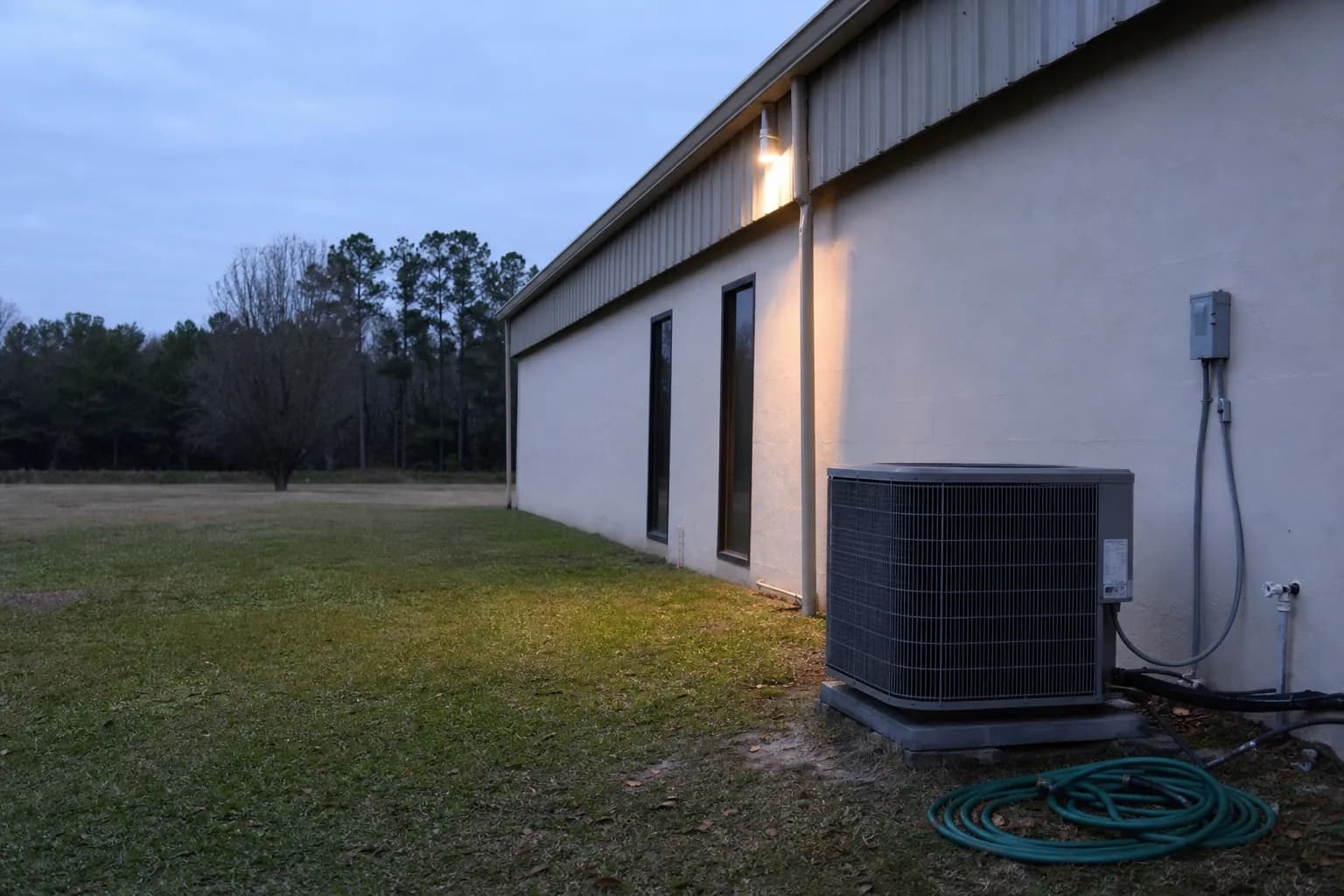
Outdoor condenser coils accumulate leaf debris, oxidation, and grass clippings. A coil that's 30% obscured loses meaningful heat-rejection capacity. The compressor compensates by running longer with higher head pressure, the indoor coil runs colder than spec, and the freeze window opens earlier in the afternoon than it would for a clean unit.
I've stood next to plenty of rental condensers where the fins were packed with debris from a Friday mowing the owner never thought to check. Tell your lawn crew not to blow grass clippings into the condenser. Walk around the unit every couple weeks during summer and pull out leaves, sticks, and debris by hand. Do not pressure-wash the fins yourself; bent fins create the airflow problem you're trying to fix.
The fix: Annual outdoor coil cleaning by a tech who'll do it properly — chemical wash, fin inspection, drainage path check. Schedule it as part of a preventive maintenance visit before peak summer.
Mistake 5: No documentation, no plan, no relationship
An owner who calls a different contractor every time something breaks is calling cold every time. The tech has no service history on the equipment, no baseline capacitor readings to compare against, no idea which components are original and which were replaced two years ago. Diagnostics take longer, recommendations have to be more conservative, and there's no continuity from one visit to the next.
The alternative is establishing a relationship with one contractor. Maintenance plan, service history on file, equipment tagged. When something goes wrong, the tech walks in already knowing what they're working with.
The fix: Pick one HVAC contractor and stick with them. Our Comfort Plan is $20/month or $240/year and includes 2 tune-ups annually, 10% off repairs and replacements, $0 service fees, and no overtime fees. For a rental owner, the value isn't really the discount — it's the file of readings, photos, and component history that exists when you call from out of town on a holiday weekend.
Out-of-state owners managing Silverhill rentals from a distance benefit even more — we communicate via email with photos and written reports, bill the owner directly, and coordinate access with cleaning crews and property managers. See our Silverhill location page for service area specifics; same model applies to nearby Daphne, Fairhope, and Stockton rentals.
The five mistakes, in checklist form
- Don't trust a 20-minute test run. Run it 4 hours through midday heat in the week before guest arrival.
- Don't set vacancy temperature above 80°F. Pre-cool to 75°F starting 4 hours before guest arrival.
- Replace the filter at every turnover. Twice as often for pet-friendly listings.
- Get the outdoor coil cleaned annually. Keep lawn debris out of the unit.
- Establish a service relationship with one contractor. Maintain documentation. Tag the address for rental priority.
The five mistakes are easy to make and easy to avoid. The hard part is realizing they're mistakes before July 3 at 5 PM, not after.
Schedule a pre-rental inspection at /schedule/ or call 251-383-HVAC. Silverhill is where Landon lives, so local calls get a practical routing advantage.
FAQ
- How common are vacation rentals in Silverhill?
- Less common than Gulf Shores or Orange Beach, but growing. Silverhill's quieter character and central Baldwin County location make it appealing for renters who want a base for exploring the bay cities and beaches without the beach-traffic chaos. Most rental inventory in the 36576 zip code is 3-4 bedroom homes on larger lots off Highway 104 and County Road 55.
- Should a Silverhill rental owner buy coastal-rated HVAC equipment?
- No. Silverhill is 20+ miles from the Gulf — salt air corrosion isn't the dominant failure mode here. Standard residential equipment with proper maintenance is appropriate. The coastal-rated upcharge makes more sense for properties within 5-7 miles of the water. Match equipment to the home's actual exposure rather than the catalog upsell.
- How does ACExperts handle a Silverhill rental emergency?
- Silverhill is where Landon lives, so calls in the 36576 area get the fastest practical response. Emergency calls run day or night, every day, including Saturdays at no extra charge. During a holiday window, response time depends on queue depth — getting on the schedule for a pre-rental check the week before is the most reliable way to avoid being a 5 PM emergency call on July 3.
- What does a pre-rental inspection cover?
- A pre-rental check covers filter age, refrigerant readings, capacitor health, drain line flow, and delta-T across the indoor coil. Cost is the $79 service fee. Comfort Plan members ($20/month or $240/year) get two tune-ups annually with $0 service fees, so the pre-rental visit can fall inside the plan.
Need this handled?
Straight to the service page for your town — pricing, local details and a form that reaches a technician.
More from July 4 Vacation Rental

ACExperts HVAC
We Take The Heat So You Don't Have To
Fast, honest heating and air service across Baldwin County. Speak with a technician and get on the schedule today.