
Silverhill Mardi Gras Rental HVAC: A Pre-Parade Punch List
What one Mardi Gras week does to a Silverhill rental HVAC — and the punch list to run before guests arrive so the system survives the parade calendar.
Published 2026-02-19 · Updated 2026-02-19
Author: Landon Jahnke | ACExperts251
Reviewed by: Landon Jahnke · Owner · Alabama HVAC License AL #16117 · EPA 608 Certified
The before-and-after on a Silverhill rental HVAC after one Mardi Gras week is dramatic. Going in: white indoor coil with clean aluminum fins, dry drain pan, fresh filter, lightly-loaded outdoor condenser. Coming out: indoor coil visibly browned with a layer of skin oils, hair fragments, kitchen aerosols, and what looks like a fine red mist of King Cake powdered sugar. Drain pan with standing water and a brown ring around the perimeter. Filter so loaded it has partially collapsed into the return grille. Outdoor unit with paper plates jammed up against the fan grille and a Mardi Gras bead caught between the fins.
That's the typical cost of one solid week of guests in a Silverhill rental during parade season. Below is the punch list to run before guests arrive, what each item is actually doing mechanically, and where the homeowner-doable items end and the tech-required items start.
Why Silverhill rentals see this and Foley rentals don't quite as much
Silverhill is about 20 miles inland — past the salt-air zone but in the heart of central Baldwin County. The vacation rental market here has grown specifically because Silverhill is a cheaper option than Foley or Gulf Shores for parade-weekend renters who are driving into Mobile for the parades and want a quiet place to crash 30 minutes away. The Silverhill service area page gets into the housing stock — older retrofit gas furnaces, mid-century brick ranches, and homes that were never originally built with the duty cycle a vacation rental imposes.
Mobile claims the original American Mardi Gras (older than New Orleans by 15 years), and the parade calendar runs across multiple weekends with peak activity on Joe Cain Day, Lundi Gras, and Fat Tuesday itself. A Silverhill rental on those weekends is housing 6-8 people who arrive Friday afternoon, leave at 9 a.m. for parades, return at 6 p.m. covered in throws and bead dust, shower, eat, sleep, and repeat. The cycle is harder on a residential HVAC system than a normal vacation week because the indoor air load swings dramatically — empty house all day with thermostat held tight, then six people and showers and cooking from 6-11 p.m. The system runs hard, then sits, then runs hard.
Two weeks out: the tech-required items
These need a service truck and proper tools. Schedule them two to three weeks before the rental week so there's time to order parts if anything's marginal.
Coil inspection and cleaning. Pull the indoor access panel, inspect the evaporator coil under a good light, and clean it if there's any biofilm or particulate load. A clean coil starting the week is the single most important variable for whether it survives the week. Three months of normal owner use plus one week of guest use is enough to take a coil from white to brown.
Refrigerant charge verification. A system running marginal on charge will limp through a normal week and fail on a heavy-load week. The right diagnostic measures superheat and subcool, checks pressures against ambient temp, and tops off if needed. Marginal charge is invisible until it isn't — guests in the house, system running 18 hours a day, and suddenly the supply temp drops by 6°F and the house goes to 78°F.
Electrical component testing. Capacitor microfarad readings against nameplate, contactor resistance, blower motor amp draw under load. Marginal capacitors are the most common parade-weekend emergency call — a cap that's been at 80% capacity for six months suddenly fails when the system is asked to start 40 times a day instead of 12.
Drain pan inspection and treatment. Pull the secondary pan, inspect for biological growth, treat with EPA-registered drain pan tablets that dissolve over the rental week and continue suppressing growth. Standing water in the primary pan usually means the tablets were forgotten and the natural slope silted up with biofilm enough to slow drainage.
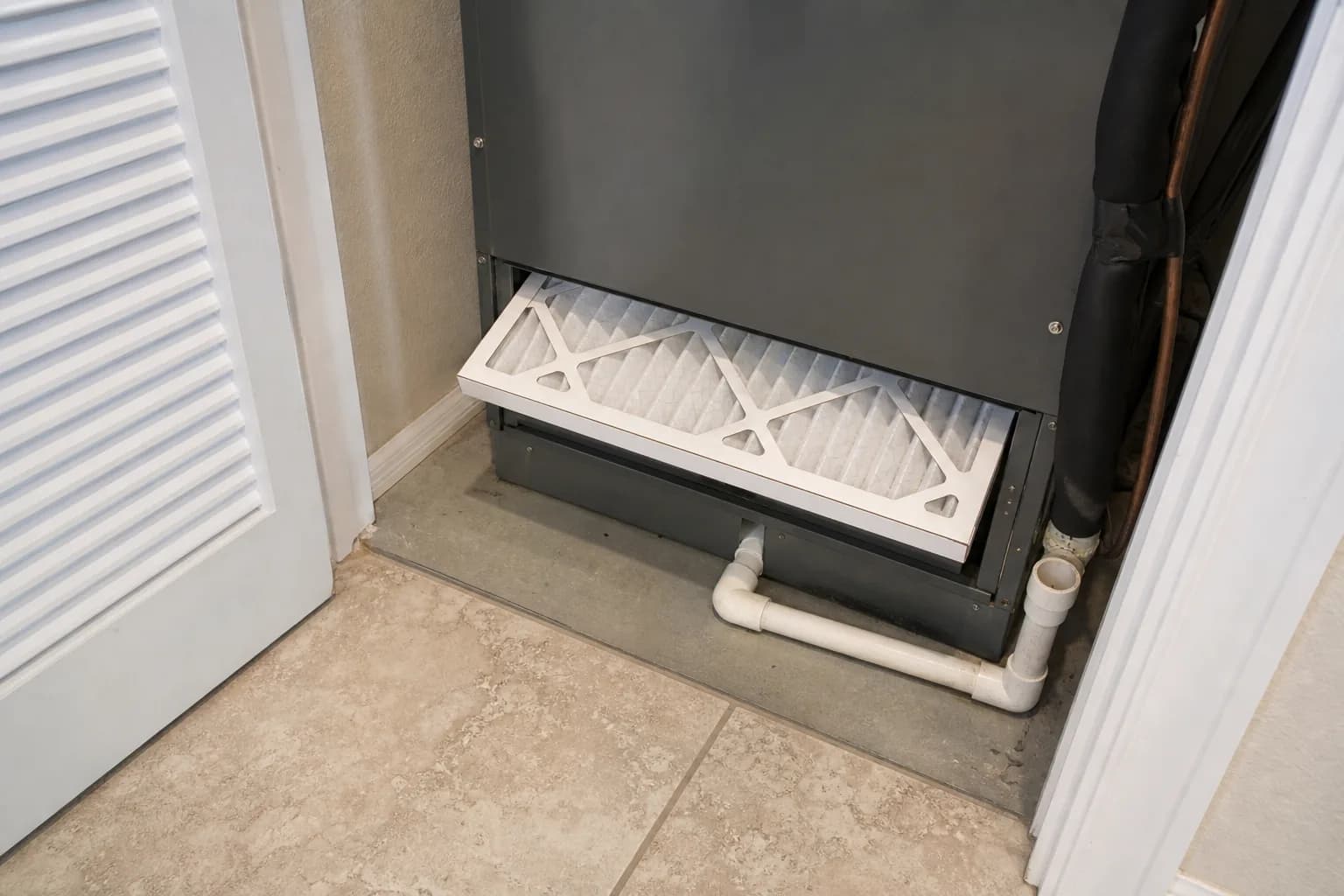
Filter assessment and upsizing. A 1-inch MERV 8 filter that's adequate for normal occupancy will load to capacity in 4-5 days under rental load. The fix is either a 4-inch media filter (lasts the full week without crushing airflow) or a fresh 1-inch paired with mid-week change instructions for the cleaning crew. A 1-inch filter on a high-occupancy week is the most common cause of mid-week filter collapse.
Static pressure test. A system that's been pulling air through compromised ducts for years will be pulling even harder when the filter loads up. Measure static pressure across the air handler before and after the filter to verify the system has headroom. Marginal static pressure plus loaded filter equals blower strain plus poor dehumidification plus comfort complaints.
The full preventive maintenance service page documents the standard checklist. For rental properties, add a few items: drain treatment that lasts longer than seven days, a filter strategy for the high-load period, and a written summary the cleaning crew can reference if anything looks off mid-week.
One week out: owner-doable items
These you can run yourself the weekend before guests arrive. None take long.
Outdoor unit clearance check. Walk the perimeter of the condenser. Pull any leaves, paper, mulch, or yard debris within 18 inches of the cabinet. Verify the top discharge is unobstructed (no overhanging branches that have grown in since fall). Check the line set insulation hasn't been chewed by squirrels or torn by weed-eater contact. Mardi Gras beads from a previous guest week can sit in the fins for months — the pre-rental walk-around is the moment to spot them.
Thermostat lockdown. Set a temperature band the schedule can't override. For a heat pump in February, 66-72°F is a sensible band. For a system running cool during a warm parade weekend, 70-75°F. Lock it. Most smart thermostats allow this directly. For older programmable thermostats, the homeowner can set a temporary hold and password-protect the schedule. Without the lockdown, you will get one guest who pushes it to 78°F and another who pushes it to 62°F, and the system will spend the week chasing a moving target.
Condensate line flush. Pour about a cup of distilled white vinegar diluted 1:1 with water down the indoor side of the condensate line at the air handler service tee. Let it sit 30 minutes, then flush with warm water. This kills the algae and biofilm that accumulate during the dormant winter weeks and would otherwise bloom under the heavy condensate load of a high-occupancy week.
Register and return inspection. Walk every room. Pull every supply register, look at the boot, vacuum any dust accumulation. Pull the return grille, check the filter, vacuum the inside of the return cavity if it's accessible. This isn't critical maintenance but it's the difference between guests arriving to a clean-smelling house and guests arriving to a house that smells like the dust the system kicked up the first time it ran.
Filter swap, marked with date. Even if you have a tech installed a 4-inch filter two weeks ago, a fresh 1-inch backup in the housing means the cleaning crew can swap it Wednesday if needed. Write the install date on the cardboard frame in Sharpie. The cleaning crew between Saturday and Sunday turnovers can verify it visually.
For the Elberta service area and Magnolia Springs — both also seeing rental growth for parade weekends — the same checklist applies with minor adjustments for housing stock. Magnolia Springs homes near the river will need a closer look at humidity baseline before guests arrive, and the Fort Morgan rental notes cover the salt-air variant of the same punch list.
The morning of guest arrival
Three things to verify in the hour before the cleaning crew leaves:
Thermostat is at the target setpoint, not 8°F off it. If you set it to 70°F and the room is 78°F because the cleaning crew opened the door for two hours, the system will be in catch-up mode when guests walk in. Bring the house to setpoint before the crew leaves.
Run the bath fans and the kitchen vent for ten minutes each. Cleaning chemicals — bleach, oven cleaner, mildew remover — off-gas hard for the first hour. Pulling that exhaust before guests arrive is the difference between a fresh-smelling house and a chemical-smelling one.
Walk every room and confirm no register is closed. Cleaning crews close registers to vacuum behind furniture and forget to reopen them. A closed register dumps static pressure imbalance into the system and can cause the room to be 5°F off the rest of the house. Open everything.
During the week: cleaning crew quick-check
If you have a Saturday turnover and a Sunday-to-Sunday rental, your cleaning crew can do a 5-minute HVAC check between guests:
- Filter inspection (swap if visibly loaded — leave a fresh one in the closet labeled).
- Thermostat verification (back to lock band if a guest changed it).
- Drain line listen (water dripping outside the unit means it's working; bone dry means a possible clog).
- Outdoor unit walk-around (pull anything blown against it).
This is not a service call. It's a 5-minute literacy check that can prevent a Saturday-night emergency. Train the cleaning crew once and they'll do it every turnover for the rest of the season.
When you should call mid-week anyway
Call if the system stops cooling or heating. Call if the supply air at any register is dramatically warmer or cooler than it should be. Call if water is leaking from the air handler ceiling or if the float switch has shut the system down. Call if guests report a strange smell that doesn't clear after running the fan for 30 minutes. The AC repair service page walks through diagnostic logic and standard call flow. The indoor air quality service covers persistent smell issues that aren't equipment-driven.
Mardi Gras week is one of the harder weeks of the year on Silverhill rental HVAC. The systems that survive it are the ones that started the week tuned, charged, clean, and locked. The systems that don't are usually the ones whose owners assumed the October service was enough to carry them through February.
A clean October service plus another cleaning the week after Mardi Gras isn't enough on its own. Without a pre-rental punch list in between, the system goes through the heaviest week of the year unprepared. Doing the punch list is the difference between a smooth turnover and a Saturday night emergency call.
ACExperts answers calls Monday-Saturday 8am-6pm; emergency calls around the clock, any day of the week, no Saturday upcharge. Same-day response in Silverhill when routing allows. Pre-rental tune-up scheduling fills fast in late January and early February — book ahead. The Mobile Bay Mardi Gras rental tune-up post covers the bay-side rental variant if your property is in Daphne or Fairhope rather than Silverhill.
FAQ
- Why does a one-week rental beat up an HVAC system more than a month of normal use?
- Density and behavior. A typical Silverhill rental during Mardi Gras week sleeps six to eight people instead of the home's normal two-to-three occupants. They cook more, shower more, run the dryer more, and they leave the thermostat at a temperature that keeps the system running close to continuously. The coil sees roughly 4x the moisture load and 2-3x the particulate load of a normal week, compressed into seven days. That's why a single rental week visibly changes the coil.
- How early should I schedule a Silverhill rental tune-up before Mardi Gras week?
- Two to three weeks ahead. Mardi Gras parade season runs across multiple weekends in Baldwin and Mobile, and rental-prep slots fill up fast in late January through mid-February. The pre-arrival tune-up needs enough lead time that if a marginal capacitor or weak contactor turns up, there's time to order parts and get back out before guests check in.
- Can I do the punch list myself or do I need a tech for everything?
- About half of it is owner-doable: filter swap, condensate-line flush with diluted vinegar, thermostat lockdown, register-and-return inspection, outdoor unit clearance check. The other half — coil cleaning, refrigerant verification, electrical-component testing, drain pan inspection — needs a tech with proper tools. The combined approach is what keeps the system reliable through a high-occupancy week.
- What's the actual cost difference between a tune-up and a mid-week emergency call?
- ACExperts charges a flat $79 service fee on diagnostics, with no Saturday upcharge during regular hours. Comfort Plan members ($20/month or $240/year) get $0 service fees and 2 tune-ups annually. Compare that to a parade-weekend emergency call with a no-cool diagnosis, a capacitor replacement, and a coil rinse — plus the cost of any guest comfort accommodation you have to make. The pre-rental tune-up is one of the few HVAC investments where the ROI is genuinely measurable in avoided emergencies.
Need this handled?
Straight to the service page for your town — pricing, local details and a form that reaches a technician.
More from Mardi Gras Rental

ACExperts HVAC
We Take The Heat So You Don't Have To
Fast, honest heating and air service across Baldwin County. Speak with a technician and get on the schedule today.