
How Gulf Shores Rental Owners Walk the Airflow Path Before July 4
Air moves from compressor to line set to air handler to registers and back. Each step can fail. Here's how Gulf Shores rental owners walk it before July 4 peak.
Published 2026-07-10 · Updated 2026-07-10
Author: Landon Jahnke | ACExperts251
Reviewed by: Landon Jahnke · Owner · Alabama HVAC License AL #16117 · EPA 608 Certified
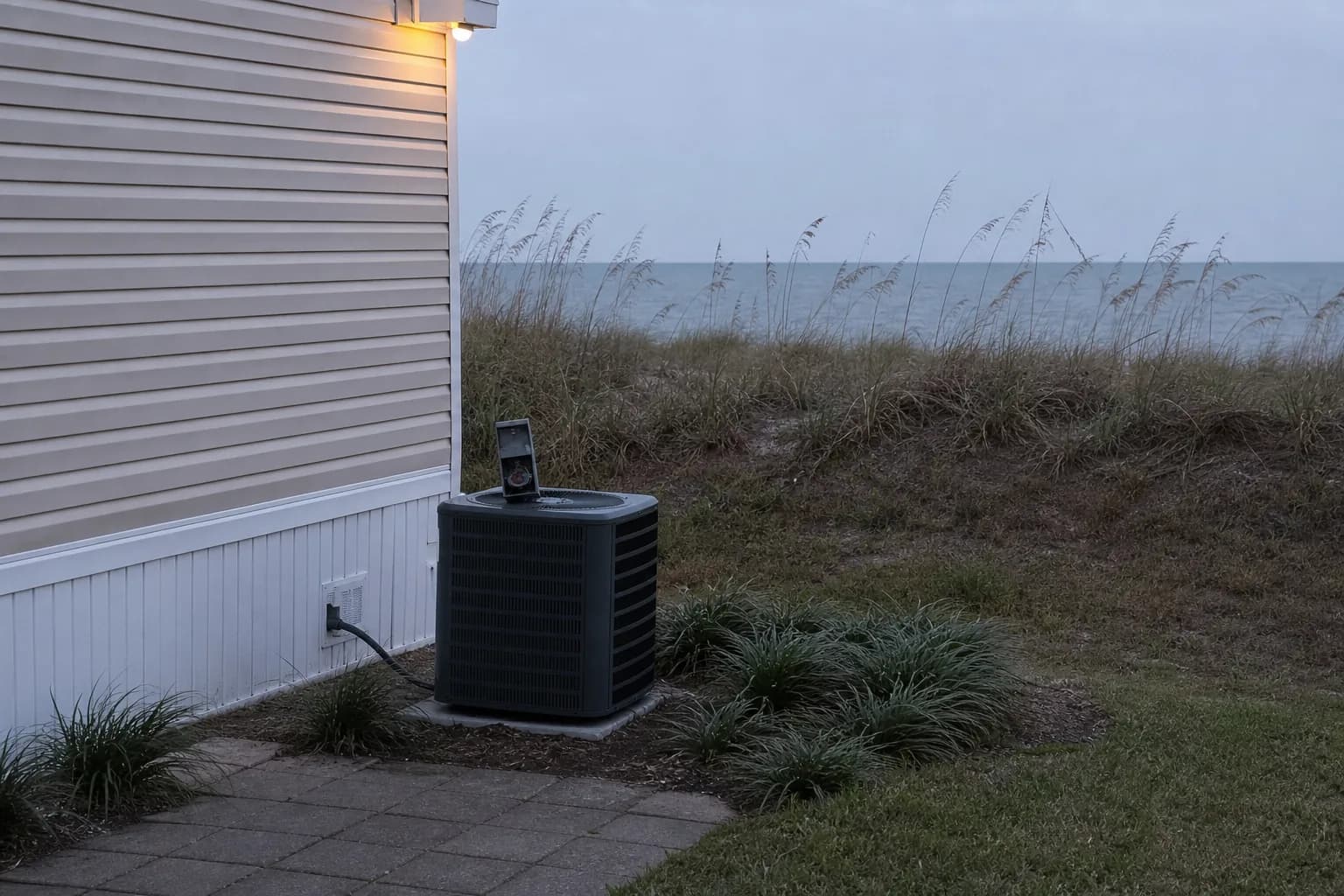
The air moves from the outdoor compressor on the side of the Gulf Shores rental, through the line set running along the foundation and up the wall, past the air handler in the closet, through supply trunks in the unconditioned attic, out the register grilles in the conditioned space, back through the returns, and into the air handler again. Each step is a place where airflow can fail. The rental owners who catch their July 4 problems early walk that path the week before — not to replace the technician's work, but to know their property well enough to notice when something has changed.
Over 13 years of HVAC work in Baldwin County, I've watched the same owners who run this walk consistently end up with the cleanest guest reviews. Here's the path, step by step.
Step 1: The outdoor compressor
Start outside. The compressor sits on a pad on the side of the house. With the system running on a hot afternoon, point an infrared thermometer at the cabinet and note the surface temperature. Compare it to last summer's reading in similar conditions. A meaningful increase (5+ degrees) is worth attention — that's where you check for compressor strain or refrigerant issues.
Look at the coil fins on all accessible sides. The Gulf-front-adjacent (south) face will accumulate salt deposit residue; the inland faces accumulate leaf litter and pollen. A fresh-water rinse in May or June clears most surface contamination. Visible fin damage (bent fins from storms, mechanical damage from yard equipment) is worth photographing for the next service visit.
Watch the unit cycle through a couple on-off cycles. No clicking irregularities, no extended hesitation between thermostat call and compressor engagement, no humming during off cycles that would indicate a hung contactor.
This is the part of the airflow walk where most rental owners stop. The owners who get the most value are just starting.
Step 2: The line set
The refrigerant line set runs along the foundation or wall from the compressor to the air handler. Walk the run, looking for three things: insulation integrity, visible UV damage, and any signs of pest disturbance.
The insulation jacket on the suction line is the part most likely to fail in coastal Gulf Shores. Wind events stress fence-adjacent line sets routinely. A tear in the jacket exposes the bare copper to oxidation and lets the line sweat into surrounding spaces, dripping condensate onto the foundation and adding humidity load to the property. The fix is a sleeve patch with UV-rated tape — small parts cost, small labor, but easy to miss until it becomes a humidity problem.
Check for pest disturbance. No rodent gnaw marks, no nesting debris, no obvious wasp activity. The line set's vertical climb should show no sagging or pulling at the entry point.
Step 3: The air handler
The air handler sits in a closet, attic, or mechanical room depending on the property. Listen to it running. Take surface temperature readings at three points: the top of the cabinet, the supply plenum exit, and the return plenum entry. A 20-degree delta-T between supply and return is where a properly charged system at moderate load should sit.
Pull the filter. Note the date you put it in. A 30-day filter that's heavily loaded is telling you something about either the filter rating or the load.
Look at the condensate drain. The pan should be clear. Early biofilm at the trap doesn't yet restrict flow but is worth treating — a cup of distilled vinegar through the drain access cleans it up before it becomes a clog.
Listen to the blower. Smooth running, no bearing whine, no squeal at startup, no harmonic vibration that would indicate a wheel out of balance.
This is where the equipment-side walk ends and the distribution-side walk begins.
Step 4: The supply ductwork in the attic
This step requires climbing into the attic. Most rental owners skip it because most attics are uncomfortable in late June. The reward for climbing up there is information you can't get any other way.
The supply plenum exits the air handler and trunk runs leave the plenum in a starburst pattern, each serving register branches. Walk each trunk visually, looking for two things: jacket integrity (is the insulation in place and bonded?) and joint integrity (are the connections at takeoffs and transitions sealed and supported?).
The most common finding: a trunk has separated at a transition joint somewhere along the run. A separation of an inch or more is enough for visible attic air to be drawn into the duct or for conditioned air to escape into the attic, depending on whether the system is running with positive or neutral pressure at that point. The fix is mastic sealant and mechanical strapping — a short attic job that prevents large airflow losses.
Photograph anything that looks off and put it on the repair list for the next service visit.
Step 5: The register grilles
Back inside, walk the conditioned space with the thermometer and a notebook. Take the air temperature at each supply register grille during a continuous run with the system at setpoint. The goal: identify any registers running noticeably warmer than the median, which would indicate distribution loss upstream of that register.
The pattern that most often surfaces in Gulf Shores rentals: downstairs registers cluster around one temperature, upstairs registers cluster a few degrees warmer. A 3-4 degree gap between the upstairs and downstairs supply temperatures usually traces directly to a trunk leak or separation in the attic — the affected trunk serves the warmer-supply rooms.
The thermostat reads the downstairs setpoint correctly, but upstairs guests feel the difference at the worst part of the day. The system "works" — air is coming out of every register. The measurement tells you it isn't working as well as it could.
Step 6: The returns
Last step. Walk to each return grille while the system is running and hold a single sheet of paper across the grille. The paper should hold flat against the grille — that's good return draw. If it falls, return draw at that grille is compromised, which throttles the whole system.
Pull each return grille off and check the duct interior visible behind the grille. Light dust accumulation is normal. Heavy buildup, mold spots, or visible debris is worth flagging.
What to do with the findings
The walk surfaces a list of small items — a line set insulation patch, a supply trunk re-seal, a drain line clear, a register grille that needs adjustment. None of these have failed yet. None of them will fail on their own by next week. But all of them compound: the trunk leak makes the upstairs warmer, which makes the system run longer, which loads the filter faster, which restricts airflow further, which raises supply temperatures.
The fix is to compile the list and address it before peak season — not during.
Call 251-383-HVAC with the list. A diagnostic visit is $79, credited toward any repair work. Most of these items are 15-30 minutes of work each, and a single visit can knock out the whole list before the holiday weekend.
Without the walk, none of these items typically fail by July 4. They sit in the developing-but-not-yet-failing category. With the walk and the proactive repair, guests check in to a system running at full delta-T across all the registers, with the upstairs cooling to setpoint as fast as the downstairs.
What this teaches Gulf Shores rental owners
A few takeaways:
The airflow path is something you can learn. It's not a black box. The compressor, the line set, the air handler, the supply ducts, the registers, and the returns are all components you can see, touch, and measure. The point of walking the path isn't to fix things yourself — it's to know the property well enough to flag changes.
Measurement is the part most owners skip. A $15 infrared thermometer makes the difference between "the AC is on" and "the upstairs registers are running 4 degrees warmer than the downstairs registers, which means we're losing air somewhere upstream." The first sentence isn't actionable. The second sentence is the diagnostic.
Coastal Gulf Shores stresses the line set's exterior run. Wind events, fence shifts, and salt environment all work against the insulation jacket on a line set you can see from the property. A quick visual on every quarterly walk catches the issues before they become humidity loads.
The attic walk is the one nobody does. It's also where the highest-impact issues live. If you can't physically do the attic walk yourself, that's exactly what the Comfort Plan covers — the bi-annual visit includes attic-side inspection. For multi-property owners across Magnolia Springs, Fort Morgan, and Lillian, this is the highest-leverage line item on the contract.
Catching it early is cheaper than catching it late. A short list of proactive repairs on a Wednesday in June is dramatically cheaper than the same three issues — allowed to compound through July and August — turning into an emergency invoice in September with a guest checking in tomorrow. The math always favors early. Always.
Most owners don't have the time or the engineering background to walk their property's airflow with a notebook. That's fine. The job of the Comfort Plan is to put a competent set of eyes on that walk twice a year and to give you the same one-page summary with photos. Different person doing the work, same outcome.
If you own a Gulf Shores rental and you're reading this in early July, you're already late for this season. Schedule the walk for late August, before the back-to-school slowdown, and use the off-season to address whatever the walk finds. Your equipment will thank you next summer.
If you're reading this in spring before peak season, you have time. Either learn the walk yourself or schedule someone to do it for you. The 90 minutes it takes is the cheapest insurance you'll buy all year.
The compressor, the line set, the air handler, the trunks, the registers, the returns. Six steps. Walk them.
FAQ
- Can a Gulf Shores rental owner actually trace the airflow path themselves?
- Yes — most of it, anyway. The outdoor compressor, the line set's exterior run, the air handler closet, the visible portion of supply ductwork, the register grilles, and the return grilles are all accessible without tools. What you can't see — duct interiors, sealed plenum joints, and the evaporator coil's downstream face — is what gets covered during the bi-annual maintenance visit. The point of walking the airflow path isn't to replace the technician. It's to know the property well enough to spot when something has changed.
- What's the most commonly missed airflow problem in Gulf Shores rentals?
- Disconnected or compromised attic duct trunks. The original installation can be sound but a decade of attic storage, pest activity, and trades replacing components stresses the takeoff connections at the air handler and at the trunk transitions. Conditioned air leaks into unconditioned attic space and the symptom — supply registers in upstairs bedrooms running 8-10 degrees warmer than the thermostat reading — is something the homeowner can verify with a $15 infrared thermometer.
- Should a Gulf Shores rental owner walk the airflow before every check-in?
- Not before every check-in. Once a quarter is the right cadence, with a more thorough walk before peak season and after major weather events. The high-frequency check at every check-in is something else: confirming the system reaches setpoint during a continuous four-hour run before guests arrive. That tests the system as a whole. The quarterly airflow walk is what catches the slow, developing changes that the runtime test won't reveal until something fails.
- What does a pre-season airflow audit cost on a Gulf Shores rental?
- A standalone diagnostic visit runs $79, credited toward any repair work that comes out of it. For rental owners running multiple properties, the [Comfort Plan](/comfort-plan/) at $20/month or $240/year per system includes two tune-ups annually plus 10% off repairs and replacements and $0 service fees — the airflow walk is part of those tune-ups. The plan economics typically pencil out within the first repair-call avoidance.
Need this handled?
Straight to the service page for your town — pricing, local details and a form that reaches a technician.
More from July 4 Vacation Rental

ACExperts HVAC
We Take The Heat So You Don't Have To
Fast, honest heating and air service across Baldwin County. Speak with a technician and get on the schedule today.