
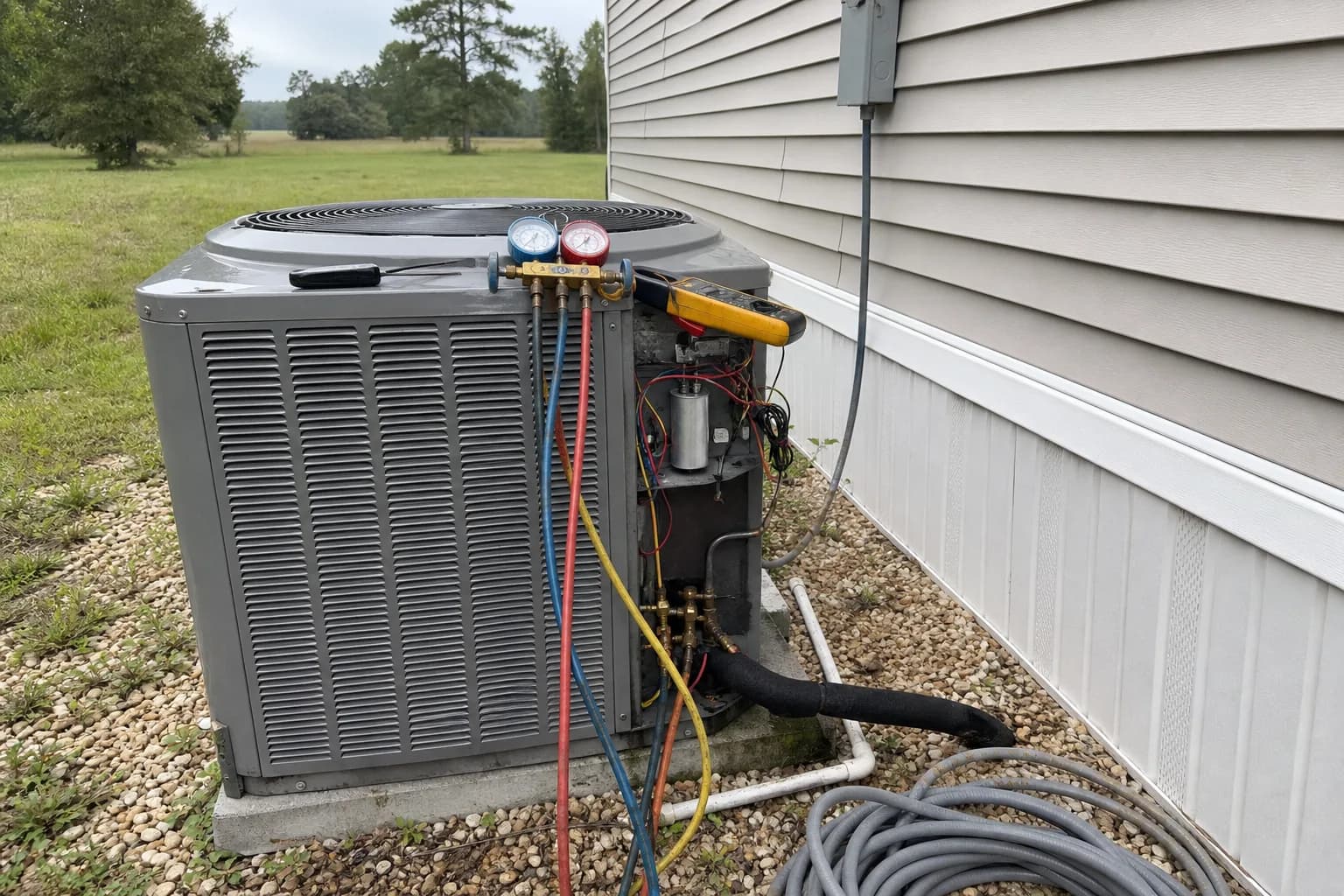
Foley HVAC Repair or Replace: How We Decide On the Spot
Foley AC repair or replace — the honest math we run on the spot: heat exchanger and coil condition, the repair-cost ratio, and what your ductwork is actually doing.
Published 2026-06-13 · Updated 2026-06-13
Author: Landon Jahnke | ACExperts251
Reviewed by: Landon Jahnke · Owner · Alabama HVAC License AL #16117 · EPA 608 Certified
Your AC is down in the middle of a Foley summer, a technician is standing in your driveway, and the conversation has arrived at the question every homeowner dreads: do we repair this thing, or is it time to replace it? It's a few-hundred-dollar decision on one side and a several-thousand-dollar decision on the other, and it usually has to get made the same afternoon.
We don't think that decision should rest on a sales pitch or a gut feeling. There's actual math behind it, and you're entitled to see the math. Here's the framework we walk through on the spot in a Foley home — the same one whether you're in a 1970s ranch in the Walker Grove area or a newer build out in Glenlakes or Graham Creek Estates.
The four things we're actually weighing
A repair-or-replace call comes down to four questions, and we work through them in order.
1. What's the condition of the expensive core? A system's value lives in a handful of components: the compressor, the outdoor and indoor coils, and — on the heating side — the heat exchanger. Capacitors, contactors, fan motors, igniters, and control boards are repair items; replacing one of those on an otherwise healthy system is almost always the right move. But when the failure is the compressor or a leaking coil, you're into the part of the system that costs enough to make replacement a real competitor. So the first thing we determine is whether the problem is a peripheral part or the costly core.
2. What does the repair cost as a share of replacement? This is where the well-known rule of thumb earns its keep: if the repair in front of you — or the sum of what you've spent on repairs over the last couple of years — is climbing toward 35 to 40 percent of what a replacement would cost, replacement usually wins on an older system. A modest capacitor or fan-motor repair on a healthy ten-year-old unit is an easy call. A compressor on a fifteen-year-old system that already needed a coil last summer is a different story, and the ratio makes that clear once we put the actual numbers for your equipment on the table.
3. How old is it, and what refrigerant does it use? Age matters partly on its own and partly because of refrigerant. Systems built around R-22 are working with a refrigerant that's been phased out of production — it's expensive and increasingly scarce, so any R-22 repair involving a recharge is both pricier and more of a stopgap. If your equipment is older and on R-22, the honest answer tilts toward replacement earlier than it would for a newer system on current refrigerant. We'll tell you which one you have.
4. What is the ductwork doing? This is the Foley-specific one, and it's the question that saves people from expensive mistakes. A lot of poor-cooling complaints here aren't really equipment problems at all.
Why ductwork is the Foley wildcard
Foley has grown fast — it's one of the fastest-growing cities in the country — which means established Walker Grove-era homes from the 1950s and 1970s sit on the same street grid as dozens of new-construction communities. Both ends of that range have duct issues, just different ones.
In the older ranch homes, central air was frequently retrofitted decades after the house was built, through ductwork squeezed into attics and crawl spaces with whatever clearance existed. Thirty to fifty years later those runs are commonly uninsulated, baking in a 130-degree attic, with returns sized for the window-unit era that can't move enough air for a modern system, and joints that have separated and now dump cooled air into the attic.
In the newer subdivisions, the problem is the opposite kind of shortcut. Tight modern envelopes are good, but tight doesn't mean correct — spec construction often hands the HVAC to the lowest bidder, and undersized ducts or sloppy sizing show up in the very first summer as a system that runs forever and still can't keep a back bedroom comfortable.
Either way, the point is the same: if the ductwork is the bottleneck, a brand-new condenser won't fix your comfort problem. It'll just give you a more efficient way to cool the attic. We inspect the ducts as part of the decision precisely so you don't spend replacement money on a problem replacement can't solve.
When repair is clearly the answer
Plenty of the time, repair wins outright, and we'll tell you so without hesitation. A failed capacitor, a pitted contactor, a bad fan motor, a clogged condensate line, a tripped float switch — these are bread-and-butter AC repair items, and on a system that's otherwise sound and not too old, fixing the failed part and getting you back to cooling is plainly the smart spend. Foley's heat runs a few degrees warmer than the coast because there's less marine moderation, so getting cooling restored quickly is the priority, and a same-visit repair usually does it when we carry the common parts.
When replacement starts to make sense
Replacement moves to the front when the failure is in the costly core, the repair ratio is high, the system is older and on phased-out refrigerant, or several of those stack together — the fifteen-year-old R-22 system that needs a compressor and already cost you a coil last year is the textbook case. In that situation we lay out a free AC installation estimate and let you compare it directly against the repair number. The decision stays yours. The Foley service area page has more on how the city's mix of housing eras shapes these calls.
How the visit actually goes
When we come out, the service fee is $79 and we quote everything in writing before any work begins. We diagnose the failure, check the core components, read the refrigerant pressures, look at the ductwork, and then put the repair-or-replace math on the table in plain numbers. If repair is the better deal, we do the repair. If replacement genuinely makes more sense, the free estimate makes that case on its own merits — no pressure, no midnight scare tactics. And if another company already handed you a replacement quote and it didn't feel right, we offer free second opinions for exactly that.
If you want to keep this decision off your plate in the first place, a pre-summer tune-up catches failing parts while they're cheap, and the ACExperts Comfort Plan rolls two seasonal visits and priority routing into $20 a month or $240 a year. The repair-vs-replace calculator lets you plug in your own numbers if you'd like to run the math before we ever show up.
The bottom line
A repair-or-replace decision shouldn't feel like a gamble or a guess. There's a real framework — core condition, the cost ratio, age and refrigerant, and what the ducts are doing — and the right answer falls out of it once the facts are on the table. Our job in your Foley driveway is to put those facts in front of you honestly and let the better decision be obvious. To get the diagnostic started, call 251-383-HVAC. Regular scheduling runs Monday through Saturday, 8am to 6pm, and we answer emergencies 24/7, every day.
FAQ
- How do you decide whether to repair or replace an HVAC system in a Foley home?
- We weigh four things: the condition of the expensive core components (compressor, indoor and outdoor coils, and on the heating side the heat exchanger), the cost of the needed repair as a share of replacement cost, the age and refrigerant type of the system, and what the ductwork is doing. The rough economic line is the 35-to-40-percent rule — if a single repair, or your repairs over the last couple of years, approach 35 to 40 percent of replacement cost on an older system, replacement usually wins. But the rule is a guide, not a verdict, and we run the actual numbers with you before you decide.
- My AC uses the old R-22 refrigerant. Does that change the math?
- It does. R-22 has been phased out of production, so it's expensive and getting harder to source, which makes any repair that involves recharging an R-22 system pricier and more of a stopgap. If your system is on R-22 and needs refrigerant or a major component, that pushes the honest answer toward replacement sooner than it would for a newer system. We'll tell you which refrigerant your equipment uses and what it means for the decision rather than leaving you to find out later.
- Can a new AC fix poor cooling if my Foley home's ductwork is the real problem?
- Often, no — and this matters a lot in Foley. A meaningful share of cooling complaints here trace to ductwork, not the equipment: undersized returns, uninsulated runs baking in a hot attic, and disconnected joints leaking cooled air into the attic in older Walker Grove-era homes, or spec-construction shortcuts in newer subdivisions. Dropping a brand-new system onto bad ducts buys you a more efficient way to cool the attic. We inspect the duct system as part of the decision so you're not paying for equipment that can't deliver.
- Will you give me a straight answer if repair is the better deal?
- Yes — that's the whole point. Our service fee is $79 and we quote repairs in writing before any work begins. If a repair is the smart spend, we say so and do the repair. If replacement is genuinely the better call, we give you a free estimate and let the numbers make the case. We also offer free second opinions if another company already quoted you a replacement and you want it checked.
Need this handled?
Straight to the service page for your town — pricing, local details and a form that reaches a technician.
Related reading

ACExperts HVAC
We Take The Heat So You Don't Have To
Fast, honest heating and air service across Baldwin County. Speak with a technician and get on the schedule today.